Sunday, July 16, 2006

Contradictions

In the space of a Friday lunchtime, a visit to the Tate Modern got me thinking about what we human beings try to do with time and space:

  • We divide up time and space because time and space are both indivisible
  • We find ways of visualising time and space because time and space are invisible
  • We fight for time and fight for space because time and space are infinite and unlimited.

My first stop was the fourth floor: back to Pierre Huyghe's One Year Celebration inside his Celebration Park. Huyghe's premise was that our calendar is a map, a map of the year, and the map has some uncolonised territory in the form of days which don't have a holiday attached to them.

At Hugyhe's invitation several artists and critics have come up with suggestions for colonising these days with celebrations.

Two of these proposed celebrations are attempts to resist the mapping of time, in order to escape the constraints that our mappings of time place on the way we live our lives and on the way we think about the universe.

Joe Scanlan suggested having an 'open day': a day slotted in somewhere between Sunday and Monday. Nothing can be scheduled for this day (because no-one knows when it is) and we can instead enjoy things in life that don’t need to be scheduled (Scanlon suggests that coffee, newspapers and cigarettes should be half price).

Another artist suggested a day out of the year, a revival of the Mayan practice of having one day in the year that wasn't included in the calendar, to remind everyone that time is greater than the calendar, that time is impervious to attempts to measure it.

I popped into the bookshop to flick through the book accompanying Celebration Park and noted Hughye' s comment (in an interview with Hans Ulrich Obrist) that he regarded time as a corollary of space. He talked about how a television programme exist mainly in time, but also in space, and differently from objects.

All this talk about the relationship between space persuaded me to pop upstairs to the fifth floor to revisit my favourite thing in the Tate Modern: 1,000 millimetres by Stanley Brouwn.

It consists of a card index box, containing 1,000 pieces of card. Each card has the words '1mm' written on it, above a horizontal line, in pencil, one millimetre long. So you have a thousand millimetres in the box.

There are no more or less millimetres in that card index box than there would have been if Brouwn had left the cards blank and saved himself the effort of drawing all those lines.

We have no way of adding a millimetre or a second to the universe.

As I was coming down the escalator from the fifth floor of the Tate Modern I had a Eureka moment. I solved the mystery of time and space: they don’t exist!

Monday, July 10, 2006

Genius is still genius


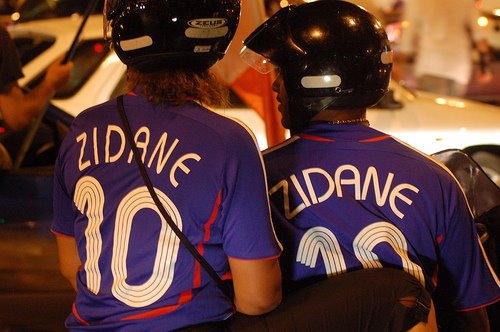
Photo by choudoudou


When I opened my eyes this morning, my first thought was of how Zinedine Zidane must be feeling, opening his eyes this morning.

I listened to French radio after the world cup final last night. I was impressed by the loyalty to Zidane of all those who reported or were interviewed. In the whole hour that I listened not person blamed him for the defeat, not one person used any words like shame or disgrace. Some expressed their thanks to Zidane for what he had done for France in this world cup and over the years.

One correspondent described the moment Zidane got sent off as like moving from 'le chaleur' of a Rio de Janeiro beach to ‘la froideur’ of a cold bath in the space of a split second.

Another correspondent described an empty café, with a lone man in a Zidane top clearing up the clutter left by the fans who had gone home. The correspondent imagined that some of the fans who had left the café were parents who had gone home to kids wearing Zidane tops too.

A convincing case could still be made for Zidane being the player of that tournament. He was pulling the strings again last night, throughout the second half and extra time. As a 34 year old, to be still bombing into the penalty area half way through extra time is a phenomenal achievement: compare with his fellow 34 year old Luis Figo who never seemed to last past the seventy-fifth minute of matches.

Does one lapse in self control wipe out fifteen marvellous years? it depends what you want to remember people for, and what you want to see in people.

I’m reminded of the Nottingham Forest fans on at the end of the 1992/93 season, defiantly singing ‘Brian Clough is a football genius’ as they watched their team get relegated. They will have suspected that Clough was by then an alcoholic, and that his drinking had contributed to the relegation, but they also knew that he had preformed football miracles for them.

Saturday, July 08, 2006

Today we celebrate unlikely but uplifting combinations

Pierre Hugyhe wants ever day to be a celebration, so he asked some of his artist friends to come up with a reason to celebrate on days that we don’t have a holiday at the moment.

Pierre has used his exhibition at the Tate Modern to display the new holidays to the public for the first time.

The day I am most looking forward to is the day celebrating our sense of anticipation. But no date has been set for that yet.

The most enlightening holiday will be the day of rational certainty. On that day we will be enjoined not to cross our fingers or worry about stepping on the cracks in the pavement. The horoscopes won’t be published. Temples, churches and mosques will shut their doors for the day.

The results of the day will be interesting. Can we base our lives solely on things that can be rationally proven? We don’t know what time is, or how many dimensions there are in the universe, or why the universe was created, or why a table feels solid when the atoms that it is made of consist mainly of empty space. We need metaphors, assumptions, beliefs, and maybe even faith, to bridge these gaps.

The day will necessitate a temporary laying aside of the existing public explanations of the nature, purpose, and destiny of the universe. It will thus provide you with a bit of space to come up with your own answers to these questions, whichever answers help you pursue whichever type of life you most want to live.

Julia Cameron in her book The Artist's Way urges anyone wanting to make more use of their own creativity to come up with their own view of why the creator of the universe created it and what that creator is like.

I like to think of the creator of the universe as a being that is not all-knowing, but is instead all-learning: learning from the new things that are happening all over the universe all the time. That learning isn't stored by the creator seperately from the universe, the learning is stored in the universe itself. The universe works to both use some of that learning and to keep on creating new situations for new learning.

The creator of the universe created it because no universe had been created before, and the happiness and beauty it could potentially generate might well be worth the inevitable pain.

Later in the year another Hugyhe holiday will celebrate the future. The curator Hans Ulrich Obrist asked his artist friends to tell him what they think the future is. It is a nice twist, a curator asked to produce a work of art by an artist and doing so by curating the comments of other artists to create an exhibition within an exhibition within an exhibition. All the artists have come up with different little straplines for the future, thus confirming that not only do we not know what the future holds, we don’t even know what the future is.

We at World Flapjack day are a little disappointed that that this French led endeavour has not come up with a day to celebrate any of the wonderful things found in patisseries.

To make up for this omission we are proposing to make July 8 the celebration of ‘unlikely but uplifting combinations’.

On this day evey year people will be enjoined to take the day off to combine different things that they like but don’t normally do at the same time. This is so often a sure fire recipe for happiness in life.

The inspriration for this day came from the Banauchoc: a pain au chocalat with banana in. (you can get them from the Panos bakery on the concourse of Brussels Gare du Midi station).

Some of the things I like doing are: playing chess, having a bath, meeting new people, learning new languages, getting fresh air. In Budapest at the Szechenyi Baths you can stand for hours in an open air thermal bath, play chess with a waterproof chess set and improve your Hungarian.

We at World Flapjack Day support Pierre’s endeavour. and will be celebrating each of these new holidays as they come through the year.


Photos of Szechenyi baths by phnk

Sunday, July 02, 2006

Kick

So England’s world cup quarter final went to a penalty shoot out. The commentators said they wouldn’t wish the experience on anyone. You can tell which players are going to miss by the fear written on their face.

Andrew (aged 7) switched the telly off and ran out of the room when Jamie Carragher missed his retaken penalty. The miss gave Christian Ronaldo the chance to knock England out of the tournament if he scored his penalty for Portugal.

I switched the telly back on in time to see something that impressed me. Ronaldo picked the ball up and kissed it. He was taking time to say that whatever the level of pressure on the moment, he loved playing football. He put the ball down on the spot and then chipped it into a part of the net that no goalkeeper could ever reach.

A triumph of love over fear.

Looking back on it it was inevitable that England would lose. They had played poorly all tournament, the manager had run out of ideas four years ago and only stayed in his job becase it would cost the FA to much money to end his contract. He didn’t seem to be able to adjust to injuries to his first choice strikers.

The only thing keeping England going was the superstitions of fans but even they seemed to have run out by the Quarter final.

Andrew had worn his England wristband, given to him by one of his teachers at school, continuously from the start of the tournament, and told us how it made England win, because his teacher had made it magic. The wristband fell down the toilet three days before the Portugal game.

Sunday, June 25, 2006

Permanent marker


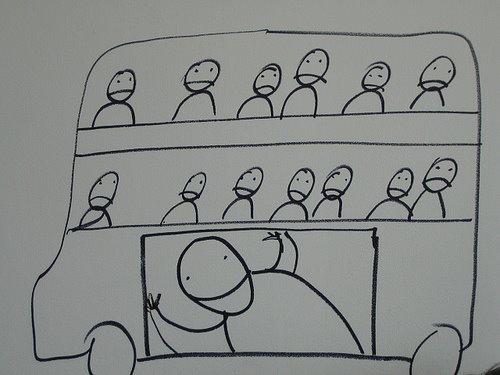
Drawing by Dan Perjovschi, This photo was taken by Blinkybee


Tate Modern commissioned Dan Perjovschi to draw with permanent marker all over the member's room. I went to see the drawings before, like all permanent markings, they got scrubbed off.

My favourite was the one showing the bus driver and passengers looking glum but the advert on the side of the bus showing someone looking as happy as Larry.

There will come a time when the panels on the side of public transport are simply screens , connected to the internet, which could display any combination of image and message.
But will there come a time when the people on the bus will be able to influence what is expressed on the side of the bus? Or will the image/message always be determined at a distance in time and space from the driver and passengers?

Thursday, June 22, 2006

Reduced to almost nothing

I went to the Big London Brainstorm in Lindsey Street, Smithfield yesterday, where lots of architects have had put forward their ideas for improving our city.

My favourite was the one suggesting that instead of building Renzo Piano's shard of glass, we should build a massive grain of sand. This would serve as a tribute to William Blake, and as a reminder to people that we are present in the universe.

Here is the quote from Blake's Auguries of Innocence:

''To see a world in a grain of sand
And a heaven in a wild flower,
hold infinity in the palm of your hand
And eternity in an hour.''

Saturday, June 17, 2006

Let’s be

Jorge Luis Borges died 20 years ago this week, aged 87.

At the age of 79 Borges had made the following brave and honest statement in a lecture entitled Immortality:

‘’I don’t want to continue being Jorge Luis Borges: I want to be someone else. I hope that my death will be total: I hope to die in body and soul.’’

Borges does not claim to know what will happen after his death. He does not deny that there is a possibility that he might find himself re-incarnated as another being, or that he might find eternal life in heaven. But he is saying that he does not desire either re-incarnation or eternal life.

Later in his lecture Borges describes how some of the things that he has said and done will live on in the words and deeds of people to come. This is the way that Borges does want to live on in the universe: in the same way that Borges himself has kept alive Shakespeare,Dante, his own parents, neighbours and acquaintances by using and remembering their words and deeds.

I hope Borges got his wish. I am not convinced that eternal reincarnation or eternal life for one individual entity is in accordance with the spirit of the universe. The universe seems to be more interested in re-using and re-combining things than in ring- fencing and preserving things. The greatest gift of the creator to this universe is evolution: the fact that life can learn and adapt and new life forms can develop which are novel and different.

Why would the universe need a James Lappin in a million years time? What possible use would ‘I’ be to anything?

Jeff Barry, who lives in Borges’ home city of Buenos Aires, blogged last Wednesday about this same quote, as part of his wonderful series of blog posts called ‘30 days with Borges’. I’ve posted each of the 30 days to a del.icio.us page if you want a quick way of accessing all thirty of them.

Thursday, June 15, 2006

Uncertainty now

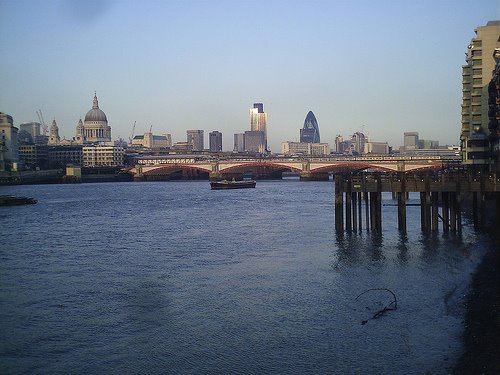
Photo of me in Blackfriars yesterday. The photographer (Seize the Dave) must have taken it from the top of St Paul's Cathedral.


Jorge Luis Borges came up with a comprehensive classification of all living creatures. He attributed the classification to Dr Franz Kuhn and it was the organisational basis of a Chinese Encyclopedia called the Heavenly Emporium of Benevolant Knowledge.

It has often been held up as an example of the potential absurdities of classification, but I have learned something quite profound about my appearance from it: I look like a fly from a distance

Here is the classification in full:

a) those [animals] that belong to the emporer
b) embalmed ones
c) those that are trained
d) suckling pigs
e) mermaids
f) fabulous ones
g) stray dogs
h) those that are included in the classification
i) those that tremble as if they were mad
j) innumerable ones
k) those drawn with a very fine camel’s hair brush
l) etcetera
m) those that have just broken the flower vase
n) those that at a distance resemble flies

I must look like a fly from a distance, it is the only category I fit into. Continually breaking flower vases is not a viable option socially or financially.

Most people seem not to notice, either because they are standing to close, or because their eye is tricked by a curious effect of an uncertainty principle which is caused by the following:
  • When I look like a fly from a distance I am included in the classification, and therefore must move from category n) to category h).
  • As soon as I join category h) there is no necessity for me to look like a fly from a distance
  • As soon as I stop looking like a fly from a distance I am no longer in the scope and therefore, need to look like a fly again (from a distance).

This Uncertainty principle can be stated something like:

  • You can determine precisely the position of a living creature within Borges’s classification, and you can determine whether or not it looks like a fly from a distance, but you can not determine both things at the same moment in time.

It just shows how much effort is required to fit into someone else's world view

Sunday, June 11, 2006

Possibilities

Photo: Forth bridge by Aesop


There are an infinite number of parallel lines on the same plane. They reach backwards to infinity and forwards to infinity and are destined never to touch each other.

Along the path of each infinite line there are an infinite number of points. At each of these points the line is crossed by an infinite number of other lines, coming from different angles on the same plane; or from different planes; or from the past or the future.

Each one of these lines has something in common with the creator of the universe (as described in many of the great spiritual traditions): it has no beginning and no end in either space or time.

Thus the creator of the universe was never lonely, never bored with the emptiness. There always was an infinite number of infinite lines, but a creative spark was needed to make something finite out of them, something that wouldn’t last for ever, and could grow into anything.

After 29 years in Weybridge (Surrey, England) my mum and dad are settled back in Dalgety Bay (Fife, Scotland), where they spent their first decade of married life, and where me and my sister were born. I was so pleased to hear both of them sound so happy when they rang me on Friday.

Hats off to my mum for masterminded the move. Douglas Adams said that it was a good idea to redefine yourself at least once after you reached the age of 50. He did it by moving from England to Los Angeles. My mum has done it twice.

After retiring from teaching twelve years ago she took up embroidery. She found a creative streak noone knew she had and produced really lovely work based on patterns in things that inspired her, the gradual decay of old walls, the canal, rooftops of a Japanese town.

Then she started producing work based on motifs from the Forth bidge: everything from wall hangings to a toilet roll holder.

That is the great thing about doing anything creative, and about expressing your creativity: it’s such a good way of honing in on what you really love in life, like diving rods for water.

They can see the Forth bridge from their new home.

Friday, June 09, 2006

One zag

Can you have a zag without a zig?

Is there a word for a word which sounds like the letter that the concept it represents looks like?

Do geometry professors use the word zigzag? Or is it just a lay term?

Does the zig zag count as a shape or is it just a pattern? What if someone drew a zig zag line that went round in a circle and joined up with the start of the zig zag line again. Would that count as a shape? Would it be a zigzag shape or a circle?

Did Euclid have anything to say about zig ags?

What do languages without the letter ‘z’ in their script call zigzags?

Does the word ‘zigzag’ have anything to do with the word ‘ziggurat’ or do they just sound the same.


Good luck to people leaving England on great adventures today:
  • Val heading south to the world cup in a van
  • Mum and dad heading north to their new home in Dalgety Bay

Wednesday, June 07, 2006

Reflection

This is a mirror.

You are a written sentence


Luis Camnitzer issued the above statement as a work of art in 1966: one of nine statements on sticky labels that he sent out by post.


In Chronology Camnitzer explains why he had stopped making pictures and prints and started producing these statements. He had been looking for ways in which his art could escape from the trap that once someone bought the art object it was lost to the rest of the world.

He discovered the answer staring out at him from his local newstand. He states:

The ideal was the newspaper headline: a simple reading allowed appropriation which then unleashed imagery within the viewer. Material possession of art would lose its meaning since possession would take place through reading

I love this quote about the later development of his art:

I discovered (1971) that if I made a minimal mark on a piece of paper, I irrevocably altered the order of the universe. Any new order would have to include my mark. My action conditioned any new definition of order. Thus, to change the universe wasn't that difficult and anybody could do it. It was more difficult to convince the art market of the fact that the alteration had taken place.

Thank you to the Lehman College Art Gallery for making the full catalogue of their Camnitzer retrospective available online, including articles by and about Camnitzer.

Saturday, June 03, 2006

242


I took the 242 bus to Shoreditch to see ‘Some pictures and a song’ – Claire Harvey’s installation at Store.

I was tempted up Hoxton Street having read that the installation includes drawings of people on scotch tape, stuck onto the walls. I imagined the walls plastered with hundreds of these figures, like the end of a brainstorming workshop gone mad.

It is more restrained than I'd anticipated: the sticky tape people are confined to a small area of one wall, over in the corner, by the front window of the gallery. Each drawing is made on two pieces of sticky tape: one for the person, one for their shadow.

They are a loose collection of people, walking away from me; detached from me; detached from each other; detached from the ground on which their shadow would have been cast; and as the title of the piece acknowledges, easily detached from the wall.

On the other side of the window I was aware of the occassional passer by walking down Hoxton Street to the college next door and the little shops.

The installation really came to life when I took up the invitation on the record player to play the 7inch single that sat on the turntable.

I heard Harvey sing a wistful song about a fly who fell victim to her botched attempt to save it after it had flown into her studio and got stuck on some oil paint on one of her paintings that had not yet dried.

As I listened I looked around the gallery: bare wooden floor, some oil paintings on the wall, Hoxton outside.

The paintings on the wall are neither large nor bright. The colours used are greyish blue and white. Some of the paintings show people on the edge of the land and the sea, alone but not lonely, absorbed in what they are doing.

One shows a close up painting of a person’s face, smelling a cheese, what is he thinking as he inhales? The next painting pans back, and shows all of the cheese smeller, it’s a young man. The title of the picture (cheese counter) betrays the fact that he is in a supermarket, but the hazy blue/white/ grey way the cheese counter is painted makes it looks as though he too could be on the edge of land and sea.

The installation took me right back to student days . Maybe because the room was bare, or because it was a record not a CD player, or because no-one in the installation was in a rush, or wearing a suit (unless you count me standing there with my rucksack on my back), or doing anything particularly demanding.

The lady at the gallery said to me ‘its like slipping back into a familiar memory of something that never actually happened to you, just like the fly story may never have happened’.

(The exhibition is running until 1 July 06: read Russell Herron's account of the private view)

Wednesday, May 31, 2006

Do you remember an exhibition in a car?

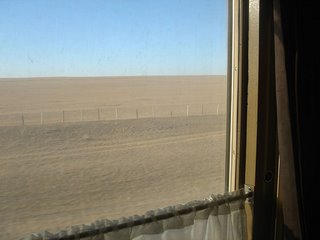
Mongolia by David Klasen


The curator of en route via another route commandeered a car of the Trans Siberian express train to Beijing. It left Moscow on September 12 2005, the day that England drew the fifth test to win back the ashes.

I would have loved to have been on that train:

• To have read out, live on Trans Siberian Radio, a Russian translation of Keith Arnatt’s ‘Is it possible for me to do nothing as my contribution to this exhibition?’

• To have released some balloons and watch them float into the big skies of the steppe bearing the slogan ‘all that is solid melts into air’

• To have sat in the dining car , seen the abandoned dinner on the table, and read Gabriel Kuri’s note in Russian explaining that the person who had purchased it had left in a hurry. To find out how many countries the train would have to pass through, and how many translations of the note would have to be made, before anyone took up the invitation to eat the dinner.

Well worth missing the cricket for!

Were you there? Did you enjoy it? Did anyone eat that dinner?

Friday, May 26, 2006

Nothing

In 1970 Keith Arnatt produced a work of art entitled

‘Is it Possible for Me to Do Nothing as My Contribution to this Exhibition?’


The work consisted of a written statement in which he explored several different ways of doing nothing as a contribution to an exhibition.

All the ways of doing nothing that he identified, actually involved doing something. Even if that something was as simple as:

  • putting forward the idea ' I have done nothing' as a contribution to the exhbition
  • requesting some space within the exhibition in which 'to do nothing'
  • making the statement 'I will do nothing' and sticking to it for the duration of the exhibition

Arnatt was using conceptual art (art using ideas and language) to show the limits of conceptual art.

Lawrence Weiner made a famous statement about conceptual art to say that:
An artist can come up with an intention for a work of art and then:
• Might make it themselves
• Might get someone else to make it
• Might decide not to make the intention into a physical reality at all
Either way in Weiner’s view you still have a work of art that can be distributed, received and owned.

Arnatt has come up with an intention for a work of art that can not be made by the artist or by anyone else, and the intention of which can not be communicated by the artist to anyone else.

(I haven't been able to find the text of Arnatt's work on the web, but it is reprinted in full in the book 'Six Years' by Lucy Lippard.)

Wednesday, May 24, 2006

Things on walls

Photo by ebmorse of 'The Wall that Went for a Walk' at Stormking USA

Andy Goldsworthy builds walls that have renounced their mission, forgotten the boundary line that they were supposed to demarcate, and gone for a walk. They wind their way around and between trees, up and down hills, and into and out of ponds.

Last year part of ‘The Wall that Went for a Walk’ at Grizedale Forest in the Lake District got blown down by the wind.

This month ‘s Art Monthly reports that Goldsworthy declined the Forestry Commission’s offer to repair the wall. Goldsworthy said that:

‘I knew that change would continue after the making of The Wall and that I could not dictate or determine what that change would be’

The writer and physisist David Bohm identified the tendency of us human beings to defend our thoughts and opinions, to take up fixed positions. Bohm wrote:

we often find that we cannot easily give up the tendency to hold rigidly to patterns of thought built up over a long time. This kind of thought leaves no room at all intellectually for any other possibility


Goldsworthy has resisted the temptation to attempt to defend his wall, and recognised that no fixed state is sustainable over time.

Even if the Forestry Commission fixed it this time, for how long would they keep repairing it: 30 years, 100 years?

The act of repairing the wall would have seen the wall take back its mission as a wall again, holding back nature and holding back time. The wall that went for a walk doesn’t hold back anything.

Friday, May 19, 2006

Post-global art


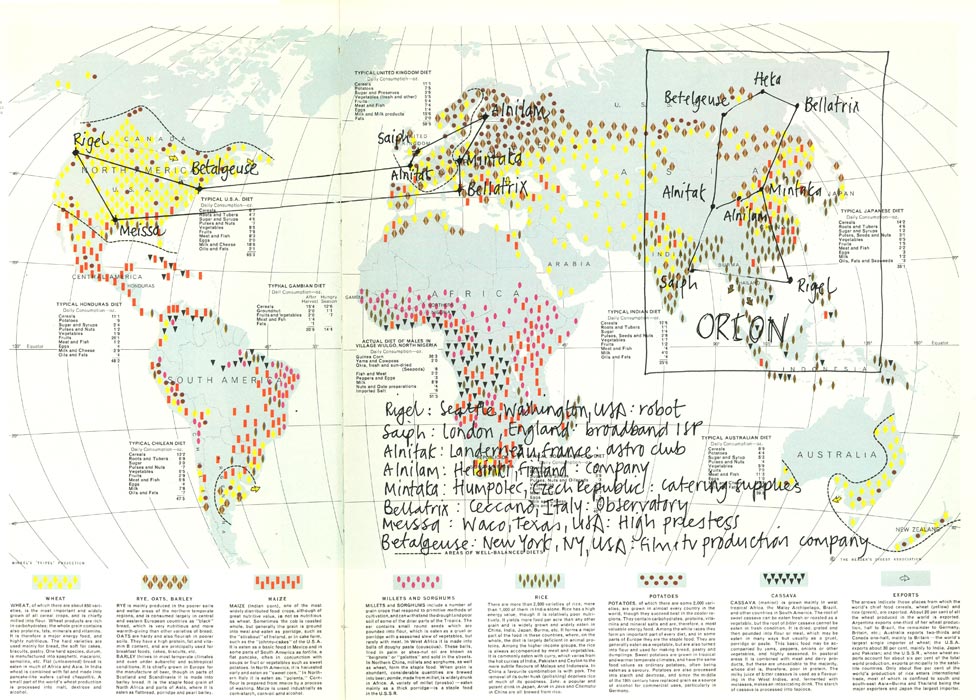
Jem Finer has meshed together the three spheres of the world wide web, the night sky and the earth.

He has found a website for every star : a website that names someone, somewhere or something on earth that shares or contains the name of the star.

You can find the links to these websites in 'On earth as it is in heaven', which provides access via his old readers digest atlas to a set of world maps: one global double page spread per constellation.

Each star in the consellation is plotted onto the atlas at the point of the earth where the person/thing/place that shares its name is located. Click on the star and the link takes you to the website that identified it. All the stars joined up by lines which make a new earthly shape for the constellation.

The picture above is the map for the constellation Orion . I was hoping that Jem would have found something about Betalgeuse in Guildford (where Arthur Dent thought that Ford Prefect came from). But instead the point is situated in New York, home of the Betalgeuse film and TV production company.

Stars, earthly towns and cities, websites, : lasting for billions of years, hundreds of years, years. When we come to map them we only have our human recognition of shape, our shared myths, and our understanding of words with which to map them with.

We have nothing anywhere near as potent and user friendly as the constellations with which to navigate our way around the world wide web.

Tuesday, May 16, 2006

Blank (700)

Making up a story for children is more fun than reading from a book.

Leaving some words blank for the kids to fill in is more fun than making up the whole story yourself.

Last night’s story went like this:

Two (blank) lived on the moon. Their house was on the edge of a (blank). In their bedroom was an enormous (blank) made out of (blank). In their living room was an enormous (blank) made out of (blank).

The blanks filled in by Andrew and Anna were:
1 children, 2 crater, 3 blanket, 4 lettuce, 5 sofa, 6 cucumber.

The last delivery rocket to the moon had been filled half with lettuce and half with cucumber.

There was no cucumber left after making the sofa so the family have been eating lettuce salad for the past seven weeks .

They have all been tempted to pick at the sofa to get some cucumber to liven up the lettuce salad. But so far they have managed to restrain themselves.

They next delivery rocket is scheduled to reach the moon at bedtime tonight. It is going to bring them (blank) and (blank).

Monday, May 15, 2006

The impossibility of choosing (433)

One week last summer I ran training courses in Glasgow and Manchester.

On the Tuesday night I was sitting out in George’s square, enjoying the Glasgow jazz festival, and wondering why I hadn’t followed the Scot in me and gone to University there when I was 18.

On the Wednesday night I was walking into Manchester’s Cornerhouse centre wondering why I hadn’t stayed followed the Smiths fan in me and gone to University there when I was 18.

It struck me that the two regrets were contradictory.

Some versions of quantum theory hold that for every choice you have made, the alternative paths that you didn’t take are followed by another you in a parallel universe.

Other theories state that if our universe is infinite in scope and duration then somewhere else in our universe, on a planet just like ours, another person just like you has taken/is taking/will take all the different paths that you chose not to take.

The ‘mis-guide to anywhere’ gives the following advice:

‘’in a place that is new to you, dream that you live there. Go on a quest to find this other self. Find the place you live; the place you work; the routes you take to see your family; the places where your friends hang out; your favourite places to eat or read or daydream; the places of crisis in this other life; the points of meeting and departure; the places of grief; the places of joy; the place where you can get the best plain pillowcase; the places where you can pick fruit from the trees; the place where you can get funny cards with the message spelled wrong; the places where your children might be born and the place where you might die. Live this other life for a day’’

Wednesday, May 10, 2006

Nostalgia (253)

Donskibeat has uploaded onto You Tube a film called Morrissey - Charlie's bus.

It shows Morrissey and Jonny Marr in 1984, taking a group of young school kids on an open topped bus to a sunny Kew Gardens, where they meet Sandie Shaw. They find a nice place to sit and listen to Sandie sing 'Jeanne' while Jonny played guitar.

I love the contrast between the sun shining on an idyllic setting, and all the kids enjoying themselves, having an ice cream, and Sandie Shaw singing the saddest of all the Smiths songs
'Jeanne, I don't know what happiness means, but I've looked in your eyes, and its not there'
set in the bleakest description of late 70s Manchester
'Jeanne, there is ice in the sink where we bathe, how can you call this a home,when you know its a grave?'

Tuesday, May 09, 2006

Conference (293)

I was in Manchester the other week, for the Records Management Society’s Conference.
In a break in the proceedings I visited the Cube (Centre for the Understanding of the Built Environment), to see their exhibition Found shared: the Magazine Photowork.

There is a good review of the exhibition by Redeye

Editors of Magazine photoworks collect already existing images and collage them together to make a magazine.

They look, feel and smell like convential magazines, but the experience of reading them is different. They do not attempt to inform or entertain you. They do not pretent to be ‘current’. The images inside them have a history, a previous life of their own. But you aren’t told what that previous life is. They are just presented as though those pictures were always meant to be grouped together.

The character of the magazine photoworks depends in part on where the editors get the pictures from:

Ohio finds its pictures in photographic archives, archives of different small societies or organisations. It takes these dull photos that would never see normally see the light of day, from totally unconnected archives, and presents them for you to read into them what you will.

Found is made up of bits of paper, notes and photographs that people have found in the street, or on trains, buses etc, and sent into Found. The Found website has things posted every day that people have sent in, but visually the magazine is more of a treat because of the effort that has gone in to fit all these things together on the pages to look like a magazine.

Permanent food takes their images from glossy magazines, and makes a new magazine out of them all that looks just as glossy, sensational and edgy as the type of magazines the pictures come from.

My favourite thing in the exhibition was a film called Helicopters made by Ohio. The film consisted of a succession of still pictures which happened to contain a helicopter, set to a musical background. In most of the pictures the helicopter was an incidental detail and in some it was just a smudge.

I chose to buy the latest issue of Permanent Food, mainly because on the contents page the section that started on page 73 was entitled ‘Back to the Old House’ (title of an old Smiths song). I have no idea whether the contents page was written by Permanent Food as some sort of commentary on the pictures they have brought together, or whether it was copied from another magazine and collaged into Permanent Food like all the rest of the pages.

Sunday, May 07, 2006

Other peoples titles (28)

Its funny how the kids come up with their most philosophical questions when we are in the car.

Yesterday we were just turning out of our road when andrew (age 6) asked
'have you ever tasted anything in a dream?'

On the Isle of Wight we were driving to to Brading Roman Villa when Anna (aged 3) asked:

'Where people made when the Romans were here?'

She had been to the Dinosaur museum the previous day and I think she was just arranging geological and historical time in her head.

I would love to use these as blogpost titles. What if I made a seperate list of potential blogpost titles, that I haven't been able to use while I am busy trying to use up Bruggerman's potential exhibition titles?

Saturday, May 06, 2006

Unfinished projects and ways of presentation (312)

Wes White has retyped the first twelve chapters and seven verses of Genesis and re-arranged all the words into alphabetical order. The words of (320 times) God (54 times).

You can buy a copy of it in fanzine form for £2 from his website: www.ecartilage.co.uk

In his forward to the fanzine Wes tells us how he had planned to spend till 2010 rearranging the whole of the King James Bible into alphabetical order. The project was first delayed (because of laptop failure) and then abandoned (because Wes read of Simon Popper's alphabetical rendition of Ulysses in this years Becks Futures exhibition).

If the story in the forward is true then it is one of art’s great coincidences that Popper exhibited his edition while Wes was starting on his. But I’d like to believe that Wes has made up the story, and in so doing has taken Popper’s idea and done something new and original with it.

Friday, May 05, 2006

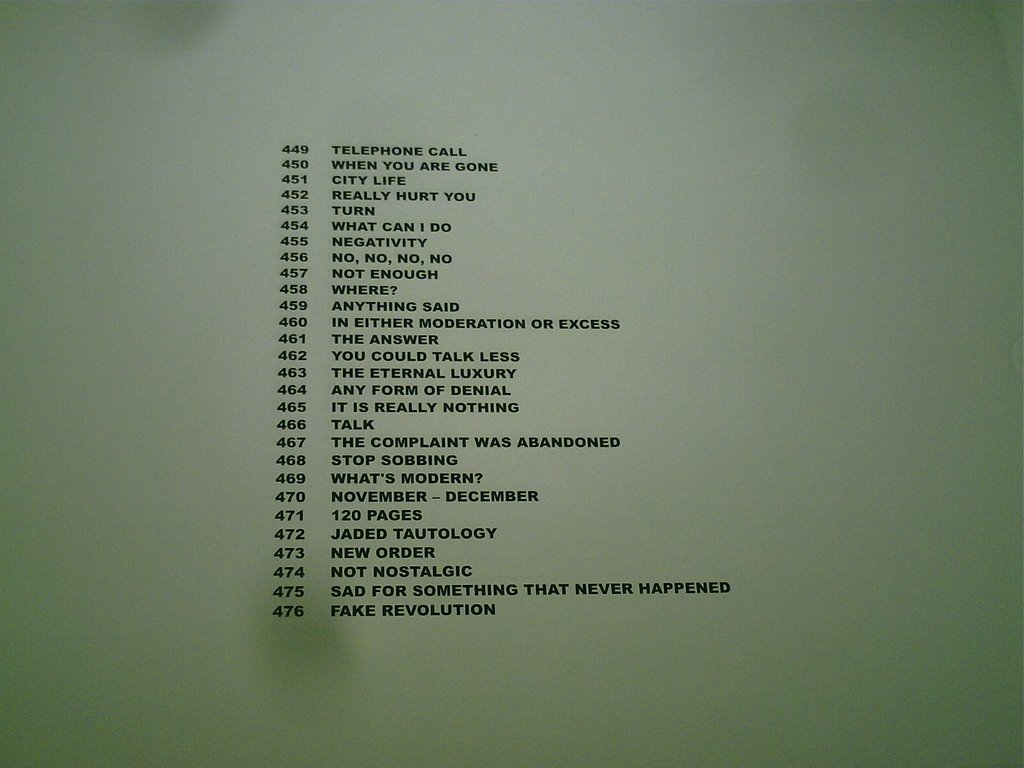
It is really nothing (465)

The first concert I ever went to was The Smiths at Brixton Academy on Friday March 1 1985,
Three days before my 16th birthday.

The first song they sang was 'William it was really nothing'

Not a bad debut eh?

In the song Morrissey tells a suburban male that ''it was really nothing....... it was your life''. And somehow that has always come over to me as a very liberating and reassuring statement.

Nice to have it confirmed by another Steven (Bruggeman).

Wednesday, May 03, 2006

List

Oulipo were/are a group of writers who would not write a novel or a poem without first imposing rules on themselves to constrain what they wrote.

There is no better Oulipo resource on the web than Derek Badman's list of novels written using Oulipo-like constraints.

Not the least pleasing of the novels listed was ‘Negativeland’ by Doug Nufer.
No sentence in Negativeland was expressed with a positive construction.

Nufer does not discount the possibility that the inspiration for this was the number of rejection letters he had received from publishers for his previous novels.

It was announced this week that Stefan Bruggeman’s ‘Show titles’ did not win the 2006 Becks Futures art prize.

Monday, May 01, 2006

Can't wait for tomorrow (287)


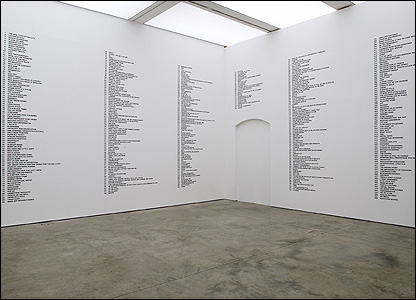
Stefan Brüggemann has painted 728 potential exhibition titles onto the walls of the ICA, in his entry for the 2006 Beck's Futures competition.

I believe that the winner of the competion will be announced today.

Bruggeman says anyone is free to use the exhibition titles if they want to. He offered first choice from the titles to the organisers of the Becks Futures exhibition themselves, and they chose a title for each of the three venues that the exhibition is being staged (London, Bristol and Glasgow).


The title for the London Becks Futures at ICA is ‘Can’t Wait for Tomorrow’, the 287th of Bruggeman’s titles.
  • I have decided to put all of these titles to good use: I am going to us them as the titles my next 728 blog posts.
  • I will not use any other titles until I have got through all of Bruggeman’s titles.
  • I will not use any title more than once.
  • I will use the titles in any order I like
  • I will make a blog post a day
  • I'm starting with this post: 727 to go now!

Saturday, April 29, 2006

Not a word

I haven’t been back (yet) to the ICA bookshop to buy one of Tino Sehgal’s words. Instead I went to the Whitechapel Art Gallery, for the first day of the Inner Worlds Outside exhibition of Outsider Art.

It shows the work of inspired and talented artists who weren’t part of the art world, and had never received any art training. People like Madge Gill who never sold any of her drawings in her lifetime because she didn't want to offend the guiding spirit who she said inspired them. Most of the drawings were found piled up in her bedroom when she died.

There is drawing from Gill that runs the length of one of the galleries, with the picture of the same woman appearing again and again in a swirl of shapes and colour. Apparently Gill would get a long roll of Calico and she would draw a bit, cover the drawing up and then unroll the next bit. until she had covered up the whole roll with her drawing. Must have taken months.

On the way out of the exhibition I was interviewed by the Independent on Sunday. The journalist took a photo. Might quote me in the paper this Sunday. I should have mentioned this blog, I might have got a free plug for it.

I went into the Gallery bookshop to buy an art mag. While I was there I bought, on impulse, a book by one French post-modernist philosopher (Deleuze) about another (Foucault). The reason I bought the book is that its opening sentence reads
‘a new archivist is appointed. But has anyone actually appointed him? Is he not acting rather on his own instructions?’

Its not often my proffession gets such a privileged mention in in philosophical texts. (I confess to not yet having read ‘Archive fever’ by Jacques Derrida).

So buy the time I had left I had spent £15. A tenner more and I could have had one of Sehgal’s words.

It is easy to spend money at the Whitechapel art gallery bookshop and the ICA bookshop. Sehgal is taunting me by selling his 100 words in the ICA bookshop. He is saying to me, ‘’you want to buy half the books and magazines in this shop. And yet you will end up spending £25, taking away nothing, for the sake of hearing one word’’

Maybe I should resist the Sehgal temptation, and use a line from a Smiths song instead to re-title this blog. That would be free.

Monday, April 24, 2006

Misguided

On 8 April 2006 Wrights and Sites published ‘A Mis-guide to anywhere’, a book of ideas for you to try out in your City: ways of walking in your City that help you to see it differently.

In the MisGuide they develop the old situationist idea of using a map of one city to navigate around another. (a bit like the I'm Sorry I haven't a Clue game where you sing the words of one song to the tune of another).

They quote the example of a Ferris wheel moved from Paris to Birmingham in 2003. The wheel still had the French audio commentary installed. For several weeks people looked out on England’s second city whilst being told to look out for familiar Parisian landmarks.

If you are in London, Wrights and Sites suggest you get a map of Paris and use it to find where in London the Eiffel tower is. Stop along the way to enjoy the Parisian ambience, find a place for a Ricard and a croissant.

Tania and I inadvertently did something like this on our holiday in the Isle of Wight. On the bookshelf of the cottage we were staying in there was a pile of leaflets about places on the Island. The pile included a guide to Mottisfont Abbey.

The guide described the history of the Abbey. and its conversion to a manor house after the Reformation. The house has a drawing room designed by Rex Whistler. A river runs through its extensive gardens, which houses the national collection of roses.

A check of its facilities (with our hungry son in mind) revealed the existence of a café/restaurant open every day and serving hot meals.

Sounded good so we got in the car and drove over to the West of the Island. Got there at 12. Kids bored and hungry after an hour in the car. Restaurant turned out to be a tea hut, which didn’t take debit cards. No disaster, back in the car to the nearest village for an agreeable pub lunch looking towards the cliffs at Freshwater.

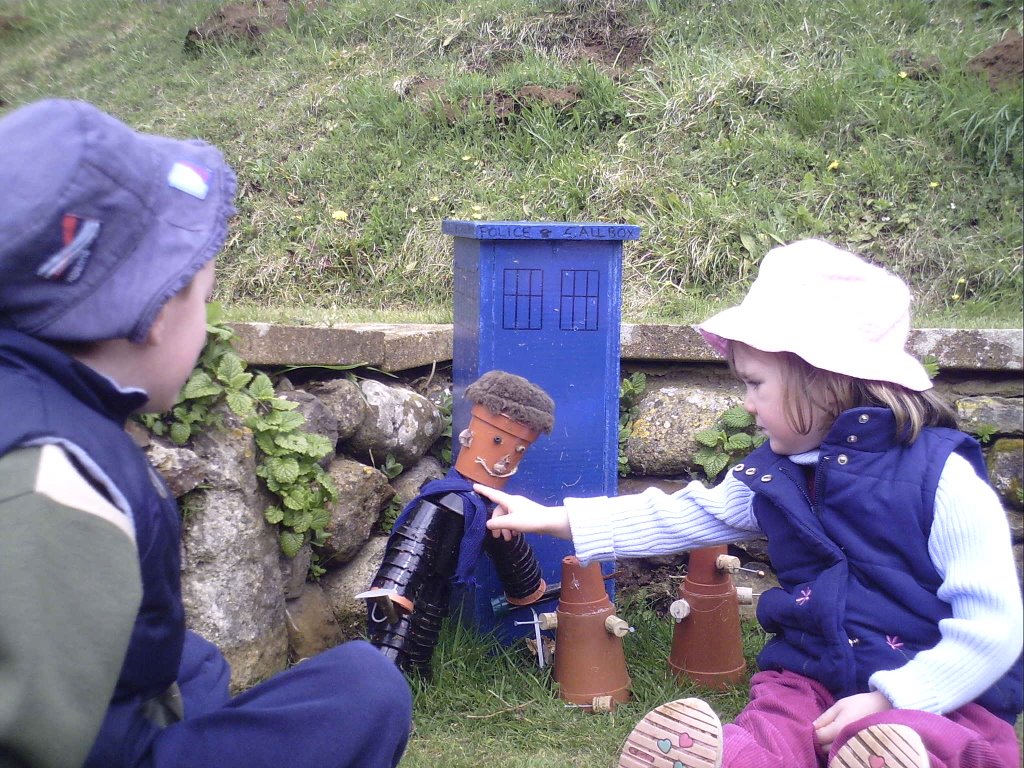
Should we go back? Might as well. After all, said Tania, it would be nice to see round the house. Back we go, spent an enjoyable hour helping Andrew and Anna find flowerpot men and women in the gardens.


(Here we found Dr Hoe and the Garleks)

Had a look at the house. It didn’t look much like an abbey, it didn’t look very open either. It wasn’t open.

A conversation with the Reception staff revealed that Mottisfont Abbey isn't on the Isle of Wight. We were at Mottistone Manor. The house in the gardens is a private residence which is open to the public one day per year (on the August bank holiday).

If I had known about the Mis-Guide we would have looked for the river and the rose collection.

Sunday, April 23, 2006

Update on Tino Sehgal’s words

I went back to the ICA on Friday.

I asked whether Tino Sehgal had read the text out yet that contains the 100 words he has been selling for £25.

The man in the ICA bookshop said that:

  • they hadn’t sold all 100 words yet
  • Sehgal will wait until they are all sold until he reads the text
  • There is no deadline set for selling the words. If they are not all sold Sehgal may never read the text

I am sorely tempted to go back again next week, buy a word, and rename this blog with whatever Sehgal word I get.

What do you think?

Friday, April 21, 2006

could you eat 24 cans of beans in half an hour?

Last night Mark McGowan and two fellow artists tried to break the world record for speed eating tins of baked beans: they were aiming to eat 24 tins in 30 minutes.

In the end Mark managed to eat 10 cans. Simon Ould won the competiton with 12 cans but was sick immediately afterwards.

There was an environmental angle to the event: Mark wants to raise awareness of the global gas crisis.

McGowan’s art mainly consist of protests. They are the type of protests that don’t hurt anyone. Sometimes they are about serious issues but the protests are never fully serious themselves.

To protest against unnecessary pollution from unnecessary car journeys he kept his Audi 80 running non stop in a car park in Peckham.

When one of his friends from Europe criticized the English breakfast he lay in a bath of baked beans, chips and sausages for a week as a gesture of solidarity with the meal.

To protest against wasted water he ran a tap non stop for days and days and hung a sign next to it saying ‘if you see this tap left off please switch it on’.

The running tap really got some people’s back’s up. The tap was in a gallery in South London. People rang in, wrote in and e-mailed in telling them to switch it off. Some people even came into the gallery and switched it off themselves. It was as though everyone in London was living in one big family: someone in the house had left a tap on and they needed to be shouted at until they turned it off.

Part of the ‘art’ in an event like that is the effect it has on people, the responses it provokes or evokes . I like art that attempts to impact on people’s lives in some ways. I know it wasted water in itself but I have definitely reduced the amount of time I spend running taps over the past two days since I read of his event.

Thank you to Russell Herron for his blogpost that alerted me to Mark McGowan: Russell described McGowan coming into the ICA bookshop and showing him a film he had made with Simon Ould.

In Russell’s words the film ''shows Simon, dressed in a black cape and crappy handmade crows beak jumping down the Duke of York Steps, then hopping around crowing while some kids point and laugh. The film ends with a rather long segment of Simon holding an umbrella made to look like a crow, again making loud squawking noises. ''

After eating 2 cans of beans in half an hour Simon really has got something to crow about now.

Saturday, April 15, 2006

Words

I’ve been reading The Phantom Tollbooth to Anna and Andrew. It was my favourite book from childhood. Milo and Tock visit the market place of Dictionopolis. The stall holders have buckets of words for you to buy. If you can’t afford a whole word (some of them are very expensive) you can go to the DIY stall which has buckets of letters which you can use to make your own words up.

‘Isn’t this market great!’ said Milo.
‘It is if you have something to say’ said Tock

Three artists have created installations in London art galleries this spring in which they present us with words: words that they have cut loose from the narrative structures (novels, books, a text) in which they had previously been combined.

  • Simon Popper has listed, in alphabetical order, all the words used by James Joyce in his novel ‘Ulysses’ (Beck’s futures 2006 , ICA, London SW1, until May 14 2006)
  • Simryn Gill has cut words out of books and sorted them into bags (Tate Modern, Level 2 Gallery, until 7 May 2006)
  • Tino Sehgal has been selling individual words at the ICA bookshop (as a spin off from his recent exhibition at the ICA)

Each of these artists has something to say, and is using words to say it. Visitors to these installations are faced with a challenge: how do we 'read' these words?


Popper’s A-Z list of the words from ‘Ulysses’

By reducing Joyce’s Ulysses to an A-Z word list, Simon Popper kills of the main character of the book, Leopold Bloom.

Bloom is no longer evoked as a living, breathing human being, walking the streets of the city of Dublin. He is no longer even named. There are many occurrences of ‘Bloom’ in the words beginning with B, and many of ‘Leopold’ in the words beginning with L, but no link is made between the two words.

We can no longer read the book. We can only look at the debris, the words strewn across the page like boulders on a beach. Like geologists we can only speculate on the creative force that could have brought this set of objects together.

Alongside the A-Z wordlist Popper exhibits a model train on a circular track. The train bears the livery of ‘Blum and Popper’, a company operating in Trieste where Joyce stayed when he wrote Ulysses. The name of the company had given Joyce the idea for the name of his main creation, Leopold Bloom. Now the same company name has given Popper the idea for a work of art that un-names and un-creates Leopold Bloom

The train shows the power of coincidence as a creative and destructive force: the coincidence of a connection between James Joyce, Leopold Bloom and Simon Popper.


Gill's bags of words

Simryn Gill’s installation 'Untitled' at the Tate Modern consists of:

  • A list of the books in the installation
  • A list of over 80 words that Gill has (literally) cut out from every book each time the word occurs
  • A set of archival quality boxes, each containing a bag of the cuttings of a particular word
  • A set of worktables and chairs at which you can sit down and open the boxes and look at the bags of words
  • A shelf of all the books. You can pick them up and browse through them. There are holes in them where the words have been cut out.

One of the words that Gill removed from the books was ‘small’ I thought it amusing that I could go and look at a bag of smalls.

The shelf contains the type of miscellaneous assortment of books you might find in a hospital waiting room. I was drawn to ‘The Bookshops of Sydney’ written in the 1970’s: a historical survey of the second hand and new bookshops of the city, with lots of black and white photographs. There are also some ‘Observer books’ that I remember loving when I was a kid.

The books are now impossible to read. When you come to a missing word you know that it might be one of the 80 or so words that Gill has raided from the books. But then again it might not. It might have been printed on the reverse side of the paper from one of the words on Gill’s list, and in that case, if you wanted to find the missing word you would have to:

  • work out which word was cut from the other side of the paper
  • go to the bag or bags for that word
  • sift through the bag until you found a piece that matched the shape of the hole
  • manoeuvre that word around inside the bag until you can read what was on the reverse side of it.

The loss of comprehensibility of these books by the actions of the artist is a key element of this work. Gill has highlighted the loss by allowing us to browse the books, to see what we are losing, to be tantalised by the information we can no longer glean.

In this installation the bags of words are more cared for than the mutilated books. They have been brought together purposefully, as though by a curator, in archival quality bags secured in archival quality boxes. The bags of words will be helped to resist the ravages of time longer than the books which brought them into existence.

Looking at a word in these bags is like looking at a roman coin in a museum. Like the coin, the word has a meaning. We can read a meaning for the word like we can read a value for the roman coin. But for both the word and the coin we can tell little or nothing of what the coin meant to the people that handled it, that wrote/read bought/sold/ with it. The words, like the museum coins, are out of circulation, reduced to being one instance of the many instances of that word/coin. The only thing that the words or the roman coins really tell us about is the collection policy of the individual/institution that brought them together.


Sehgal's £25 words

Tino Sehgal aims not to leave any traces of his work. For his latest exhibition at the ICA:

  • The publicity text didn’t tell you what the work was about or what it consisted of
  • The title of the exhibiton was simply ‘Tino Sehgal'. This was the second of three exhibitions of his at the ICA with that title.
  • There was nothing tangible in the exhibition to view, nothing on the floors, nothing on the walls.
  • The work itself consisted of the conversations that the exhibition guides have with you as you walk through the empty galleries

Tino hasn’t left any traces of his work, but the work has left traces in the world. B, Russell Heron, and Jasmine Chan are bloggers who have each attended the exhibition and described their experience of it.

As an adjunct to his ‘Tino Sehgal’ exhibition, Sehgal invited people to purchase, from the ICA bookshop, for £25, an original work of art of which the author has created a limited edition of 100. Sehgal did not leave any further trace of the work than that: no description of it, no viewing before you buy.

As luck would have it the guy in the ICA bookshop, is a blogger. his name is Russell Heron, and he has put up six interesting blog posts about people buying this work of art.

  • post 1: introduction: the work of art is a paragraph, 100 words long. You can come in and buy a word from the paragraph for £25. The word is whispered in your ear by the guy in the bookshop (our blogger). You don't get the word written down, or a receipt. Words are sold in the order they come in the paragraph. If you buy a word you are invited to come and listen to the artist read the whole paragraph
  • post 2 journalist from the Times buys a word
  • post 3 journalists from the Evening Standard and London Tonight buy a word each
  • post 4 The Evening Standard journalist tries to sell their word on e-bay for £4.99 to recoup some of the money they paid out for the word (and couldn't claim on expenses because ICA wouldn't give them a receipt)
  • post 5 Russell Heron bought the word on e-bay himself, for £5.51

Heron has not (at least not yet) posted anything about the completed paragraph: I'll do a technorati search of the blogsphere to see if anyone has written anything about it and report back to you in a later post.

Sehgal’s work works in the opposite direction to that of the other two artists. Popper and Gill took books which we know already and wrenched words out of them to force us to look at the words in a new way. Sehgal offered us the words whist delaying our access to the text which brought them together.

Seghal seems to be mocking us for our dependence on writers or artists to create meaning for us: we are so dependant on artists to create the meaning that we will even pay for words which are free (just like the shoppers at Dictionopolis). The spectators are disempowered, sepeartated and taken advantage of by the artist.

A thought on the three works

In each of these we encounter words which are objects free from the meanings that the author may have intended for them. W are invited to free ourselves from having to imagine what the author might have meant in using these words.

Instead we wonder what the artists meant by freeing us from imagining what the authors meant when using these words

Thursday, March 30, 2006

Jim Latter's 'Stations of the Cross'

‘Stations of the Cross’ by Jim Latter is a series of 15 paintings. Each painting relates to a particular point in the journey of Jesus from condemnation to resurrection. The paintings are on display in St Mary le Bow church for the duration of Lent (until Easter Sunday, April 16).

The paintings are incredibly simple. Each shows the same sized rectangle on the same sized piece of paper. Each rectangle contains a cross. The dimensions and proportions of the cross do not vary. This gives the series coherence, strength, and power.

Using only colour, shape, pattern and the relationship between the foreground of the cross and background of the rectangle, the artist manages to convey or suggest something of the essence of each of the episodes in the story of the Passion of Christ, and also something of the essence of the story as a whole.

I visited the exhibition four times. On my third visit I quickly toured round the 15 paintings, making a note into my laptop of what I perceived in each painting. Yesterday lunchtime I went back to note down the titles of each painting. By a nice co-incidence Jim Latter was in the church at the time. He introduced himself, and walked around the exhibition with me.

What follows is, for each painting, firstly the original notes that I took of my perceptions of the painting, and then some of what Jim told me of how he made the painting and what he was looking to convey.


I
red at the bottom fading in to black at the top. like a sunset or a dawn with light diffusing but it feels like the darkness from the top is pushing down on the red fading light below
(condemned)

Jim’s comments: I paid a lot of attention to the proportions of the cross, and the ratios between it and the rectangle that the cross is contained in. I’ve noticed that most of the crosses you see in churches haven’t got the right proportions. The dimensions of the cross in this rectangle create two squares as background above the arms of the cross, and two rectangles below the arms.

I started by placing masking around the rectangle and over the cross. I painted the background with layers of acrylic paint. Then I uncovered the cross, masked the rest of the rectangle and painted the cross.


II
the darkness is lightened somewhat. The cross is brought to the fore by evenly spaced vertical lines, like scars that cut across the grain and run down the cross - both its arms and its support. In the background you have green light at the bottom fading into grey at the top.
(taking up the cross)


III
the cross stands out blue, garish and the lines on the cross are at an oblique angle, all leaning the same way. The background is brown - a light mud brown – but it is scarred by lines, lines that have been made before the imposition of the cross, lines that are interrupted by the cross.
(first fall)

Jim: I masked over the cross and used a ruler and a knife to scour lines into the paper in the rectangle. I did it with a ruler, more or less at random. Then I scoured the diagonal lines onto the cross.

I used a blue oil pastel to colour the cross: it was like brass rubbing, it’s a solid lump of pastel and, the pastel doesn’t get into the channels created by the knife. The scourings into the paper are there to show the pain, I was thinking of someone scraping their fingernails down a blackboard.


IV
the only one where the pain spills outside of the rectangle and reaches into the white space beyond the rectangle. The one where the cross almost merges into the background, the cross is a deeper blue, the background the same blue more lightly applied, it is watercolour and you get the fluidity of the cross and the background joining, spreading, merging, like the baby and the mother in the womb.
(mary)

Jim: I wanted to show the pure pain and grief of a mother for a child. I thought of tears.
I used a different technique for this one. I didn’t use the masking tape. First I wet the whole rectangle and dripped drops of blue watercolour (like putting in eyedrops). Most of the blue stayed within the rectangle but sometimes the blue splashed outside the rectangle, like tears.

I waited till it dried then I wetted the cross, leaving the background of the rectangle dry. I dropped blue paint onto the cross to make the cross stand out from the background in a deeper blue, knowing that some of the blue of the cross would spill out into the background.

V
wow. Colours, bright colours. The cross marked out by vertical stripes going from left to right (arm) green black yellow red green black yellow (support) red green black yellow red (arm) green black yellow red green black yellow. The four corners of the background are reading from left to right and top to bottom: black green yellow red. The background corners have diagonal lines each diagonal taking the line from the edges in towards the centre of the cross, the cross of the cross.
(Simon)

Jim: I spoke to Rev Bush (the minister at St Mary le Bow) about Simon. He helped Jesus. Some sources suggest he was black. I wanted to use colours that paid homage to that: I wanted to use Rasta colours.


VI
watercolour again. The cross brown, the background a dull blue. Some horizontal drips of blue flow downwards and change their course as they flow over the brown cross. Several patches of the cross are a darker brown, where the head would be, where the feet would be, where the arms would hang
(Veronica)

Jim: Veronica wiped Jesus’ brow with her cloth, when she looked at the cloth afterwards the sweat had formed the image of Jesus’ face on the cloth.

I made the cross wet and applied the brown, then I made the background wet and applied the blue watercolour.

When you wet the paper it buckles, when it buckles the paint runs into hollows and groups in different places: you can’t control how it turns out. The dark patches of brown you see on the cross could have occurred in any pattern, it was beyond my control, I was amazed to see that way the dark patches have grouped suggests the presence of the body of Jesus, like an x-ray.

VII
cross is a blue, a deeper blue than before. Background is brown, a deeper brown than before. The lines on the cross are diagonals moving downwards from right to left. In the background there are lines, interrupted by the cross, entangled lines, lines that form an entangling meshy trap like lots of ropes that keep tripping you up
(second fall)

Jim: If the scar lines on the cross had been horizontal and vertical everything would have seemed stable: I made the scar lines diagonals to show the instability, the falling


VIII
watercolour. Cross is brown but invaded by the colours of the background which is a tie died, psychedelic, rainbow of beautiful, peaceful spectrum-like colours.
(women of Jerusalem)


IX
the cross is a duller blue, almost all the blue has faded now. The demarcation between the blue of the cross and the brown of the background is being lost: they are fading into one. The lines of the cross are diagonals going downwards from left as I view to the right. The same entangling, tripping lines.
(third fall)

X
the mood feels different over here, more serious, less human, less alive, hope has been stripped out. The cross, white, the background black with paler patches.
(stripped)

Jim: The cross is bare, just white, to show the nakedness of flesh. For the background I wanted to create the effect of metal. To show the vulnerability of the flesh against the harshness of the metal.

XI
the cross red the background red. The cross demarcated from the background only by the different orientation of the lines scarring its surface. The lines scarring the surface of the background run horizontally, the lines scarring the surface of the cross are orientated vertically. The lines don’t run as neat parallels: they are entangled lines, like the lines in the paintings of the falls
(crucifixion)

Jim: I’ve given this painting to the church, so it will stay here at St Mary le Bow when the exhibition has finished.

XII
black. Only black. If you look for a long time, the black of the cross appears to show out from the black of the background.
(death)

Jim: I painted the whole rectangle black. Then I masked over the background and gave another coat of the same paint to the cross. So the only difference between the background and the cross is that the cross is painted twice.

XIII
some colour is coming back. Pale colour, but pale hopeful colours. The foot of the cross is pink like flesh, the foot of the background is green like grass, pink and green fading upward but the colour of the background at the top is blue, not black.
(taken down)

Jim: for the blue at the top I was thinking of all those renaissance paintings which seem to have a clear morning sky, when it hasn’t got hot yet, when there is still a bit of freshness in the air.

When I painted the cross I had in my mind a picture from an American comic that was passed round my school when I was a kid. It was a pretty nasty comic and one picture showed a picture of a man who had been shot. The man was slumped back on a chair, his arms hanging over the sides of the chair. He had obviously been dead for some hours and the blood had sunk down to the bottom of the arms, so the artist showed the top of the arms as pale, getting pinker as you moved down towards the man’s hands. This was my image of what death was for a long time.

XIV
the cross is black with thin, horizontal, evenly spaced, parallel red scars. The background is black with thin vertical parallel scars.
(entombment)

Jim: There is nowhere that the horizontal lines of the cross can go, they are trapped by the vertical lines of the background. I wanted to give that feeling of being closed in, of being unable to move. This is also a nod to the work of Frank Stella, an abstract artist whom I admire.

XV
white. If you look for a while you will see the white cross emerging from the white background and appearing to light up the white of the paper outside the square.
(resurrection)

Jim: I didn’t know what to do for resurrection. I spent two weeks wondering around my studio without a clue on how to depict it. Then I thought ‘white’.

I painted the whole rectangle white, then masked out the background and painted the cross again with another coat of white. But the second coat was very light, there is very little difference in weight between the white of the cross and that of background.

When you look at this you are seeing four different whites: the white of the cross, the white of the background, the white of the paper, and the white of the mount.

Some comments from Jim about the work as a whole
When I researched the stations of the cross all the previous work I came across, with one exception, were figurative, depicting in some way the people involved in the story. The one exception was a Stations of the cross by the abstract artist Barnett Newman.

Newman's work simply used geometric shapes, it did not even use the cross. But somehow it worked. I saw it in London when it came over as an exhibition about 5 years ago. I felt that the work gave me 'permission' to do the work without figures. At one point I was thinking of using circles as the basis of the work, but after a time I realised that I needed to have the cross in there.

Some comments from me for Jim about the work as a whole
It seems that most stations of the cross by other artists have 14 stations: is your work unique in adding the 15th station, for the resurrection?
The first time I saw this work it was the contrast between the black of your depiction of death, and the white of your depiction of the resurrection that really sucked me into this whole work. The contrast gives a pure energy to the work, like a star near a black hole.

Does the series continue after resurrection? Does the slight difference between the white and the white mean a new cycle, a different cycle starts anew? Or does the white gradually dissolve into the white?

Wednesday, March 29, 2006

Monday, March 27, 2006

Inspired writing

Here are the notes I took at Nick William’s ‘inspired writing’ course on Saturday

Nick’s recipe for writing is to:
• work out what inspires you
• overcome the resistance you feel to writing
• turn up at the page and write
• learn some craft techniques for making the most of your ideas

Work out what inspires you
Inspiration is natural to human beings. The latin origin of the word ‘inspiration’ is to breathe, and it is as simple as that. Inspiration is available to us as human beings living in the world.

Inspiration is an evolutionary force, a force for change in our lives. You may have an idea and think to yourself ‘that is a great idea but I’m not big enough to do/write that’’. Inspiration is the motive force for us to grow to become big enough to express and develop that idea.

To stay inspired we need to stay in touch with the things in the world that inspire us. Our sources of inspiration are like our wells which stop us from running dry. Work out what inspires you. Make time in your daily life for the things that inspire you: if nature inspires you, spend time with it. If you get inspired by art, spend time with art. If you get inspired by dancing, dance.

Nick advised us to look for unexpected source of inspiration, and to trawl our nets wider in search of new sources of inspiration. Nick was surprised to be inspired by Las Vegas, by all the entertainment available there.

I realised on the course that I am inspired by:
  • people who are willing to express and live by their values in life
  • acts of friendship, kindness and solidarity
  • small second-hand bookshops, art galleries and bakers that manage to keep going
  • art
  • conversations or books that cause me to make connections between people, places, ideas ,times and possibilities
  • strong and humorous communities of people
  • rivers and the sea
  • my friends.


Overcome your resistance
Resistance is our attempts to dissuade ourselves from acting on our inspiration. Could be anything from ‘I’ m too tired’ ‘I’m not ready’ ‘I’m not capable’ ‘I’ve got more important things to do’.

The more important something is to you, the stronger will be your own resistance to doing it. Realise that you will resist your own creativity, and be prepared to defend your own creativity against your own resistance.


Turn up at the page and write
Nothing will get written if you don’t turn up at the page and write.

Don’t wait until you have something great to say before you write: start off by writing some crap! Adults have a tendency to think they ought to know how to do stuff. The best way of learning is to try things. When children learn to walk they fall over lots of times and they don’t care, they try again. When adults try something that doesn’t work they have a tendency to say to themselves ‘I can’t do this’.

Don’t wait until you feel inspired with lots of ideas before you write: start writing to unlock your ideas.

Use some craft techniques
Start small. Lower your bars for success. You don’t have to write a book all at once. Start with an article, or a presentation or a workshop.

Craft your writing so that it works for the reader. You don’t have to tell the reader everything you know.

One craft technique that Nick showed us was coming up with some ‘top tips’ and then elaborate on each one: I’ve used it for this blog post.

Be clear about why you are writing: are you writing to entertain, to inform, as catharsis for yourself, to make money? Any one piece of writing may be for one or more of those reasons. We will write for different purposes at different times.

If your writing was just about using craft techniques then you would just end up as a hack and you would not enjoy it. But if you keep in touch with your inspiration then writing will not only be a source of joy but also of personal growth and fulfilment.

Sunday, March 26, 2006

Meeting other succesful authors

Yesterday I went to an Alternatives workshop on Creative writing.

The course leader was Nick Williams who has written books such as The work we were born to do and How to be inspired.

The first thing Nick asked to us to do was to introduce ourselves to other people in the room as though we had already published a really succesful book that we were proud of.

I told a tall, quiet chap about my history of Hungarian literature, and how I had written it without ever having read a Hungarian novel. I told him about my research for the book, which involved riding on buses and trams in Budapest and asking people to tell me which stories and characters from their country’s literature had made an impression on them.


He told me about his economics book. He wrote it from the standpoint that resources in the world are abundant, thus overturning the traditional view of of economists that resources are scarce. His book has inspired the creation of many different self-sufficient communities. He is proudest of the one near his hometown in the West Country, which now has over 50 members.

Later on I introduced myself to Maureen who has written a self help book from the different perspectives of the many cultural groups in London.

And I met Stephanie who has written a book about how to connect with people. I told her about the book that I had written on how to enjoy life, with its chapters on how to enjoy watching a cricket match, how to enjoy your lunch break, how to enjoy an art exhibition and so on.

Stephanie and I have agreed to co-operate on a book which will tell you you how to enjoy connecting with people at art galleries, cricket matches……….

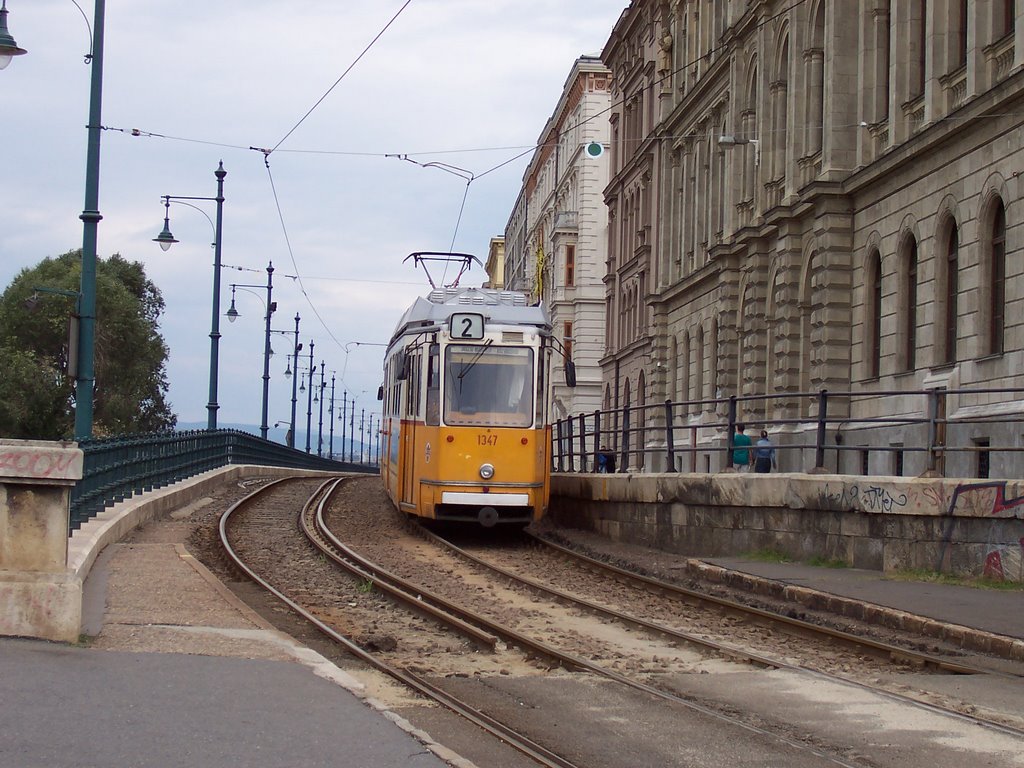
(the photo of the tram comes from http://commons.wikimedia.org/wiki/Image:Tram_in_Budapest)

Friday, March 24, 2006

Monuments

I went to see the Dan Flavin retrospective at the Hayward Gallery on Tuesday.

Every piece consists of his arrangement of flourescent lights. The tubes are from a narrow range of colours, a narrow range of lengths. Flavin was influenced by the Constructivists, an artistic movement that grew up in the years just after the Russian Revolution, which mad repeated use of a relatively small set of simple elements, which they combined in different ways.

The flourescent lights provide all the light in the gallery: there is no other sources of light in the exhibition apart from the art (well I did spot a couple of lights on the stairs that must have been there for safety reasons). In fact the Hayward haven't just switched off their own lighting, they have totally removed all their lighting: their are no other lights to be seen. You walk around the gallery bathing in the light of Flavin's art.

The experience started to twig with me when I realised that the walls were different colours depending on where you were looking at them from:. Flavin was painting the walls with his lights. I didn't just have to look at the arrangement, shape, and colour of the tubes themselves: I could look all around me at the colours and the luminescence that I was walking in.

A lot of the pieces are entitled 'monument to' . I found that moving. Flavin is quoted as saying that in calling them monuments he was being ironic because his light tubes don't last anywhere near as long as your traditional stone monument.

Flavin was creating light sculptures which he is dedicating to people: some people he knows, some dead, some alive, some he doesn't know like the Soviet Constructivist V.Tatlin. And he does multiple different monuments: so we think of one main monument someone, but here is Flavin doing 50 monumebts for Tatlin, each composed of a small number of white flourescent tubes, each monument different from the other, different shape, different disposition.

It reminded me of that religious instinct to light candles in a flickering memory to people (as in my wife's Greek church). And I have since learned that Flavin had trained to be a Catholic priest before starting his career as an artist, and had studied Byzantine icons.

Flavin's monument Tatlin is interesting because Tatlin is most famous for designing a monument that was never built, a monument to the Third Socialist International. Well it was never built in Moscow where Tatlin intended. I remember the Transport and General Workers Union had a small one built on the PierHead in Liverpool which my grandad used to take Lucy and I too: I wonder what happened to that: does anyone else remember it?

Saturday, March 18, 2006

Forget about the station, forget about the game

A few weeks ago I got the wrong branch of the Northern Line coming southbound.
It didn't really matter, I got off at Bank and went on the Central Line to Tottenham Court Road and got to Waterloo that way (it was too late for the Waterloo and City Line).

But getting the wrong branch of the Northern Line northbound is more serious. Look at this story that I read on wikipedia yesterday, in the page for 'The game':

"Three young men, following a heavy night out in the west end, accidentally took the wrong branch on the northern line, and found themselves stranded at East Finchley. As they had no money, they decided to wait on the platform until the first morning service to take them back into town. To help the time pass, they decided to play a game, and one suggested that they should try to forget about where they were, and that they were playing a game, and the first one to think about the game, or about East Finchley, was the loser."

This has now been formulised into a game that apparently anyone can play . The object is simply to forget you are playing the game. You lose every time you remember that you are playing, and you should announce the fact that you have lost.

There are some good tactics for winning the game mentioned on the wikipedia site, liking putting post it notes up where your opponents can see them that say 'the game'. But this does cause philosophical problems as you were probably thinking about the game when you wrote the post it.

There is a wikipedia deletion page for the article where there is a debate going on about whether or not to delete the page

Thursday, March 02, 2006

Will you ever play test cricket again?

Andrew asked me that question while I was washing up last night.

Of course I stopped washing up and looked at him, eager to hear more. Does my son think I was once a swashbuckling, globetrotting, batsman, striding out to the wicket carrying the hopes and dreams of my nation, before the call of fatherhood led me to shun travel and stardom in favour of records management consultancy?

Andew's next question dispelled my illusions: will you play test cricket for Battersea Ironsides again daddy?

Saturday, February 25, 2006

why is your face on your head?

That is another one of Anna’s questions, that she shouted it out from her bed at 8:30pm: I guess like a facilitator at a meeting she is asking a thought provoking question to stimulate discussion. I didn’t respond at the time, but having had time to think about it I would say that having the face on your head (rather than say, your lower back) shortens the communication lines between your brain and the rest of the universe.

Later on I popped upstairs and she was still awake. She said ‘daddy I can’t get to sleep because my dreams are too noisy’.

I’ve been reading Uncle Lubin with Andrew. I used to love that book when I was about 10. What a cool guy Uncle Lubin is. He always finds a way out of things. A huge long serpent is about to eat him, but he remembers that serpents can't resist music, so he plays his concertina for hours and hours and the serpent just gets caught up in knots and dies. Lubin's only real mistake is at the start of the book when he falls asleep looking after his nephew Peter and the wicked bag bird snatches Peter away in his beak. At the time of writing Uncle L still hasn’t managed to get Peter back, but he is working on it.

Here is a link to a guy has scanned onto his website lots of Heath Robinson’s illustrations for Uncle Lubin http://bugpowder.com/andy/e.robinson.heath_lubin.html

Andrew is really looking forward to going to the test match (England v Sri Lanka) with me and my mate Phil on May 11. He asked me if I could get a bit of card and draw a 6 on it He said ‘I will hold it up if it is a six, but if I catch it then I’ll give it to you and you can hold it up’ Visions of Freddie Flintoff hitting a massive six into the grandstand and Andrew calmly passing me his little cardboard number 6 before pouching the ball in both hands.

Sunday, February 19, 2006

My other religion is the right one


I saw this graffiti on the river facing wall of the Tate Modern last week.

The sentiment really resonates with me. I remember attending a superb parenting course (http://www.familycaring.co.uk/course_parents.htm), run by local health visitors. The course had a session on spirituality and parenting. At the end I asked the course leader whether she thought it was a good idea for us as parents to introduce our children to religion and she said 'yes, and to as many religions as you can'.

Religions shouldn't have to prove themselves to be true. To me it is enough if their teachings help those who come into contact with them to express and explore their feelings at being alive at a particular point within the vastness of space and time on a planet and in a universe that are both so uniquely hospitable to us.

Wednesday, February 08, 2006

No wonder I couldn’t find it


Have you ever lost a boiled egg?

For the first time in my life that happened to me on Monday morning. I got up early, put the egg on to boil, and plugged in the laptop to write a blog post. I started to type about how the people that came to my training course last Friday walked over the Thames with me at lunchtime to visit the Tate Modern.

Once the egg had boiled I drained the water out, took the laptop to the table and ate a bowl of muesli. When I’d finished the muesli I went to get my boiled egg, but couldn’t find it. It wasn’t in the pan, or in the sink. I hadn’t put it back in the fridge, nor had I chucked it in the bin.

I made Tania a cup of tea, warned her about the free-ranging boiled egg and went to work. The absence of egg didn’t affect me too much, our very hospitable clients at the bank gave me a nice croissant to have with a cup of tea.

I got a text from Tania saying ‘it was in the kettle!’

Courtney Pine

Saw Courtney Pine at the Jazz Café with my dad on Saturday (I mean I went with my dad, it didn’t look like Courtney needed the help of a fellow saxophonist)

Piney was great. After an hour and a half he said to us ‘’well, our time is up now, and I guess your busy, you’ve got things to do and all that….. shame cos me and the band are just getting warmed up’’

Then when the audience made some noise he said ‘’I want you to sing along with this next one: we will do a three part harmony, yesterday they managed something special but you’re gonna do better cos you’ve got the Saturday night Camden Town Jazz café vibe, yeah?’’

So he pointed his sax at different parts of the audience, played a riff and got them to sing it back to him. And he liked our part of the audience the best cos we made the most noise at the beginning, so when another part of the audience didn’t come up to scratch he said to them ‘watch how my people can do this’ and turned back to us to do the riff. When we’d got it right he just left us to repeat it over and over again while he was off playing something else entirely.

I found it inspiring that someone at the top of his fame put so much effort, warmth and fun into his performance, into involving the audience in it, and into creating a memorable evening.

I remember seeing Tommy Smith play the sax at the Glasgow Jazz festival. He was quieter than Courtney. He played old standards, hackneyed tunes you’d heard millions of times before, with a real care and depth of heart that made them sound suddenly really touching and profound. I thought what dedication he must have to his instrument and int his art to play it that well.

My dream would be to let the passion, freedom and enjoyment shown by Pine, and the care and dedication shown by Smith , show up in my work too.

On the train back home Dad told me that the gig he played a couple of weeks ago was at The Greyhorse in Kingston: I was really impressed: they have some semi-decent bands on there.

Daddy, why do we have to protect our eyeballs when we are asleep?

Anna has just called down from her bedroom to ask me that. Funny how she comes up with these great questions when she is lying in bed trying to get to sleep.

At this time on Friday she shouted ‘mummy, why can’t you see your head?’.

Later that night she asked ‘why can you only dream when you are asleep?

Friday, February 03, 2006

February 2: National flapjack day


TFPL celebrated National Flapjack Day on Thursday, and the competion for the 'flapjack of the year' award was the closest fought many of us could remember.

The competion had everything:
- skulduggery (Carmel tipped a tub of marks and spencers flap's into a tupperware pot and expected us to believe she'd cooked it)
- heroism (Nicky and her mum drove to Beddington Asda at 1am to buy another pot of syrup after their first batch of flapjacks had charred in the oven)
- international rivalry (Belinda had told us that Anzac biscuits were better than flapjacks, and was bitterly disappointed at only getting 2 votes).
- despair (Nicky's late night vigil had looked like paying off until a late flurry of votes tore victory from her grasp)
-triumph (Clare's bold decision to make an exotic ginger and chocolate flapjack was rewarded when the last vote, from Sheetal, handed her victory by one vote)

Well done Clare!


-

Friday, January 27, 2006

Bert update

Anna pointed out to me last night that Bert knew how to say soup too.

I told Anna how I taught Bert to say cheese, how long it took me and how many pieces of cheese I ate whilst saying the word.

I told her how I smiled when he pointed at the wardrobe and said 'cheese' and how puzzled he was when on subsequent performances of the same manoeuvre I shook my head and said 'no Bert thats not cheese, I can't keep my school uniform and my P.E kit and my jeans and t-shirts in cheese, they would smell awful'.

Every day for months he would swivel his head, look at the wardrobe, point and say cheese. Every day he would look crestfallen in his teddy way when I shook my head. I tried everything. I got my parents to bring back a really pungent cheese from France so he could compare the smell to the veneer of my walnut wardrobe. Nothing worked.

Next time they crossed the channel I got them to bring back a poster of the 360 cheeses of France. I stuck it on the wardrobe. Bert pointed, said cheese, I smiled, he smiled.

Then I started to teach him about Yoghurt.

Thursday, January 26, 2006

Bert

I told Anna about Bert last night, the teddy I had when I was small that only knew seven words. Each of the seven words was the name of a fruit or other type of foodstuff.

I told her how he would slowly swivel his head, then lift his arm and point to an object in my room.

Once he pointed to my wardrobe and said 'cheese'. Anna asked whether he could say 'Baby Bell' and I had to admit that he couldn't distinguish between types of cheese.

Another time he pointed at the window when my next door neighbour was walking past and said 'bannana'.

He didn't seem to have much facility for learning, but he was very entertaining: I wonder which child has him now.

Wednesday, January 25, 2006

Will there ever be a world flapjack day?

I've hit an obstacle: Belinda tells me that in Australia the word flapjack has nothing to do with oats: it is merely a synonym for 'pancake'.

I didn't realise how strong my cultural prejudices are. I thought the concept of oats baked with butter and syrup was so simple as to be universal (as I write this I realise that without Columbus we in England would not been missing a rather crucial ingredient).

What is the nearest French/Russian/Hungarian/Ghanaian equivelant to a flapjack? I find it hard enough to find a freshly baked flapjack in London, what chance would I have in Adelaide or Lagos?

A further blow to my preconceptions has been dealt by Martin on my left here: apparently the original application of the word flapjack is from the New England states of America, and does indeed refer to a pancakefried on a griddle. Jack was then a common workd for 'thing' and flapjack meant a thing that was flipped. Our present biscuity use of the term originated in England in the 1930s.