Our one year celebration kicks off with the suggestion of Marine Hugonnier that we rejoice in the knowledge that human beings have walked on the moon.
I am celebrating by singing the REM tune 'do you believe they put a man on the moon' but changing the lyrics to suit whatever I am doing at the time.
At the breakfast table I sang 'do you believe, I've got some egg on my spoon, egg on my spoon'
On the 08:07 New Malden to Waterloo train I am writing these words and singing 'do you believe, I can type without much room, without much room'
Thursday, July 20, 2006

Sunday, July 16, 2006
Contradictions
In the space of a Friday lunchtime, a visit to the Tate Modern got me thinking about what we human beings try to do with time and space:
- We divide up time and space because time and space are both indivisible
- We find ways of visualising time and space because time and space are invisible
- We fight for time and fight for space because time and space are infinite and unlimited.
My first stop was the fourth floor: back to Pierre Huyghe's One Year Celebration inside his Celebration Park. Huyghe's premise was that our calendar is a map, a map of the year, and the map has some uncolonised territory in the form of days which don't have a holiday attached to them.
At Hugyhe's invitation several artists and critics have come up with suggestions for colonising these days with celebrations.
Two of these proposed celebrations are attempts to resist the mapping of time, in order to escape the constraints that our mappings of time place on the way we live our lives and on the way we think about the universe.
Joe Scanlan suggested having an 'open day': a day slotted in somewhere between Sunday and Monday. Nothing can be scheduled for this day (because no-one knows when it is) and we can instead enjoy things in life that don’t need to be scheduled (Scanlon suggests that coffee, newspapers and cigarettes should be half price).
Another artist suggested a day out of the year, a revival of the Mayan practice of having one day in the year that wasn't included in the calendar, to remind everyone that time is greater than the calendar, that time is impervious to attempts to measure it.
I popped into the bookshop to flick through the book accompanying Celebration Park and noted Hughye' s comment (in an interview with Hans Ulrich Obrist) that he regarded time as a corollary of space. He talked about how a television programme exist mainly in time, but also in space, and differently from objects.
All this talk about the relationship between space persuaded me to pop upstairs to the fifth floor to revisit my favourite thing in the Tate Modern: 1,000 millimetres by Stanley Brouwn.
It consists of a card index box, containing 1,000 pieces of card. Each card has the words '1mm' written on it, above a horizontal line, in pencil, one millimetre long. So you have a thousand millimetres in the box.
There are no more or less millimetres in that card index box than there would have been if Brouwn had left the cards blank and saved himself the effort of drawing all those lines.
We have no way of adding a millimetre or a second to the universe.
As I was coming down the escalator from the fifth floor of the Tate Modern I had a Eureka moment. I solved the mystery of time and space: they don’t exist!
Monday, July 10, 2006
Genius is still genius
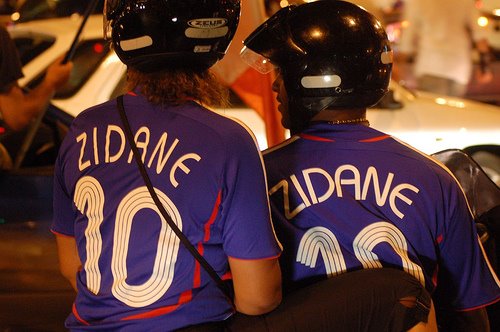
Photo by choudoudou
When I opened my eyes this morning, my first thought was of how Zinedine Zidane must be feeling, opening his eyes this morning.
I listened to French radio after the world cup final last night. I was impressed by the loyalty to Zidane of all those who reported or were interviewed. In the whole hour that I listened not person blamed him for the defeat, not one person used any words like shame or disgrace. Some expressed their thanks to Zidane for what he had done for France in this world cup and over the years.
One correspondent described the moment Zidane got sent off as like moving from 'le chaleur' of a Rio de Janeiro beach to ‘la froideur’ of a cold bath in the space of a split second.
Another correspondent described an empty café, with a lone man in a Zidane top clearing up the clutter left by the fans who had gone home. The correspondent imagined that some of the fans who had left the café were parents who had gone home to kids wearing Zidane tops too.
A convincing case could still be made for Zidane being the player of that tournament. He was pulling the strings again last night, throughout the second half and extra time. As a 34 year old, to be still bombing into the penalty area half way through extra time is a phenomenal achievement: compare with his fellow 34 year old Luis Figo who never seemed to last past the seventy-fifth minute of matches.
Does one lapse in self control wipe out fifteen marvellous years? it depends what you want to remember people for, and what you want to see in people.
I’m reminded of the Nottingham Forest fans on at the end of the 1992/93 season, defiantly singing ‘Brian Clough is a football genius’ as they watched their team get relegated. They will have suspected that Clough was by then an alcoholic, and that his drinking had contributed to the relegation, but they also knew that he had preformed football miracles for them.
Saturday, July 08, 2006
Today we celebrate unlikely but uplifting combinations
Pierre Hugyhe wants ever day to be a celebration, so he asked some of his artist friends to come up with a reason to celebrate on days that we don’t have a holiday at the moment.
Pierre has used his exhibition at the Tate Modern to display the new holidays to the public for the first time.
The day I am most looking forward to is the day celebrating our sense of anticipation. But no date has been set for that yet.
The most enlightening holiday will be the day of rational certainty. On that day we will be enjoined not to cross our fingers or worry about stepping on the cracks in the pavement. The horoscopes won’t be published. Temples, churches and mosques will shut their doors for the day.
The results of the day will be interesting. Can we base our lives solely on things that can be rationally proven? We don’t know what time is, or how many dimensions there are in the universe, or why the universe was created, or why a table feels solid when the atoms that it is made of consist mainly of empty space. We need metaphors, assumptions, beliefs, and maybe even faith, to bridge these gaps.
The day will necessitate a temporary laying aside of the existing public explanations of the nature, purpose, and destiny of the universe. It will thus provide you with a bit of space to come up with your own answers to these questions, whichever answers help you pursue whichever type of life you most want to live.
Julia Cameron in her book The Artist's Way urges anyone wanting to make more use of their own creativity to come up with their own view of why the creator of the universe created it and what that creator is like.
I like to think of the creator of the universe as a being that is not all-knowing, but is instead all-learning: learning from the new things that are happening all over the universe all the time. That learning isn't stored by the creator seperately from the universe, the learning is stored in the universe itself. The universe works to both use some of that learning and to keep on creating new situations for new learning.
The creator of the universe created it because no universe had been created before, and the happiness and beauty it could potentially generate might well be worth the inevitable pain.
Later in the year another Hugyhe holiday will celebrate the future. The curator Hans Ulrich Obrist asked his artist friends to tell him what they think the future is. It is a nice twist, a curator asked to produce a work of art by an artist and doing so by curating the comments of other artists to create an exhibition within an exhibition within an exhibition. All the artists have come up with different little straplines for the future, thus confirming that not only do we not know what the future holds, we don’t even know what the future is.
We at World Flapjack day are a little disappointed that that this French led endeavour has not come up with a day to celebrate any of the wonderful things found in patisseries.
To make up for this omission we are proposing to make July 8 the celebration of ‘unlikely but uplifting combinations’.
On this day evey year people will be enjoined to take the day off to combine different things that they like but don’t normally do at the same time. This is so often a sure fire recipe for happiness in life.
The inspriration for this day came from the Banauchoc: a pain au chocalat with banana in. (you can get them from the Panos bakery on the concourse of Brussels Gare du Midi station).
Some of the things I like doing are: playing chess, having a bath, meeting new people, learning new languages, getting fresh air. In Budapest at the Szechenyi Baths you can stand for hours in an open air thermal bath, play chess with a waterproof chess set and improve your Hungarian.
We at World Flapjack Day support Pierre’s endeavour. and will be celebrating each of these new holidays as they come through the year.
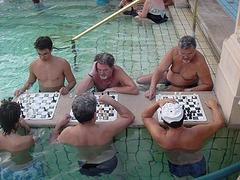
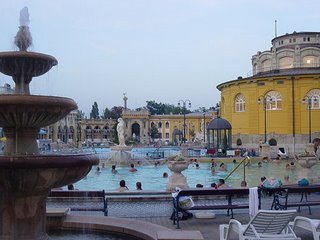
Photos of Szechenyi baths by phnk
Pierre has used his exhibition at the Tate Modern to display the new holidays to the public for the first time.
The day I am most looking forward to is the day celebrating our sense of anticipation. But no date has been set for that yet.
The most enlightening holiday will be the day of rational certainty. On that day we will be enjoined not to cross our fingers or worry about stepping on the cracks in the pavement. The horoscopes won’t be published. Temples, churches and mosques will shut their doors for the day.
The results of the day will be interesting. Can we base our lives solely on things that can be rationally proven? We don’t know what time is, or how many dimensions there are in the universe, or why the universe was created, or why a table feels solid when the atoms that it is made of consist mainly of empty space. We need metaphors, assumptions, beliefs, and maybe even faith, to bridge these gaps.
The day will necessitate a temporary laying aside of the existing public explanations of the nature, purpose, and destiny of the universe. It will thus provide you with a bit of space to come up with your own answers to these questions, whichever answers help you pursue whichever type of life you most want to live.
Julia Cameron in her book The Artist's Way urges anyone wanting to make more use of their own creativity to come up with their own view of why the creator of the universe created it and what that creator is like.
I like to think of the creator of the universe as a being that is not all-knowing, but is instead all-learning: learning from the new things that are happening all over the universe all the time. That learning isn't stored by the creator seperately from the universe, the learning is stored in the universe itself. The universe works to both use some of that learning and to keep on creating new situations for new learning.
The creator of the universe created it because no universe had been created before, and the happiness and beauty it could potentially generate might well be worth the inevitable pain.
Later in the year another Hugyhe holiday will celebrate the future. The curator Hans Ulrich Obrist asked his artist friends to tell him what they think the future is. It is a nice twist, a curator asked to produce a work of art by an artist and doing so by curating the comments of other artists to create an exhibition within an exhibition within an exhibition. All the artists have come up with different little straplines for the future, thus confirming that not only do we not know what the future holds, we don’t even know what the future is.
We at World Flapjack day are a little disappointed that that this French led endeavour has not come up with a day to celebrate any of the wonderful things found in patisseries.
To make up for this omission we are proposing to make July 8 the celebration of ‘unlikely but uplifting combinations’.
On this day evey year people will be enjoined to take the day off to combine different things that they like but don’t normally do at the same time. This is so often a sure fire recipe for happiness in life.
The inspriration for this day came from the Banauchoc: a pain au chocalat with banana in. (you can get them from the Panos bakery on the concourse of Brussels Gare du Midi station).
Some of the things I like doing are: playing chess, having a bath, meeting new people, learning new languages, getting fresh air. In Budapest at the Szechenyi Baths you can stand for hours in an open air thermal bath, play chess with a waterproof chess set and improve your Hungarian.
We at World Flapjack Day support Pierre’s endeavour. and will be celebrating each of these new holidays as they come through the year.


Photos of Szechenyi baths by phnk
Sunday, July 02, 2006
Kick
So England’s world cup quarter final went to a penalty shoot out. The commentators said they wouldn’t wish the experience on anyone. You can tell which players are going to miss by the fear written on their face.
Andrew (aged 7) switched the telly off and ran out of the room when Jamie Carragher missed his retaken penalty. The miss gave Christian Ronaldo the chance to knock England out of the tournament if he scored his penalty for Portugal.
I switched the telly back on in time to see something that impressed me. Ronaldo picked the ball up and kissed it. He was taking time to say that whatever the level of pressure on the moment, he loved playing football. He put the ball down on the spot and then chipped it into a part of the net that no goalkeeper could ever reach.
A triumph of love over fear.
Looking back on it it was inevitable that England would lose. They had played poorly all tournament, the manager had run out of ideas four years ago and only stayed in his job becase it would cost the FA to much money to end his contract. He didn’t seem to be able to adjust to injuries to his first choice strikers.
The only thing keeping England going was the superstitions of fans but even they seemed to have run out by the Quarter final.
Andrew had worn his England wristband, given to him by one of his teachers at school, continuously from the start of the tournament, and told us how it made England win, because his teacher had made it magic. The wristband fell down the toilet three days before the Portugal game.
Andrew (aged 7) switched the telly off and ran out of the room when Jamie Carragher missed his retaken penalty. The miss gave Christian Ronaldo the chance to knock England out of the tournament if he scored his penalty for Portugal.
I switched the telly back on in time to see something that impressed me. Ronaldo picked the ball up and kissed it. He was taking time to say that whatever the level of pressure on the moment, he loved playing football. He put the ball down on the spot and then chipped it into a part of the net that no goalkeeper could ever reach.
A triumph of love over fear.
Looking back on it it was inevitable that England would lose. They had played poorly all tournament, the manager had run out of ideas four years ago and only stayed in his job becase it would cost the FA to much money to end his contract. He didn’t seem to be able to adjust to injuries to his first choice strikers.
The only thing keeping England going was the superstitions of fans but even they seemed to have run out by the Quarter final.
Andrew had worn his England wristband, given to him by one of his teachers at school, continuously from the start of the tournament, and told us how it made England win, because his teacher had made it magic. The wristband fell down the toilet three days before the Portugal game.
Sunday, June 25, 2006
Permanent marker
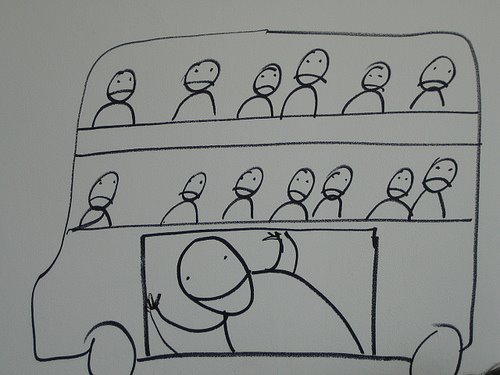
Tate Modern commissioned Dan Perjovschi to draw with permanent marker all over the member's room. I went to see the drawings before, like all permanent markings, they got scrubbed off.
My favourite was the one showing the bus driver and passengers looking glum but the advert on the side of the bus showing someone looking as happy as Larry.
There will come a time when the panels on the side of public transport are simply screens , connected to the internet, which could display any combination of image and message.
But will there come a time when the people on the bus will be able to influence what is expressed on the side of the bus? Or will the image/message always be determined at a distance in time and space from the driver and passengers?
Thursday, June 22, 2006
Reduced to almost nothing
I went to the Big London Brainstorm in Lindsey Street, Smithfield yesterday, where lots of architects have had put forward their ideas for improving our city.
My favourite was the one suggesting that instead of building Renzo Piano's shard of glass, we should build a massive grain of sand. This would serve as a tribute to William Blake, and as a reminder to people that we are present in the universe.
Here is the quote from Blake's Auguries of Innocence:
''To see a world in a grain of sand
And a heaven in a wild flower,
hold infinity in the palm of your hand
And eternity in an hour.''
My favourite was the one suggesting that instead of building Renzo Piano's shard of glass, we should build a massive grain of sand. This would serve as a tribute to William Blake, and as a reminder to people that we are present in the universe.
Here is the quote from Blake's Auguries of Innocence:
''To see a world in a grain of sand
And a heaven in a wild flower,
hold infinity in the palm of your hand
And eternity in an hour.''
Saturday, June 17, 2006
Let’s be
Jorge Luis Borges died 20 years ago this week, aged 87.
At the age of 79 Borges had made the following brave and honest statement in a lecture entitled Immortality:
Borges does not claim to know what will happen after his death. He does not deny that there is a possibility that he might find himself re-incarnated as another being, or that he might find eternal life in heaven. But he is saying that he does not desire either re-incarnation or eternal life.
Later in his lecture Borges describes how some of the things that he has said and done will live on in the words and deeds of people to come. This is the way that Borges does want to live on in the universe: in the same way that Borges himself has kept alive Shakespeare,Dante, his own parents, neighbours and acquaintances by using and remembering their words and deeds.
I hope Borges got his wish. I am not convinced that eternal reincarnation or eternal life for one individual entity is in accordance with the spirit of the universe. The universe seems to be more interested in re-using and re-combining things than in ring- fencing and preserving things. The greatest gift of the creator to this universe is evolution: the fact that life can learn and adapt and new life forms can develop which are novel and different.
Why would the universe need a James Lappin in a million years time? What possible use would ‘I’ be to anything?
Jeff Barry, who lives in Borges’ home city of Buenos Aires, blogged last Wednesday about this same quote, as part of his wonderful series of blog posts called ‘30 days with Borges’. I’ve posted each of the 30 days to a del.icio.us page if you want a quick way of accessing all thirty of them.
At the age of 79 Borges had made the following brave and honest statement in a lecture entitled Immortality:
‘’I don’t want to continue being Jorge Luis Borges: I want to be someone else. I hope that my death will be total: I hope to die in body and soul.’’
Borges does not claim to know what will happen after his death. He does not deny that there is a possibility that he might find himself re-incarnated as another being, or that he might find eternal life in heaven. But he is saying that he does not desire either re-incarnation or eternal life.
Later in his lecture Borges describes how some of the things that he has said and done will live on in the words and deeds of people to come. This is the way that Borges does want to live on in the universe: in the same way that Borges himself has kept alive Shakespeare,Dante, his own parents, neighbours and acquaintances by using and remembering their words and deeds.
I hope Borges got his wish. I am not convinced that eternal reincarnation or eternal life for one individual entity is in accordance with the spirit of the universe. The universe seems to be more interested in re-using and re-combining things than in ring- fencing and preserving things. The greatest gift of the creator to this universe is evolution: the fact that life can learn and adapt and new life forms can develop which are novel and different.
Why would the universe need a James Lappin in a million years time? What possible use would ‘I’ be to anything?
Jeff Barry, who lives in Borges’ home city of Buenos Aires, blogged last Wednesday about this same quote, as part of his wonderful series of blog posts called ‘30 days with Borges’. I’ve posted each of the 30 days to a del.icio.us page if you want a quick way of accessing all thirty of them.
Thursday, June 15, 2006
Uncertainty now
 Photo of me in Blackfriars yesterday. The photographer (Seize the Dave) must have taken it from the top of St Paul's Cathedral.
Jorge Luis Borges came up with a comprehensive classification of all living creatures. He attributed the classification to Dr Franz Kuhn and it was the organisational basis of a Chinese Encyclopedia called the Heavenly Emporium of Benevolant Knowledge.
It has often been held up as an example of the potential absurdities of classification, but I have learned something quite profound about my appearance from it: I look like a fly from a distance
Here is the classification in full:
a) those [animals] that belong to the emporer
b) embalmed ones
c) those that are trained
d) suckling pigs
e) mermaids
f) fabulous ones
g) stray dogs
h) those that are included in the classification
i) those that tremble as if they were mad
j) innumerable ones
k) those drawn with a very fine camel’s hair brush
l) etcetera
m) those that have just broken the flower vase
n) those that at a distance resemble flies
I must look like a fly from a distance, it is the only category I fit into. Continually breaking flower vases is not a viable option socially or financially.
Most people seem not to notice, either because they are standing to close, or because their eye is tricked by a curious effect of an uncertainty principle which is caused by the following:
- When I look like a fly from a distance I am included in the classification, and therefore must move from category n) to category h).
- As soon as I join category h) there is no necessity for me to look like a fly from a distance
- As soon as I stop looking like a fly from a distance I am no longer in the scope and therefore, need to look like a fly again (from a distance).
This Uncertainty principle can be stated something like:
- You can determine precisely the position of a living creature within Borges’s classification, and you can determine whether or not it looks like a fly from a distance, but you can not determine both things at the same moment in time.
It just shows how much effort is required to fit into someone else's world view
Sunday, June 11, 2006
Possibilities
 Photo: Forth bridge by Aesop
There are an infinite number of parallel lines on the same plane. They reach backwards to infinity and forwards to infinity and are destined never to touch each other.
Along the path of each infinite line there are an infinite number of points. At each of these points the line is crossed by an infinite number of other lines, coming from different angles on the same plane; or from different planes; or from the past or the future.
Each one of these lines has something in common with the creator of the universe (as described in many of the great spiritual traditions): it has no beginning and no end in either space or time.
Thus the creator of the universe was never lonely, never bored with the emptiness. There always was an infinite number of infinite lines, but a creative spark was needed to make something finite out of them, something that wouldn’t last for ever, and could grow into anything.
After 29 years in Weybridge (Surrey, England) my mum and dad are settled back in Dalgety Bay (Fife, Scotland), where they spent their first decade of married life, and where me and my sister were born. I was so pleased to hear both of them sound so happy when they rang me on Friday.
Hats off to my mum for masterminded the move. Douglas Adams said that it was a good idea to redefine yourself at least once after you reached the age of 50. He did it by moving from England to Los Angeles. My mum has done it twice.
After retiring from teaching twelve years ago she took up embroidery. She found a creative streak noone knew she had and produced really lovely work based on patterns in things that inspired her, the gradual decay of old walls, the canal, rooftops of a Japanese town.
Then she started producing work based on motifs from the Forth bidge: everything from wall hangings to a toilet roll holder.
That is the great thing about doing anything creative, and about expressing your creativity: it’s such a good way of honing in on what you really love in life, like diving rods for water.
They can see the Forth bridge from their new home.
Friday, June 09, 2006
One zag
Can you have a zag without a zig?
Is there a word for a word which sounds like the letter that the concept it represents looks like?
Do geometry professors use the word zigzag? Or is it just a lay term?
Does the zig zag count as a shape or is it just a pattern? What if someone drew a zig zag line that went round in a circle and joined up with the start of the zig zag line again. Would that count as a shape? Would it be a zigzag shape or a circle?
Did Euclid have anything to say about zig ags?
What do languages without the letter ‘z’ in their script call zigzags?
Does the word ‘zigzag’ have anything to do with the word ‘ziggurat’ or do they just sound the same.
Good luck to people leaving England on great adventures today:
Is there a word for a word which sounds like the letter that the concept it represents looks like?
Do geometry professors use the word zigzag? Or is it just a lay term?
Does the zig zag count as a shape or is it just a pattern? What if someone drew a zig zag line that went round in a circle and joined up with the start of the zig zag line again. Would that count as a shape? Would it be a zigzag shape or a circle?
Did Euclid have anything to say about zig ags?
What do languages without the letter ‘z’ in their script call zigzags?
Does the word ‘zigzag’ have anything to do with the word ‘ziggurat’ or do they just sound the same.
Good luck to people leaving England on great adventures today:
- Val heading south to the world cup in a van
- Mum and dad heading north to their new home in Dalgety Bay
Wednesday, June 07, 2006
Reflection
This is a mirror.
You are a written sentence
Luis Camnitzer issued the above statement as a work of art in 1966: one of nine statements on sticky labels that he sent out by post.
In Chronology Camnitzer explains why he had stopped making pictures and prints and started producing these statements. He had been looking for ways in which his art could escape from the trap that once someone bought the art object it was lost to the rest of the world.
He discovered the answer staring out at him from his local newstand. He states:
The ideal was the newspaper headline: a simple reading allowed appropriation which then unleashed imagery within the viewer. Material possession of art would lose its meaning since possession would take place through reading
I love this quote about the later development of his art:
I discovered (1971) that if I made a minimal mark on a piece of paper, I irrevocably altered the order of the universe. Any new order would have to include my mark. My action conditioned any new definition of order. Thus, to change the universe wasn't that difficult and anybody could do it. It was more difficult to convince the art market of the fact that the alteration had taken place.
Thank you to the Lehman College Art Gallery for making the full catalogue of their Camnitzer retrospective available online, including articles by and about Camnitzer.
Saturday, June 03, 2006
242

I took the 242 bus to Shoreditch to see ‘Some pictures and a song’ – Claire Harvey’s installation at Store.
I was tempted up Hoxton Street having read that the installation includes drawings of people on scotch tape, stuck onto the walls. I imagined the walls plastered with hundreds of these figures, like the end of a brainstorming workshop gone mad.
It is more restrained than I'd anticipated: the sticky tape people are confined to a small area of one wall, over in the corner, by the front window of the gallery. Each drawing is made on two pieces of sticky tape: one for the person, one for their shadow.
They are a loose collection of people, walking away from me; detached from me; detached from each other; detached from the ground on which their shadow would have been cast; and as the title of the piece acknowledges, easily detached from the wall.
On the other side of the window I was aware of the occassional passer by walking down Hoxton Street to the college next door and the little shops.
The installation really came to life when I took up the invitation on the record player to play the 7inch single that sat on the turntable.
I heard Harvey sing a wistful song about a fly who fell victim to her botched attempt to save it after it had flown into her studio and got stuck on some oil paint on one of her paintings that had not yet dried.
As I listened I looked around the gallery: bare wooden floor, some oil paintings on the wall, Hoxton outside.
The paintings on the wall are neither large nor bright. The colours used are greyish blue and white. Some of the paintings show people on the edge of the land and the sea, alone but not lonely, absorbed in what they are doing.
One shows a close up painting of a person’s face, smelling a cheese, what is he thinking as he inhales? The next painting pans back, and shows all of the cheese smeller, it’s a young man. The title of the picture (cheese counter) betrays the fact that he is in a supermarket, but the hazy blue/white/ grey way the cheese counter is painted makes it looks as though he too could be on the edge of land and sea.
The installation took me right back to student days . Maybe because the room was bare, or because it was a record not a CD player, or because no-one in the installation was in a rush, or wearing a suit (unless you count me standing there with my rucksack on my back), or doing anything particularly demanding.
The lady at the gallery said to me ‘its like slipping back into a familiar memory of something that never actually happened to you, just like the fly story may never have happened’.
(The exhibition is running until 1 July 06: read Russell Herron's account of the private view)
Wednesday, May 31, 2006
Do you remember an exhibition in a car?
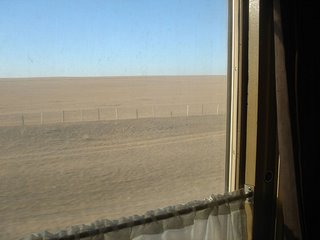 Mongolia
The curator of en route via another route commandeered a car of the Trans Siberian express train to Beijing. It left Moscow on September 12 2005, the day that England drew the fifth test to win back the ashes.
I would have loved to have been on that train:
• To have read out, live on Trans Siberian Radio, a Russian translation of Keith Arnatt’s ‘Is it possible for me to do nothing as my contribution to this exhibition?’
• To have released some balloons and watch them float into the big skies of the steppe bearing the slogan ‘all that is solid melts into air’
• To have sat in the dining car , seen the abandoned dinner on the table, and read Gabriel Kuri’s note in Russian explaining that the person who had purchased it had left in a hurry. To find out how many countries the train would have to pass through, and how many translations of the note would have to be made, before anyone took up the invitation to eat the dinner.
Well worth missing the cricket for!
Were you there? Did you enjoy it? Did anyone eat that dinner?
Friday, May 26, 2006
Nothing
In 1970 Keith Arnatt produced a work of art entitled
‘Is it Possible for Me to Do Nothing as My Contribution to this Exhibition?’
The work consisted of a written statement in which he explored several different ways of doing nothing as a contribution to an exhibition.
All the ways of doing nothing that he identified, actually involved doing something. Even if that something was as simple as:
- putting forward the idea ' I have done nothing' as a contribution to the exhbition
- requesting some space within the exhibition in which 'to do nothing'
- making the statement 'I will do nothing' and sticking to it for the duration of the exhibition
Arnatt was using conceptual art (art using ideas and language) to show the limits of conceptual art.
Lawrence Weiner made a famous statement about conceptual art to say that:
An artist can come up with an intention for a work of art and then:
• Might make it themselves
• Might get someone else to make it
• Might decide not to make the intention into a physical reality at all
Either way in Weiner’s view you still have a work of art that can be distributed, received and owned.
Arnatt has come up with an intention for a work of art that can not be made by the artist or by anyone else, and the intention of which can not be communicated by the artist to anyone else.
(I haven't been able to find the text of Arnatt's work on the web, but it is reprinted in full in the book 'Six Years' by Lucy Lippard.)
Wednesday, May 24, 2006
Things on walls
 Photo by ebmorse of 'The Wall that Went for a Walk' at Stormking USA
Andy Goldsworthy builds walls that have renounced their mission, forgotten the boundary line that they were supposed to demarcate, and gone for a walk. They wind their way around and between trees, up and down hills, and into and out of ponds.
Last year part of ‘The Wall that Went for a Walk’ at Grizedale Forest in the Lake District got blown down by the wind.
This month ‘s Art Monthly reports that Goldsworthy declined the Forestry Commission’s offer to repair the wall. Goldsworthy said that:
‘I knew that change would continue after the making of The Wall and that I could not dictate or determine what that change would be’
The writer and physisist David Bohm identified the tendency of us human beings to defend our thoughts and opinions, to take up fixed positions. Bohm wrote:
we often find that we cannot easily give up the tendency to hold rigidly to patterns of thought built up over a long time. This kind of thought leaves no room at all intellectually for any other possibility
Goldsworthy has resisted the temptation to attempt to defend his wall, and recognised that no fixed state is sustainable over time.
Even if the Forestry Commission fixed it this time, for how long would they keep repairing it: 30 years, 100 years?
The act of repairing the wall would have seen the wall take back its mission as a wall again, holding back nature and holding back time. The wall that went for a walk doesn’t hold back anything.
Friday, May 19, 2006
Post-global art
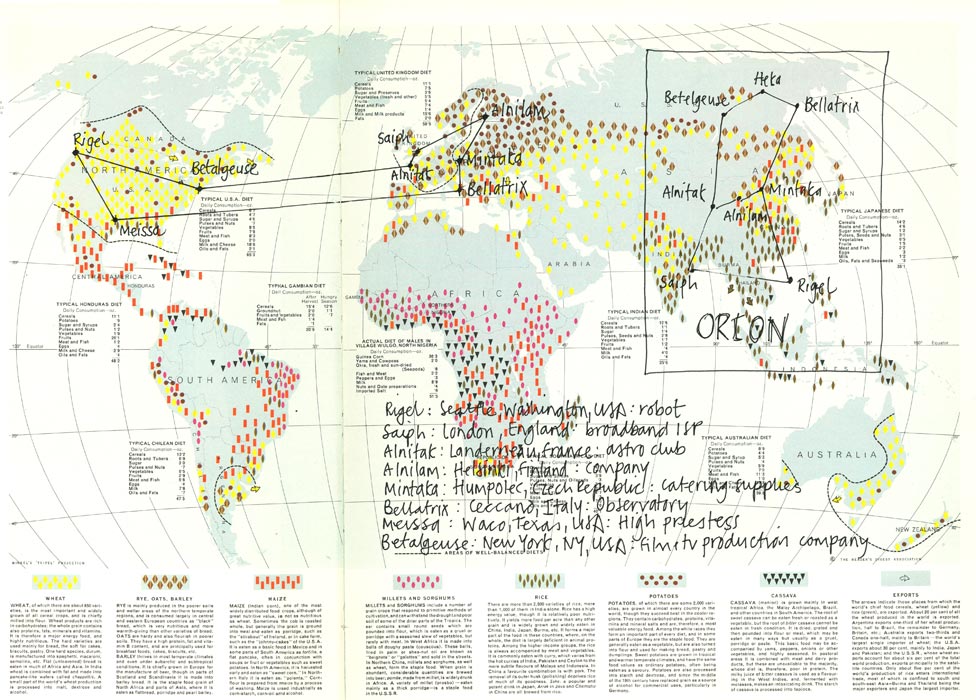
Jem Finer has meshed together the three spheres of the world wide web, the night sky and the earth.
He has found a website for every star : a website that names someone, somewhere or something on earth that shares or contains the name of the star.
You can find the links to these websites in 'On earth as it is in heaven', which provides access via his old readers digest atlas to a set of world maps: one global double page spread per constellation.
Each star in the consellation is plotted onto the atlas at the point of the earth where the person/thing/place that shares its name is located. Click on the star and the link takes you to the website that identified it. All the stars joined up by lines which make a new earthly shape for the constellation.
The picture above is the map for the constellation Orion . I was hoping that Jem would have found something about Betalgeuse in Guildford (where Arthur Dent thought that Ford Prefect came from). But instead the point is situated in New York, home of the Betalgeuse film and TV production company.
Stars, earthly towns and cities, websites, : lasting for billions of years, hundreds of years, years. When we come to map them we only have our human recognition of shape, our shared myths, and our understanding of words with which to map them with.
We have nothing anywhere near as potent and user friendly as the constellations with which to navigate our way around the world wide web.
Tuesday, May 16, 2006
Blank (700)
Making up a story for children is more fun than reading from a book.
Leaving some words blank for the kids to fill in is more fun than making up the whole story yourself.
Last night’s story went like this:
The blanks filled in by Andrew and Anna were:
1 children, 2 crater, 3 blanket, 4 lettuce, 5 sofa, 6 cucumber.
The last delivery rocket to the moon had been filled half with lettuce and half with cucumber.
There was no cucumber left after making the sofa so the family have been eating lettuce salad for the past seven weeks .
They have all been tempted to pick at the sofa to get some cucumber to liven up the lettuce salad. But so far they have managed to restrain themselves.
They next delivery rocket is scheduled to reach the moon at bedtime tonight. It is going to bring them (blank) and (blank).
Leaving some words blank for the kids to fill in is more fun than making up the whole story yourself.
Last night’s story went like this:
Two (blank) lived on the moon. Their house was on the edge of a (blank). In their bedroom was an enormous (blank) made out of (blank). In their living room was an enormous (blank) made out of (blank).
The blanks filled in by Andrew and Anna were:
1 children, 2 crater, 3 blanket, 4 lettuce, 5 sofa, 6 cucumber.
The last delivery rocket to the moon had been filled half with lettuce and half with cucumber.
There was no cucumber left after making the sofa so the family have been eating lettuce salad for the past seven weeks .
They have all been tempted to pick at the sofa to get some cucumber to liven up the lettuce salad. But so far they have managed to restrain themselves.
They next delivery rocket is scheduled to reach the moon at bedtime tonight. It is going to bring them (blank) and (blank).
Monday, May 15, 2006
The impossibility of choosing (433)
One week last summer I ran training courses in Glasgow and Manchester.
On the Tuesday night I was sitting out in George’s square, enjoying the Glasgow jazz festival, and wondering why I hadn’t followed the Scot in me and gone to University there when I was 18.
On the Wednesday night I was walking into Manchester’s Cornerhouse centre wondering why I hadn’t stayed followed the Smiths fan in me and gone to University there when I was 18.
It struck me that the two regrets were contradictory.
Some versions of quantum theory hold that for every choice you have made, the alternative paths that you didn’t take are followed by another you in a parallel universe.
Other theories state that if our universe is infinite in scope and duration then somewhere else in our universe, on a planet just like ours, another person just like you has taken/is taking/will take all the different paths that you chose not to take.
The ‘mis-guide to anywhere’ gives the following advice:
On the Tuesday night I was sitting out in George’s square, enjoying the Glasgow jazz festival, and wondering why I hadn’t followed the Scot in me and gone to University there when I was 18.
On the Wednesday night I was walking into Manchester’s Cornerhouse centre wondering why I hadn’t stayed followed the Smiths fan in me and gone to University there when I was 18.
It struck me that the two regrets were contradictory.
Some versions of quantum theory hold that for every choice you have made, the alternative paths that you didn’t take are followed by another you in a parallel universe.
Other theories state that if our universe is infinite in scope and duration then somewhere else in our universe, on a planet just like ours, another person just like you has taken/is taking/will take all the different paths that you chose not to take.
The ‘mis-guide to anywhere’ gives the following advice:
‘’in a place that is new to you, dream that you live there. Go on a quest to find this other self. Find the place you live; the place you work; the routes you take to see your family; the places where your friends hang out; your favourite places to eat or read or daydream; the places of crisis in this other life; the points of meeting and departure; the places of grief; the places of joy; the place where you can get the best plain pillowcase; the places where you can pick fruit from the trees; the place where you can get funny cards with the message spelled wrong; the places where your children might be born and the place where you might die. Live this other life for a day’’
Wednesday, May 10, 2006
Nostalgia (253)
Donskibeat has uploaded onto You Tube a film called Morrissey - Charlie's bus.
It shows Morrissey and Jonny Marr in 1984, taking a group of young school kids on an open topped bus to a sunny Kew Gardens, where they meet Sandie Shaw. They find a nice place to sit and listen to Sandie sing 'Jeanne' while Jonny played guitar.
I love the contrast between the sun shining on an idyllic setting, and all the kids enjoying themselves, having an ice cream, and Sandie Shaw singing the saddest of all the Smiths songs
It shows Morrissey and Jonny Marr in 1984, taking a group of young school kids on an open topped bus to a sunny Kew Gardens, where they meet Sandie Shaw. They find a nice place to sit and listen to Sandie sing 'Jeanne' while Jonny played guitar.
I love the contrast between the sun shining on an idyllic setting, and all the kids enjoying themselves, having an ice cream, and Sandie Shaw singing the saddest of all the Smiths songs
'Jeanne, I don't know what happiness means, but I've looked in your eyes, and its not there'set in the bleakest description of late 70s Manchester
'Jeanne, there is ice in the sink where we bathe, how can you call this a home,when you know its a grave?'
Subscribe to:
Posts (Atom)