One of the advantages of being 37 over, say, 24 is that I am the right age to have see The Smiths live. When I tell a fellow smiths fan that i saw them six times it is normally met with a deep heartfelt sigh. I dont like engendering regret in others, not after i have devoted all that time reading self help books on how to banish it from my own life (time i sometimes think could have been better spent.....)
Now i have an answer: If you loved the smiths and never saw them live, then go and see the Smyths. They do the songs justice. What more can we ask?
It is like when you support a big football team that all of a sudden goes bust.
A new team starts up, adapting the name slightly, in a much lower league. The devotees turn up, the spirit is the same, you can get much closer to the pitch and you can speak to the players after the game.
They played at the The Grey horse in kingston which is just down the road from us. Some fans of theirs had come from Edgware, another from Epping (I didnt envy their journeys back across town).
I was paranoid that we would be locked out from the surge of smiths fans descending to see them (as far as i know mozzer and the boys never came this way). So we got there at half eight. Tania and lynn got fed up standing around waiting and watching the new order tribute (who weren't bad) so they went off to see Tom do his stuff at the Willoughby, where they could sit down in comfort. I'd waited ninteteen years, ten months and twenty seven days to hear these songs performed live, another hour wasn't going to make any difference.
While i was waiting for them to come on i met natalie and lee who said the first song they danced to at their wedding was a smiths song (There is a light). Apparently the other guests had stood around a bit bemused. They run the Old Kings Head in hampton wick. They have tribute bands on at their pub too, they will have a tribute band to the Clash on soon (the Trash)
The Smyths came on and they started off with a barrage of songs from Hatful of Hollow which is the heart and soul of the The Smiths canon. Hand in glove, What difference does it make?. Singer says ''i think some of you might know this song': This charming man: everyone goes bolly.(What is bolly short for? I hope its nothing offensive).
They had flowers at the front, Natalie sniffed at them 'there not gladioli, I made my mum get gladioli for our wedding'. Oh what the hell. They were on the front of the stage, we passed them to each other, waved them around, danced with them, threw them over our shoulders. All of us at the front danced to every song, sang ever word, ended up arm in arm swaying to There is a light and then going bolly again to Big mouth strikes again. A great night.
[The Smiths]
[The Smyths]
Saturday, September 23, 2006

Friday, September 22, 2006
If only
I've told my colleagues that I am going to see the The Smyths tonight (it sounded more impressive than it reads).
Thursday, September 14, 2006
Air
Tania got the personal development books that I've accumulated over the years, and put them together in one shelf, asking jokingly 'what does this say about you James?'
I like the way personal development books talk to me. You are human they say, you are uniquely valuable, it has taken the universe billions of years to create you, your body contains elements forged in the furnaces of distant and long gone stars, you are a part of the universe looking out at the universe, your ancestors, whovever they were, have survived and sometimes prospered in many different landscapes and circumstances. So long as you are striving towards your dreams you are not a failure. The universe that made you is on your side.
Recently I read 'A Heartbreaking Work of Staggering Genius' by Dave Eggers. It is not a personal development book. It is Dave Eggers writing his autobiograhy, but writing it as though it was a novel. It relates how both his parents died within a month of each other when Eggers was 21, leaving him with his kid brother (Toph, aged 7) to bring up.
His response to the cloying gravity of the double tragedy was to sell the suburban Chicago house and rocket off with Toph to sunny San Francisco. He describes bringing Toph up, how he read him John Hersey's 'Hiroshima' as his bed time story, how they evaluated flats to live in by how long an area of hall way they had for sliding along on their socks, how Eggers hoped to strike lucky with single mums at parents evenings at Toph's school.
He reaplays the thoughts that streamed through his heads at the momentous moments like when his mums nose wouldn't stop bleeding in the advanced stages of her cancer or when he is scattering her ashes into a local lake. His thoughts try to match the gravity of the situation but keep getting pulled back to prosaic matters like whether or not to switch the telly off or whether his feet are going to slip into the lake.
At the unmomentous moments his thoughts get pulled in the other direction. He is on the beech playing frisbee with Toph. Toph has perfected some show off moves, like lying on his tummy just as the frisbee is coming down and then jumping up and catching it. Eggers proudly describing how dumb these moves are, and the writing/thoughts flick from the frisbee throwing to the last breaths of his mother and back again.
Eggers expresses the same thoughts as the personal development books, but harshly, with the gloves off.
A TV company employee interviewed him after he applied to appear on her reality TV programme. She questioned whether he was an exhibitionist, willing to live in a televised house for two months, talking on tv about the tragedy of his family. Eggers replied:
''Someone wants to celebrate their existence and you call it exhibitionism. Its niggardly. If you don't want anyone to know about your existence you might as well kill yourself, your taking up space, air.''
I like the way personal development books talk to me. You are human they say, you are uniquely valuable, it has taken the universe billions of years to create you, your body contains elements forged in the furnaces of distant and long gone stars, you are a part of the universe looking out at the universe, your ancestors, whovever they were, have survived and sometimes prospered in many different landscapes and circumstances. So long as you are striving towards your dreams you are not a failure. The universe that made you is on your side.
Recently I read 'A Heartbreaking Work of Staggering Genius' by Dave Eggers. It is not a personal development book. It is Dave Eggers writing his autobiograhy, but writing it as though it was a novel. It relates how both his parents died within a month of each other when Eggers was 21, leaving him with his kid brother (Toph, aged 7) to bring up.
His response to the cloying gravity of the double tragedy was to sell the suburban Chicago house and rocket off with Toph to sunny San Francisco. He describes bringing Toph up, how he read him John Hersey's 'Hiroshima' as his bed time story, how they evaluated flats to live in by how long an area of hall way they had for sliding along on their socks, how Eggers hoped to strike lucky with single mums at parents evenings at Toph's school.
He reaplays the thoughts that streamed through his heads at the momentous moments like when his mums nose wouldn't stop bleeding in the advanced stages of her cancer or when he is scattering her ashes into a local lake. His thoughts try to match the gravity of the situation but keep getting pulled back to prosaic matters like whether or not to switch the telly off or whether his feet are going to slip into the lake.
At the unmomentous moments his thoughts get pulled in the other direction. He is on the beech playing frisbee with Toph. Toph has perfected some show off moves, like lying on his tummy just as the frisbee is coming down and then jumping up and catching it. Eggers proudly describing how dumb these moves are, and the writing/thoughts flick from the frisbee throwing to the last breaths of his mother and back again.
Eggers expresses the same thoughts as the personal development books, but harshly, with the gloves off.
A TV company employee interviewed him after he applied to appear on her reality TV programme. She questioned whether he was an exhibitionist, willing to live in a televised house for two months, talking on tv about the tragedy of his family. Eggers replied:
''Someone wants to celebrate their existence and you call it exhibitionism. Its niggardly. If you don't want anyone to know about your existence you might as well kill yourself, your taking up space, air.''
Wednesday, September 06, 2006
Festive logic
Last December Andrew (then aged 6) was round at Tania's mums house.
He was misbehaving.
The following exchange took place:
Gran (annoyed): "stop that, or I'll get the elves and the fairies to tell santa not to bring you what you want for christmas"
Andrew (puzzled): "but how could they grandma? I don't know what I want for christmas."
He was misbehaving.
The following exchange took place:
Gran (annoyed): "stop that, or I'll get the elves and the fairies to tell santa not to bring you what you want for christmas"
Andrew (puzzled): "but how could they grandma? I don't know what I want for christmas."
Friday, September 01, 2006
Is the universe telling us where to go?
Whilst on holiday in the Isle of Wight this Easter we went to Tescos, and could not find any local produce in the store. It was almost identical to Tescos in New Malden (which, fortunately, does not stock local produce either: my father in law's allotment couldn't cope). Inside Tescos the differences between an agricultural island and a concrete south west london suburb are flattened.
Globalisation offers a total disregard for where we are on earth and cuts all connections with place and with history. Is this subliminaly preparing us to make the break with earth? Preparing us for a day when humanity packs its Tesco bags with a few momentoes of our birth planet and takes itself off to a different home somewhere else in the solar system or the galaxy?
John Gray doesn't think we will ever get off the planet. He does not believe that we inexorably make progress towards higher and better knowledge. In Straw Dogs: thoughts on humans and other animals he tells us technology is not something that human beings control. Human beings will never be able to use their knowledge and technology to become master of their fate.
Human beings bring technology into the world, but once it is in the world it becomes another thing we interact with. And our interactions with it are shaped by the same power sruggles, economic forces, big business interests, organised crime interests, emotions and desires as is human interaction with anything else.
Gray talks about the folly of those plants set up to freeze people until such time as the technology comes along to bring humans back to life and to extend human life. The freezing plants will fall victim to economic collapse, revolution or war long before the life restoring/extending technology comes on stream.
Gray believes that the surge in human population is unsustainable for the earth's ecostystem. Human beings will live for a time in a distorted envrionment, geared to sustaining the unstustainable as long as possible, with less and less animal and plant species keeping us company. The rise in human numbers will start to plateau off, and then reverse as a result of war,disease, resource scarcity and/or climate change. The progress in knowledge and technology will become a double edged sword as weapons of mass destruction become more easily replicable. Wars of resources (for water, for oil, for land) become more virulent as the resources become scarcer.
His message is not entirely pessimistic. Human beings are not stronger than the earth's ecostystem and whatever we do we will not be able to destroy life on earth. The earth will survive us, and then forget about us. The growth of human numbers is a plague that earth will deal with and climate change may just be the method that the earth will use to shrug off its human burden.
Gray's work has helped me come up with an answer to that rather tricky question:
Maybe those life-forms that have survived long enough to contemplate space travel have lived in balance with their eco-system and not felt the need to indulge in any inter-stellar tourism or colonialism.
On earth those parts of the human race that have lived in balance with the environment have tended to be wiped out by more rapacious colonists who have developed powerful weapons to support their aggressive inclinations. So how could the universe ptotect planets with diverse and sustainable eco-systems from attack by an aggressive species who have used their own eco-system as a springboard to conquer others?
The best way for the universe to protect sustainable eco-systems would be to get the home planet of the aggressive species to reject them before they developed the power to pollute other parts of the universe.
Globalisation offers a total disregard for where we are on earth and cuts all connections with place and with history. Is this subliminaly preparing us to make the break with earth? Preparing us for a day when humanity packs its Tesco bags with a few momentoes of our birth planet and takes itself off to a different home somewhere else in the solar system or the galaxy?
John Gray doesn't think we will ever get off the planet. He does not believe that we inexorably make progress towards higher and better knowledge. In Straw Dogs: thoughts on humans and other animals he tells us technology is not something that human beings control. Human beings will never be able to use their knowledge and technology to become master of their fate.
Human beings bring technology into the world, but once it is in the world it becomes another thing we interact with. And our interactions with it are shaped by the same power sruggles, economic forces, big business interests, organised crime interests, emotions and desires as is human interaction with anything else.
Gray talks about the folly of those plants set up to freeze people until such time as the technology comes along to bring humans back to life and to extend human life. The freezing plants will fall victim to economic collapse, revolution or war long before the life restoring/extending technology comes on stream.
Gray believes that the surge in human population is unsustainable for the earth's ecostystem. Human beings will live for a time in a distorted envrionment, geared to sustaining the unstustainable as long as possible, with less and less animal and plant species keeping us company. The rise in human numbers will start to plateau off, and then reverse as a result of war,disease, resource scarcity and/or climate change. The progress in knowledge and technology will become a double edged sword as weapons of mass destruction become more easily replicable. Wars of resources (for water, for oil, for land) become more virulent as the resources become scarcer.
His message is not entirely pessimistic. Human beings are not stronger than the earth's ecostystem and whatever we do we will not be able to destroy life on earth. The earth will survive us, and then forget about us. The growth of human numbers is a plague that earth will deal with and climate change may just be the method that the earth will use to shrug off its human burden.
Gray's work has helped me come up with an answer to that rather tricky question:
If there are is intelligent life on other planets near other stars, why haven't they come and found us on earth?
Maybe those life-forms that have survived long enough to contemplate space travel have lived in balance with their eco-system and not felt the need to indulge in any inter-stellar tourism or colonialism.
On earth those parts of the human race that have lived in balance with the environment have tended to be wiped out by more rapacious colonists who have developed powerful weapons to support their aggressive inclinations. So how could the universe ptotect planets with diverse and sustainable eco-systems from attack by an aggressive species who have used their own eco-system as a springboard to conquer others?
The best way for the universe to protect sustainable eco-systems would be to get the home planet of the aggressive species to reject them before they developed the power to pollute other parts of the universe.
Monday, August 28, 2006
Sixteen again
This year is the twentieth-first anniversary of me being 16.
To celebrate I have renewed the Fulham season ticket I last had for the 1984/85 season, and started to wear my old Smiths T-shirts again.
On Friday Tania and I went to see Tom who plays his guitar under the name Boss Hog every Friday night in the Willoughby Arms in Kingston. Its a friendly old style pub, where the landlord has been there for exactly twelve years and says goodbye to you as you leave.
Tom played old songs by Billy Bragg, Jam, the Clash, The Cure. He sings them well, you can hear the words and he does them justice. At his best with 'Thats Entertainment', 'Say hello wave goodbye', 'Boys don't Cry' and 'Fairy tale from New York'.
Tom is a big Billy Bragg (and Fulham) fan. I told him at the interval that when I was sixteen I had done a deal with my sister: she could play Billy Bragg and I would play the Smiths. Like Spain and Portugal in the Renaissance dividing up the New World with the blessing of the Pope. I was the older brother, so like Spain I think I got the best of the deal (though history tells us that the Portugese part of the new world has won more world cups than the Spanish parts). In the gig Tom played the intro to 'Heaven Knows I'm Miserable Now' then stopped and told me I should have chosen Billy Bragg, because its easier to play on guitar.
In 184-85 I sat with my dad in Block C, row C of the Stevenage Road stand at Craven Cottage. The oldest football stand in London. A listed building. I dont think there were many other season ticket holders that year, I dont remember anyone who sat round us, they must have changed every game. Block C was great, half way towards the Hammersmith End, the goal Fulham usually shoot to in the second half. Row C was three rows back from the Enclosure, where people stood up. You could hear the banter from the Enclosure while enjoying the view from the seat. If you went with some friends you just forgot about the seat and went to stand up on the Enclosure. Average home gate that season must have been 6,500.
A lot has happened to Fulham since 1985. First the chairman Ernie Clay sold off the first team as part of his plan to kill the club and chuck the carcass to a property developer. He made his millions, and Craven Cottage was saved only by a collapse in the UK property market. Then ten years of slowly sinking down the divisions. By 1994 Fulham were in the bottom division, under the chairmanship of the cringeworthy Jimmy Hill. No money. The players had to eat sandwiches on the way home from away games as an economy measure, the coach wouldn't even stop at a fish and chip shop shop for them. The ground looking a bit dilapidated. The top of the Eric Miller stand spelt out a message to the world 'F LHA ' in big letters (wouldn't have liked to have been standing on the touchline when the U and the M fell off).
Then the wheel started to turn, Mickey Adams cobbled a team together out of nothing, on nothing, wins an unlikely promotion and the club attracted the friendly interest of Mohammed Al Fayed. Inexorable rise to the top division with plenty of good football with a gallic twist played along the way, some of it seen by me, an occassional visitor popping back to an old friend.
So here we are at the start of 2006/07. Not all that much cash compared to many in the rest of the Premiership (would have been nice to have had enough to have bought Emile Heskey). Our star midfielder Malbranque won't play for us again. Needing to work hard to keep the wheel rolling forward, to stop it rolling back.
You hear lots of conversations when you go to a football match. When people talked about our first game of the season (away at Man Utd) you always heard the word 'shambles'. When people spoke of Wednesday's game with Bolton you heard the word 'poor'. True you would have come across the same words if you had read a newspaper, but the journalists added another word, not to be spoken of, beginning with 'r' and ending in you being sent to Coventry and Southend and loosing millions of pounds.
You pass a second hand bookshop as you start walking from Putney Bridge station to Craven Cottage. In 1984/85 it was always shut on matchdays cos the owner coached a team on a Saturday. For the last ten years it has been open on matchdays: the bookseller got disullusioned with coaching 'couldnt stop my players from cheating' he said. On Saturday we met a Sheff United fan, Jim, looking at the books outside it. He had a thoughtful air, which could have been induced by the weighty tomes he was looking at, or by the fact that as he later told me, he was meeting his priest at the match, who in turn was going to work in Peru for three years.
I put the thoughtfulness down to the fact that Sheff United were, like us, facing a real test. Their first two games in the premiership had been against Liverpool and Tottenham, games they would expect to lose. This was the type of game they needed to get something from if they are going to avoid that 'r' word.
I told Jim, as I always tell every person I have met from Sheffield, that my sister lives in that City. He asked me whether Chris Coleman will still be manager of Fulham by Christmas, and told me that Fulham have not yet seen the best of Micheal Brown, who had been brilliant for Sheff U.
At the ground. We are in block CL, in the seats they have put over the old Enclosure, just underneath Block C where I used to sit. And on our seats is a T-shirt each with a picture of Jonny Haynes on it, a black and white picture ofthe black and white hero of the 1960s, to celebrate the fact that the Stevenage Road stand has been renamed after him. It is only us in the Johnny Haynes stand that get the T-shirt, we feel special, we know the rest of the ground wants one too. (The one on Andrew's seat is a junior size T-shirt, they must have put junior ones on the seats with kids season tickets)
So our second game in a week, our second game in our seats. All the people around us are the same people from Wednesday, we are safely cocooned within loyal season ticket holders. United start off better than Fulham: they are behind our defence in the first minute but our keeper Niemi catches it off the head of that big handful of a striker Rob Hulse.
Later the ball got booted into our block of the stand. A big bloke leaps up like David Seamen in his pomp to parry the ball and squashes his neighbour as he lands. The lady next to us turns to me and said 'not your turn this time'(referring to my catch of the ball on Wednesday) and asks whether I saw myself on telly . I had to confess that nobody had stopped me in the street.
Fulham start playing a bit after twenty minutes. Collins John (young, big, fast, still with a lot to learn) spun and hit the post. Jimmy Bullard had some shots. The sun came out after half an hour, it was shining right at us, and was being reflected from the floodlights. Two bright for Andrew, he couldnt look at the game. So we left our cocoon and went down behind the stand to buy a Fulham cap. While we were away Fulham scored. When we got back a fellow behind us tapped me on the shoulder to tell us how good Bullard's free kick was.
Second half. Fulham take a stanglehold on the midfield. we are down fairly low down, close to the action, Liam Rosenior rampages down the touchline near us. In 1985 we were watching his dad, Leroy, a great header of the ball, strong and powerful centre forward with a mild temprement. He later went to West Ham and famously scored a hat trick that got Chelsea relegated one year.
Tomas Radzinski comes on, looks like he is carrying a bit of weight. He was through on goal, he could see the whites of the goalkeeper's eyes but choses to pass instead. He is obviously short of confidence, Bullard almost saves his embarrasment by picking up the loose ball and cracking it against the post. Later Brian McBride surged through, underneath us again,this time their keeper managed to get a foot on it.
The three minutes of added time were a bit nervy, because all of a sudden Fulham pulled everyone back surrendering the ball to United. They had a couple of situations but we got the three points we deserved.
So the gloom has been lifted, at least for now, The midfield was solid and dominant, Bouba Diop was winning balls and playing neat passes, Jimmy Bullard was everywhere and did everything, Michael Brown passed well. Louis Boa Morte still hasnt found his touch yet though. Our central defence was solid, Philipe Christianval read things well and kept it simple. Lots of our threat came down the right from Liam Rosenior's forward runs. Just need one of our strikers to pick up confidence and start scoring goals.
So the walk back to Bishops Park, next to the Thames, tidal at Putney. One lad commented with suprise how much water there was in the Thames when there was virtually nothing there on Wednesday: could have been a metaphor for Fulham's week.
Talking of metaphors I read this joke in John T Barrow's book on infinity:
Question: what did the mystic say to the hamburger salesman?
Answer: 'make me one with everything'
At the end of the park we saw Jim from Sheffield again. He looked disappointed. He said we deserved our win, I wished him luck for their next home game (with Blackburn). Our next home game isn't till September 23, against our local rivals.
Will Chris Coleman still be Fulham manager at Christmas? I hope so.
To celebrate I have renewed the Fulham season ticket I last had for the 1984/85 season, and started to wear my old Smiths T-shirts again.
On Friday Tania and I went to see Tom who plays his guitar under the name Boss Hog every Friday night in the Willoughby Arms in Kingston. Its a friendly old style pub, where the landlord has been there for exactly twelve years and says goodbye to you as you leave.
Tom played old songs by Billy Bragg, Jam, the Clash, The Cure. He sings them well, you can hear the words and he does them justice. At his best with 'Thats Entertainment', 'Say hello wave goodbye', 'Boys don't Cry' and 'Fairy tale from New York'.
Tom is a big Billy Bragg (and Fulham) fan. I told him at the interval that when I was sixteen I had done a deal with my sister: she could play Billy Bragg and I would play the Smiths. Like Spain and Portugal in the Renaissance dividing up the New World with the blessing of the Pope. I was the older brother, so like Spain I think I got the best of the deal (though history tells us that the Portugese part of the new world has won more world cups than the Spanish parts). In the gig Tom played the intro to 'Heaven Knows I'm Miserable Now' then stopped and told me I should have chosen Billy Bragg, because its easier to play on guitar.
In 184-85 I sat with my dad in Block C, row C of the Stevenage Road stand at Craven Cottage. The oldest football stand in London. A listed building. I dont think there were many other season ticket holders that year, I dont remember anyone who sat round us, they must have changed every game. Block C was great, half way towards the Hammersmith End, the goal Fulham usually shoot to in the second half. Row C was three rows back from the Enclosure, where people stood up. You could hear the banter from the Enclosure while enjoying the view from the seat. If you went with some friends you just forgot about the seat and went to stand up on the Enclosure. Average home gate that season must have been 6,500.
A lot has happened to Fulham since 1985. First the chairman Ernie Clay sold off the first team as part of his plan to kill the club and chuck the carcass to a property developer. He made his millions, and Craven Cottage was saved only by a collapse in the UK property market. Then ten years of slowly sinking down the divisions. By 1994 Fulham were in the bottom division, under the chairmanship of the cringeworthy Jimmy Hill. No money. The players had to eat sandwiches on the way home from away games as an economy measure, the coach wouldn't even stop at a fish and chip shop shop for them. The ground looking a bit dilapidated. The top of the Eric Miller stand spelt out a message to the world 'F LHA ' in big letters (wouldn't have liked to have been standing on the touchline when the U and the M fell off).
Then the wheel started to turn, Mickey Adams cobbled a team together out of nothing, on nothing, wins an unlikely promotion and the club attracted the friendly interest of Mohammed Al Fayed. Inexorable rise to the top division with plenty of good football with a gallic twist played along the way, some of it seen by me, an occassional visitor popping back to an old friend.
So here we are at the start of 2006/07. Not all that much cash compared to many in the rest of the Premiership (would have been nice to have had enough to have bought Emile Heskey). Our star midfielder Malbranque won't play for us again. Needing to work hard to keep the wheel rolling forward, to stop it rolling back.
You hear lots of conversations when you go to a football match. When people talked about our first game of the season (away at Man Utd) you always heard the word 'shambles'. When people spoke of Wednesday's game with Bolton you heard the word 'poor'. True you would have come across the same words if you had read a newspaper, but the journalists added another word, not to be spoken of, beginning with 'r' and ending in you being sent to Coventry and Southend and loosing millions of pounds.
You pass a second hand bookshop as you start walking from Putney Bridge station to Craven Cottage. In 1984/85 it was always shut on matchdays cos the owner coached a team on a Saturday. For the last ten years it has been open on matchdays: the bookseller got disullusioned with coaching 'couldnt stop my players from cheating' he said. On Saturday we met a Sheff United fan, Jim, looking at the books outside it. He had a thoughtful air, which could have been induced by the weighty tomes he was looking at, or by the fact that as he later told me, he was meeting his priest at the match, who in turn was going to work in Peru for three years.
I put the thoughtfulness down to the fact that Sheff United were, like us, facing a real test. Their first two games in the premiership had been against Liverpool and Tottenham, games they would expect to lose. This was the type of game they needed to get something from if they are going to avoid that 'r' word.
I told Jim, as I always tell every person I have met from Sheffield, that my sister lives in that City. He asked me whether Chris Coleman will still be manager of Fulham by Christmas, and told me that Fulham have not yet seen the best of Micheal Brown, who had been brilliant for Sheff U.
At the ground. We are in block CL, in the seats they have put over the old Enclosure, just underneath Block C where I used to sit. And on our seats is a T-shirt each with a picture of Jonny Haynes on it, a black and white picture ofthe black and white hero of the 1960s, to celebrate the fact that the Stevenage Road stand has been renamed after him. It is only us in the Johnny Haynes stand that get the T-shirt, we feel special, we know the rest of the ground wants one too. (The one on Andrew's seat is a junior size T-shirt, they must have put junior ones on the seats with kids season tickets)
So our second game in a week, our second game in our seats. All the people around us are the same people from Wednesday, we are safely cocooned within loyal season ticket holders. United start off better than Fulham: they are behind our defence in the first minute but our keeper Niemi catches it off the head of that big handful of a striker Rob Hulse.
Later the ball got booted into our block of the stand. A big bloke leaps up like David Seamen in his pomp to parry the ball and squashes his neighbour as he lands. The lady next to us turns to me and said 'not your turn this time'(referring to my catch of the ball on Wednesday) and asks whether I saw myself on telly . I had to confess that nobody had stopped me in the street.
Fulham start playing a bit after twenty minutes. Collins John (young, big, fast, still with a lot to learn) spun and hit the post. Jimmy Bullard had some shots. The sun came out after half an hour, it was shining right at us, and was being reflected from the floodlights. Two bright for Andrew, he couldnt look at the game. So we left our cocoon and went down behind the stand to buy a Fulham cap. While we were away Fulham scored. When we got back a fellow behind us tapped me on the shoulder to tell us how good Bullard's free kick was.
Second half. Fulham take a stanglehold on the midfield. we are down fairly low down, close to the action, Liam Rosenior rampages down the touchline near us. In 1985 we were watching his dad, Leroy, a great header of the ball, strong and powerful centre forward with a mild temprement. He later went to West Ham and famously scored a hat trick that got Chelsea relegated one year.
Tomas Radzinski comes on, looks like he is carrying a bit of weight. He was through on goal, he could see the whites of the goalkeeper's eyes but choses to pass instead. He is obviously short of confidence, Bullard almost saves his embarrasment by picking up the loose ball and cracking it against the post. Later Brian McBride surged through, underneath us again,this time their keeper managed to get a foot on it.
The three minutes of added time were a bit nervy, because all of a sudden Fulham pulled everyone back surrendering the ball to United. They had a couple of situations but we got the three points we deserved.
So the gloom has been lifted, at least for now, The midfield was solid and dominant, Bouba Diop was winning balls and playing neat passes, Jimmy Bullard was everywhere and did everything, Michael Brown passed well. Louis Boa Morte still hasnt found his touch yet though. Our central defence was solid, Philipe Christianval read things well and kept it simple. Lots of our threat came down the right from Liam Rosenior's forward runs. Just need one of our strikers to pick up confidence and start scoring goals.
So the walk back to Bishops Park, next to the Thames, tidal at Putney. One lad commented with suprise how much water there was in the Thames when there was virtually nothing there on Wednesday: could have been a metaphor for Fulham's week.
Talking of metaphors I read this joke in John T Barrow's book on infinity:
Question: what did the mystic say to the hamburger salesman?
Answer: 'make me one with everything'
At the end of the park we saw Jim from Sheffield again. He looked disappointed. He said we deserved our win, I wished him luck for their next home game (with Blackburn). Our next home game isn't till September 23, against our local rivals.
Will Chris Coleman still be Fulham manager at Christmas? I hope so.
Friday, August 25, 2006
Lowering the stakes
Amos Oz, the Isreali novelist and peace campaigner, is quoted by Wikipedia as saying that
When you boil that conflict down to a dispute over specific land and resources it loses its ability to fracture and destabilise the world.
Those promoting a war will always badge it as being a war for principles and values. A war for democracy, freedom, civilisation, the motherland, islam, national security: a war against terror, dictatorship, fundamentalism, zionism, genocide.
By appealing to these principles the conflicts becomes harder to resolve, more likely to spread, and more likely to lead to additional cruelty and racism.
Why do those promoting wars always appeal to principles? So that they can win the support of those who may not care about the particular resources being fought for, but do care for the values and principles being espoused.
the Israeli-Palestinian conflict is not a war of religion or cultures or
traditions, but rather a real estate dispute--one that will be resolved not by
greater understanding, but by painful compromise.
When you boil that conflict down to a dispute over specific land and resources it loses its ability to fracture and destabilise the world.
Those promoting a war will always badge it as being a war for principles and values. A war for democracy, freedom, civilisation, the motherland, islam, national security: a war against terror, dictatorship, fundamentalism, zionism, genocide.
By appealing to these principles the conflicts becomes harder to resolve, more likely to spread, and more likely to lead to additional cruelty and racism.
Why do those promoting wars always appeal to principles? So that they can win the support of those who may not care about the particular resources being fought for, but do care for the values and principles being espoused.
Thursday, August 24, 2006
Great first touch
I took Andrew to Fulham v Bolton yesterday evening.
Half way through the first half Ian Pearce (Fulham's ageing centre-half) sliced a clearance into the crowd above were we sat. Someone in C block knocked it back down and I caught it as clean as a whistle.
In all the hundreds of football matches I have been to it was the first time I have touched the ball. Their were no stewards near. El Hadj Douf of Bolton down on the touchline was waiting patiently. I could do what I liked with it. I could have drawn a cartoon on it, given it a huge boot, pretended to eat it like it was an apple........
Or I could have tried to fulfill my childhood ambition: When I was six and my dad used to take me to East End Park to see Dunfermline Athletic I had a plan that the ball would come to me sitting in the stand and I would throw it into the other teams net to score a goal for Dunfermline.
I didn't do any of those things. I went to throw it back then remembered andrew sitting next to me and handed it to him. He delayed a bit then threw it forward.
It got to Diouf eventually. Bolton created a kerfufle in the penalty area from the throw but nothing much came of it.
The most suprising thing about the ball was that it felt cold. Its at the centre of the white heat of a premiership encounter and it feels cold.
Half way through the first half Ian Pearce (Fulham's ageing centre-half) sliced a clearance into the crowd above were we sat. Someone in C block knocked it back down and I caught it as clean as a whistle.
In all the hundreds of football matches I have been to it was the first time I have touched the ball. Their were no stewards near. El Hadj Douf of Bolton down on the touchline was waiting patiently. I could do what I liked with it. I could have drawn a cartoon on it, given it a huge boot, pretended to eat it like it was an apple........
Or I could have tried to fulfill my childhood ambition: When I was six and my dad used to take me to East End Park to see Dunfermline Athletic I had a plan that the ball would come to me sitting in the stand and I would throw it into the other teams net to score a goal for Dunfermline.
I didn't do any of those things. I went to throw it back then remembered andrew sitting next to me and handed it to him. He delayed a bit then threw it forward.
It got to Diouf eventually. Bolton created a kerfufle in the penalty area from the throw but nothing much came of it.
The most suprising thing about the ball was that it felt cold. Its at the centre of the white heat of a premiership encounter and it feels cold.
Monday, August 21, 2006
Empathy
David Grossman is an Isreali novelist. Just 2 days after he and fellow novelists called for a ceasefire to halt his country's offensive in Lebanon, his son Uri, a tank commander in the Isreali army, died in the fighting. On Sunday the Observer printed his article Uri, my dear son. It is a beautiful piece of writing.
Uri was known as the lefty of his batallion. Grossman praises his son for sticking to his values even in the heart of the Isreali army. He writes:
'In our crazy, cruel and cynical world, it's not 'cool' to have values, or to be a humanist, or to be truly sensitive to the suffering of the other, even if that other is your enemy on the battlefield.'
The first casualty of war is not the truth: the first casualty of war is empathy for people who are defined as being on the other side of the conflict.
This asymmetry of empathy is encouraged by the way many media outlets report incidents of killing. The reporting gives out strong signals to us as to whether our basic emotional responses such as sympathy, fear and anger should be engaged.
Look out for the following signals in any report of deaths , on either side of any conflict:
- Do we get to hear about the lives of the people who died and the impact on the relatives and friends left behind?
- Do we get the impression that the victims are people like us, or different from us?
- Is the incident reported in a 'matter of fact' manner, or are expressions of shock and outrage added to the report?
- Is the action described as a 'military' action or a 'terrorist' action?
- Do we get the impression that a similar incident could put our lives under threat, or is this the type of thing that only happens to people unlike us?
Saturday, August 12, 2006
Politics and cream teas
We have had a wonderful fortnight on Downhouse Farm, on the National Trust’s Golden Cap estate in Dorset.
We stayed in a National Trust cottage just off the South West Coastal footpath, in Higher Eype.
Six memorable things about the holiday were:
• The view from the cottage garden over the fields sloping down to the sea. We could see chesil beach sweeping round and the whole of the Isle of Portland stuck on the end of it like a big football boot
• Looking out of the window at night and seeing the lighthouse light twenty miles away on Portland Bill appear, disappear then re-appear half a minute later. Just like in Edward Ardizzone's Ginger and Tim book, where the children make friends with the lighthouse keeper. One stormy night Tim couldn’t sleep, so he lay awake watching the lighthouse light come and go. Then he noticed a long gap without the light coming back. He knew something was up so he woke up his dad (who told him to get back to bed) and then put on his rainmac and secretly crept outside and went to the boatman's house. Together they rowed over to the lighthouse just in time to surprise some robbers who had kidnapped the lighthouse keeper and switched the light off so they could steal its cargo when it crashed into the rocks. I had my waterproof at the ready, but the light kept coming back.
• Having bats fly so close to the house after dusk that we could make out the brown of their bodies as they rushed past.
• Going to Leakers the bakers in Bridport which does three varieties of flapjack (pecan and maple, cherry and coconut, almond and apricot.) Unless any of my readers can nominate an alternative these three will sweep the board at this years World flapjack award ceremony. If there was a world bread pudding award they would surely win that too, for their innovative Bread pudding cube, the size of half a housebrick. The other distinctive thing about Leaker’s is its social conscience. It had made a mural on the wall opposite the serving counter: someone had written Peace in big green letters with a dove next to it, and there was a chubby marker for you to sign your name on the wall. The lady behind the counter was bemoaning to me that their hadn’t been a 'Ceasefire now' demonstration in Bridport. (they had a notice up for the national march in London). It was heartening to see that this bakery was bravely going against the advice given to me by my friend James’s dad Don, when I started working at La Boulangerie bakers in Guildford in 1990. His tip for me on dealing with the customers was:
‘remember they want bread. Not Lenin, not Marx, just bread’
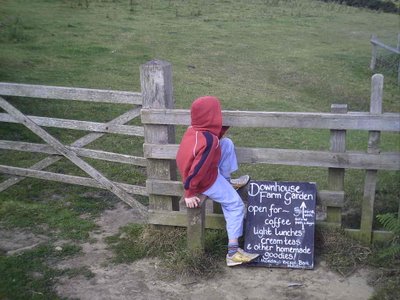
• Having the farm café next door to our cottage. Downhouse Farm is run as an organic farm by Nikki and Dean, and between mid march and mid October they open up the garden of their house as a café (it has plenty of shelter and shade). They do sublime ploughmans lunches and cream teas. Many was the time we popped next door for two big slabs of dorset apple cake to share between us while we watched Anna and Andrew’s favourite programme: the very wonderful Raven (set in the Scottish Highlands, combinoing celtic mythology with a kind of Krypton factor for kids). Disclosure: When I was eight I played football, in Guildford, with the son (or it might have been the nephew) of George Burns, who presented the Krypton Factor.
We stayed in a National Trust cottage just off the South West Coastal footpath, in Higher Eype.
Six memorable things about the holiday were:
• The view from the cottage garden over the fields sloping down to the sea. We could see chesil beach sweeping round and the whole of the Isle of Portland stuck on the end of it like a big football boot
• Looking out of the window at night and seeing the lighthouse light twenty miles away on Portland Bill appear, disappear then re-appear half a minute later. Just like in Edward Ardizzone's Ginger and Tim book, where the children make friends with the lighthouse keeper. One stormy night Tim couldn’t sleep, so he lay awake watching the lighthouse light come and go. Then he noticed a long gap without the light coming back. He knew something was up so he woke up his dad (who told him to get back to bed) and then put on his rainmac and secretly crept outside and went to the boatman's house. Together they rowed over to the lighthouse just in time to surprise some robbers who had kidnapped the lighthouse keeper and switched the light off so they could steal its cargo when it crashed into the rocks. I had my waterproof at the ready, but the light kept coming back.

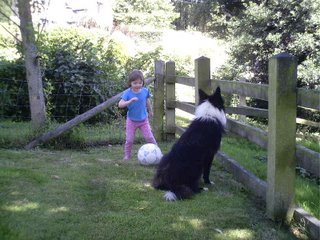
• Playing epic games of football in the garden with Dougie the farm sheepdog. We gave ourselves a point everytime we scored a goal against the little wall in front of the front door. Dougie got a point every time he intercepted a pass or blocked a shot. First to ten won. Once Dougie learned to read our tactics he won every single game. When I went out wide he would come out to block the cross, if I chipped it over him he would leap like a salmon to catch it, if I pulled it back behind him to Andrew he would turn quickly to get in front of his goal to block the shot. Even with the help of star players like Jack, Charlie and Kotalo (campers in the field opposite) we couldn’t beat Dougs. We got to 9-9 one game and Andrew’s shot agonisingly hit the post. From the restart Andrew tried to pass me, Dougie was there, business as usual, the chance had gone.

• Having bats fly so close to the house after dusk that we could make out the brown of their bodies as they rushed past.
• Going to Leakers the bakers in Bridport which does three varieties of flapjack (pecan and maple, cherry and coconut, almond and apricot.) Unless any of my readers can nominate an alternative these three will sweep the board at this years World flapjack award ceremony. If there was a world bread pudding award they would surely win that too, for their innovative Bread pudding cube, the size of half a housebrick. The other distinctive thing about Leaker’s is its social conscience. It had made a mural on the wall opposite the serving counter: someone had written Peace in big green letters with a dove next to it, and there was a chubby marker for you to sign your name on the wall. The lady behind the counter was bemoaning to me that their hadn’t been a 'Ceasefire now' demonstration in Bridport. (they had a notice up for the national march in London). It was heartening to see that this bakery was bravely going against the advice given to me by my friend James’s dad Don, when I started working at La Boulangerie bakers in Guildford in 1990. His tip for me on dealing with the customers was:
‘remember they want bread. Not Lenin, not Marx, just bread’
• Having the farm café next door to our cottage. Downhouse Farm is run as an organic farm by Nikki and Dean, and between mid march and mid October they open up the garden of their house as a café (it has plenty of shelter and shade). They do sublime ploughmans lunches and cream teas. Many was the time we popped next door for two big slabs of dorset apple cake to share between us while we watched Anna and Andrew’s favourite programme: the very wonderful Raven (set in the Scottish Highlands, combinoing celtic mythology with a kind of Krypton factor for kids). Disclosure: When I was eight I played football, in Guildford, with the son (or it might have been the nephew) of George Burns, who presented the Krypton Factor.

Tuesday, August 01, 2006
Silence
I was sitting in a fish and chip shop in Lyme Regis when I heard on the radio that George Bush had refused to condemn the Qana massacre.
Qana: a massacre of 50 people, a similar number to the July 7 bombings in London, except more of them this time were children. People sheltering at the bottom of their apartment block. People who had been faced with the choice of either staying in a village that the Isreali air force was liable to bomb, or fleeing along roads that the Isreali air force was liable to bomb.
In Britain over the last ten years we have observed more and more one or two minute silences. They are based on the assumption that our society is united in valuing human life and mourning the passing of whichever public figure or group of innocent victims is being commemorated.
I will not observe any more such silences this year. If George Bush won't condemn the slaughter at Qana, and if there is still only an insultingly thin wafer between UK foreign policy and that of the US, then how can we pretend that we all value human life, and that we value all human life?
Qana: a massacre of 50 people, a similar number to the July 7 bombings in London, except more of them this time were children. People sheltering at the bottom of their apartment block. People who had been faced with the choice of either staying in a village that the Isreali air force was liable to bomb, or fleeing along roads that the Isreali air force was liable to bomb.
In Britain over the last ten years we have observed more and more one or two minute silences. They are based on the assumption that our society is united in valuing human life and mourning the passing of whichever public figure or group of innocent victims is being commemorated.
I will not observe any more such silences this year. If George Bush won't condemn the slaughter at Qana, and if there is still only an insultingly thin wafer between UK foreign policy and that of the US, then how can we pretend that we all value human life, and that we value all human life?
Thursday, July 20, 2006
This morning
Our one year celebration kicks off with the suggestion of Marine Hugonnier that we rejoice in the knowledge that human beings have walked on the moon.
I am celebrating by singing the REM tune 'do you believe they put a man on the moon' but changing the lyrics to suit whatever I am doing at the time.
At the breakfast table I sang 'do you believe, I've got some egg on my spoon, egg on my spoon'
On the 08:07 New Malden to Waterloo train I am writing these words and singing 'do you believe, I can type without much room, without much room'
I am celebrating by singing the REM tune 'do you believe they put a man on the moon' but changing the lyrics to suit whatever I am doing at the time.
At the breakfast table I sang 'do you believe, I've got some egg on my spoon, egg on my spoon'
On the 08:07 New Malden to Waterloo train I am writing these words and singing 'do you believe, I can type without much room, without much room'
Sunday, July 16, 2006
Contradictions
In the space of a Friday lunchtime, a visit to the Tate Modern got me thinking about what we human beings try to do with time and space:
- We divide up time and space because time and space are both indivisible
- We find ways of visualising time and space because time and space are invisible
- We fight for time and fight for space because time and space are infinite and unlimited.
My first stop was the fourth floor: back to Pierre Huyghe's One Year Celebration inside his Celebration Park. Huyghe's premise was that our calendar is a map, a map of the year, and the map has some uncolonised territory in the form of days which don't have a holiday attached to them.
At Hugyhe's invitation several artists and critics have come up with suggestions for colonising these days with celebrations.
Two of these proposed celebrations are attempts to resist the mapping of time, in order to escape the constraints that our mappings of time place on the way we live our lives and on the way we think about the universe.
Joe Scanlan suggested having an 'open day': a day slotted in somewhere between Sunday and Monday. Nothing can be scheduled for this day (because no-one knows when it is) and we can instead enjoy things in life that don’t need to be scheduled (Scanlon suggests that coffee, newspapers and cigarettes should be half price).
Another artist suggested a day out of the year, a revival of the Mayan practice of having one day in the year that wasn't included in the calendar, to remind everyone that time is greater than the calendar, that time is impervious to attempts to measure it.
I popped into the bookshop to flick through the book accompanying Celebration Park and noted Hughye' s comment (in an interview with Hans Ulrich Obrist) that he regarded time as a corollary of space. He talked about how a television programme exist mainly in time, but also in space, and differently from objects.
All this talk about the relationship between space persuaded me to pop upstairs to the fifth floor to revisit my favourite thing in the Tate Modern: 1,000 millimetres by Stanley Brouwn.
It consists of a card index box, containing 1,000 pieces of card. Each card has the words '1mm' written on it, above a horizontal line, in pencil, one millimetre long. So you have a thousand millimetres in the box.
There are no more or less millimetres in that card index box than there would have been if Brouwn had left the cards blank and saved himself the effort of drawing all those lines.
We have no way of adding a millimetre or a second to the universe.
As I was coming down the escalator from the fifth floor of the Tate Modern I had a Eureka moment. I solved the mystery of time and space: they don’t exist!
Monday, July 10, 2006
Genius is still genius
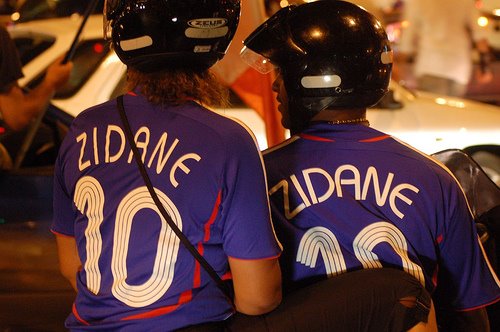
Photo by choudoudou
When I opened my eyes this morning, my first thought was of how Zinedine Zidane must be feeling, opening his eyes this morning.
I listened to French radio after the world cup final last night. I was impressed by the loyalty to Zidane of all those who reported or were interviewed. In the whole hour that I listened not person blamed him for the defeat, not one person used any words like shame or disgrace. Some expressed their thanks to Zidane for what he had done for France in this world cup and over the years.
One correspondent described the moment Zidane got sent off as like moving from 'le chaleur' of a Rio de Janeiro beach to ‘la froideur’ of a cold bath in the space of a split second.
Another correspondent described an empty café, with a lone man in a Zidane top clearing up the clutter left by the fans who had gone home. The correspondent imagined that some of the fans who had left the café were parents who had gone home to kids wearing Zidane tops too.
A convincing case could still be made for Zidane being the player of that tournament. He was pulling the strings again last night, throughout the second half and extra time. As a 34 year old, to be still bombing into the penalty area half way through extra time is a phenomenal achievement: compare with his fellow 34 year old Luis Figo who never seemed to last past the seventy-fifth minute of matches.
Does one lapse in self control wipe out fifteen marvellous years? it depends what you want to remember people for, and what you want to see in people.
I’m reminded of the Nottingham Forest fans on at the end of the 1992/93 season, defiantly singing ‘Brian Clough is a football genius’ as they watched their team get relegated. They will have suspected that Clough was by then an alcoholic, and that his drinking had contributed to the relegation, but they also knew that he had preformed football miracles for them.
Saturday, July 08, 2006
Today we celebrate unlikely but uplifting combinations
Pierre Hugyhe wants ever day to be a celebration, so he asked some of his artist friends to come up with a reason to celebrate on days that we don’t have a holiday at the moment.
Pierre has used his exhibition at the Tate Modern to display the new holidays to the public for the first time.
The day I am most looking forward to is the day celebrating our sense of anticipation. But no date has been set for that yet.
The most enlightening holiday will be the day of rational certainty. On that day we will be enjoined not to cross our fingers or worry about stepping on the cracks in the pavement. The horoscopes won’t be published. Temples, churches and mosques will shut their doors for the day.
The results of the day will be interesting. Can we base our lives solely on things that can be rationally proven? We don’t know what time is, or how many dimensions there are in the universe, or why the universe was created, or why a table feels solid when the atoms that it is made of consist mainly of empty space. We need metaphors, assumptions, beliefs, and maybe even faith, to bridge these gaps.
The day will necessitate a temporary laying aside of the existing public explanations of the nature, purpose, and destiny of the universe. It will thus provide you with a bit of space to come up with your own answers to these questions, whichever answers help you pursue whichever type of life you most want to live.
Julia Cameron in her book The Artist's Way urges anyone wanting to make more use of their own creativity to come up with their own view of why the creator of the universe created it and what that creator is like.
I like to think of the creator of the universe as a being that is not all-knowing, but is instead all-learning: learning from the new things that are happening all over the universe all the time. That learning isn't stored by the creator seperately from the universe, the learning is stored in the universe itself. The universe works to both use some of that learning and to keep on creating new situations for new learning.
The creator of the universe created it because no universe had been created before, and the happiness and beauty it could potentially generate might well be worth the inevitable pain.
Later in the year another Hugyhe holiday will celebrate the future. The curator Hans Ulrich Obrist asked his artist friends to tell him what they think the future is. It is a nice twist, a curator asked to produce a work of art by an artist and doing so by curating the comments of other artists to create an exhibition within an exhibition within an exhibition. All the artists have come up with different little straplines for the future, thus confirming that not only do we not know what the future holds, we don’t even know what the future is.
We at World Flapjack day are a little disappointed that that this French led endeavour has not come up with a day to celebrate any of the wonderful things found in patisseries.
To make up for this omission we are proposing to make July 8 the celebration of ‘unlikely but uplifting combinations’.
On this day evey year people will be enjoined to take the day off to combine different things that they like but don’t normally do at the same time. This is so often a sure fire recipe for happiness in life.
The inspriration for this day came from the Banauchoc: a pain au chocalat with banana in. (you can get them from the Panos bakery on the concourse of Brussels Gare du Midi station).
Some of the things I like doing are: playing chess, having a bath, meeting new people, learning new languages, getting fresh air. In Budapest at the Szechenyi Baths you can stand for hours in an open air thermal bath, play chess with a waterproof chess set and improve your Hungarian.
We at World Flapjack Day support Pierre’s endeavour. and will be celebrating each of these new holidays as they come through the year.
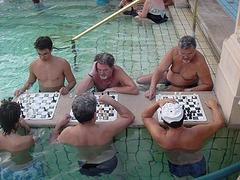
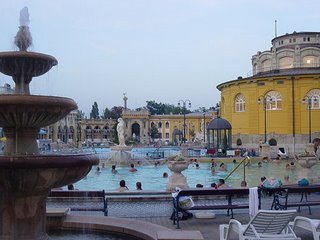
Photos of Szechenyi baths by phnk
Pierre has used his exhibition at the Tate Modern to display the new holidays to the public for the first time.
The day I am most looking forward to is the day celebrating our sense of anticipation. But no date has been set for that yet.
The most enlightening holiday will be the day of rational certainty. On that day we will be enjoined not to cross our fingers or worry about stepping on the cracks in the pavement. The horoscopes won’t be published. Temples, churches and mosques will shut their doors for the day.
The results of the day will be interesting. Can we base our lives solely on things that can be rationally proven? We don’t know what time is, or how many dimensions there are in the universe, or why the universe was created, or why a table feels solid when the atoms that it is made of consist mainly of empty space. We need metaphors, assumptions, beliefs, and maybe even faith, to bridge these gaps.
The day will necessitate a temporary laying aside of the existing public explanations of the nature, purpose, and destiny of the universe. It will thus provide you with a bit of space to come up with your own answers to these questions, whichever answers help you pursue whichever type of life you most want to live.
Julia Cameron in her book The Artist's Way urges anyone wanting to make more use of their own creativity to come up with their own view of why the creator of the universe created it and what that creator is like.
I like to think of the creator of the universe as a being that is not all-knowing, but is instead all-learning: learning from the new things that are happening all over the universe all the time. That learning isn't stored by the creator seperately from the universe, the learning is stored in the universe itself. The universe works to both use some of that learning and to keep on creating new situations for new learning.
The creator of the universe created it because no universe had been created before, and the happiness and beauty it could potentially generate might well be worth the inevitable pain.
Later in the year another Hugyhe holiday will celebrate the future. The curator Hans Ulrich Obrist asked his artist friends to tell him what they think the future is. It is a nice twist, a curator asked to produce a work of art by an artist and doing so by curating the comments of other artists to create an exhibition within an exhibition within an exhibition. All the artists have come up with different little straplines for the future, thus confirming that not only do we not know what the future holds, we don’t even know what the future is.
We at World Flapjack day are a little disappointed that that this French led endeavour has not come up with a day to celebrate any of the wonderful things found in patisseries.
To make up for this omission we are proposing to make July 8 the celebration of ‘unlikely but uplifting combinations’.
On this day evey year people will be enjoined to take the day off to combine different things that they like but don’t normally do at the same time. This is so often a sure fire recipe for happiness in life.
The inspriration for this day came from the Banauchoc: a pain au chocalat with banana in. (you can get them from the Panos bakery on the concourse of Brussels Gare du Midi station).
Some of the things I like doing are: playing chess, having a bath, meeting new people, learning new languages, getting fresh air. In Budapest at the Szechenyi Baths you can stand for hours in an open air thermal bath, play chess with a waterproof chess set and improve your Hungarian.
We at World Flapjack Day support Pierre’s endeavour. and will be celebrating each of these new holidays as they come through the year.


Photos of Szechenyi baths by phnk
Sunday, July 02, 2006
Kick
So England’s world cup quarter final went to a penalty shoot out. The commentators said they wouldn’t wish the experience on anyone. You can tell which players are going to miss by the fear written on their face.
Andrew (aged 7) switched the telly off and ran out of the room when Jamie Carragher missed his retaken penalty. The miss gave Christian Ronaldo the chance to knock England out of the tournament if he scored his penalty for Portugal.
I switched the telly back on in time to see something that impressed me. Ronaldo picked the ball up and kissed it. He was taking time to say that whatever the level of pressure on the moment, he loved playing football. He put the ball down on the spot and then chipped it into a part of the net that no goalkeeper could ever reach.
A triumph of love over fear.
Looking back on it it was inevitable that England would lose. They had played poorly all tournament, the manager had run out of ideas four years ago and only stayed in his job becase it would cost the FA to much money to end his contract. He didn’t seem to be able to adjust to injuries to his first choice strikers.
The only thing keeping England going was the superstitions of fans but even they seemed to have run out by the Quarter final.
Andrew had worn his England wristband, given to him by one of his teachers at school, continuously from the start of the tournament, and told us how it made England win, because his teacher had made it magic. The wristband fell down the toilet three days before the Portugal game.
Andrew (aged 7) switched the telly off and ran out of the room when Jamie Carragher missed his retaken penalty. The miss gave Christian Ronaldo the chance to knock England out of the tournament if he scored his penalty for Portugal.
I switched the telly back on in time to see something that impressed me. Ronaldo picked the ball up and kissed it. He was taking time to say that whatever the level of pressure on the moment, he loved playing football. He put the ball down on the spot and then chipped it into a part of the net that no goalkeeper could ever reach.
A triumph of love over fear.
Looking back on it it was inevitable that England would lose. They had played poorly all tournament, the manager had run out of ideas four years ago and only stayed in his job becase it would cost the FA to much money to end his contract. He didn’t seem to be able to adjust to injuries to his first choice strikers.
The only thing keeping England going was the superstitions of fans but even they seemed to have run out by the Quarter final.
Andrew had worn his England wristband, given to him by one of his teachers at school, continuously from the start of the tournament, and told us how it made England win, because his teacher had made it magic. The wristband fell down the toilet three days before the Portugal game.
Sunday, June 25, 2006
Permanent marker
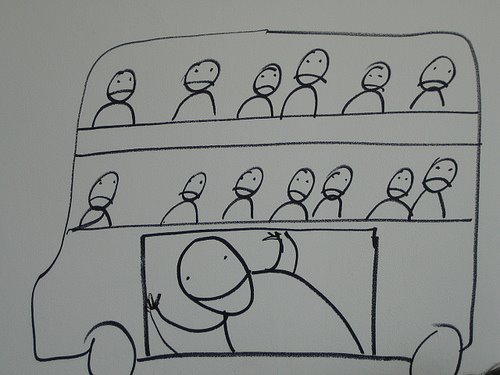
Tate Modern commissioned Dan Perjovschi to draw with permanent marker all over the member's room. I went to see the drawings before, like all permanent markings, they got scrubbed off.
My favourite was the one showing the bus driver and passengers looking glum but the advert on the side of the bus showing someone looking as happy as Larry.
There will come a time when the panels on the side of public transport are simply screens , connected to the internet, which could display any combination of image and message.
But will there come a time when the people on the bus will be able to influence what is expressed on the side of the bus? Or will the image/message always be determined at a distance in time and space from the driver and passengers?
Thursday, June 22, 2006
Reduced to almost nothing
I went to the Big London Brainstorm in Lindsey Street, Smithfield yesterday, where lots of architects have had put forward their ideas for improving our city.
My favourite was the one suggesting that instead of building Renzo Piano's shard of glass, we should build a massive grain of sand. This would serve as a tribute to William Blake, and as a reminder to people that we are present in the universe.
Here is the quote from Blake's Auguries of Innocence:
''To see a world in a grain of sand
And a heaven in a wild flower,
hold infinity in the palm of your hand
And eternity in an hour.''
My favourite was the one suggesting that instead of building Renzo Piano's shard of glass, we should build a massive grain of sand. This would serve as a tribute to William Blake, and as a reminder to people that we are present in the universe.
Here is the quote from Blake's Auguries of Innocence:
''To see a world in a grain of sand
And a heaven in a wild flower,
hold infinity in the palm of your hand
And eternity in an hour.''
Saturday, June 17, 2006
Let’s be
Jorge Luis Borges died 20 years ago this week, aged 87.
At the age of 79 Borges had made the following brave and honest statement in a lecture entitled Immortality:
Borges does not claim to know what will happen after his death. He does not deny that there is a possibility that he might find himself re-incarnated as another being, or that he might find eternal life in heaven. But he is saying that he does not desire either re-incarnation or eternal life.
Later in his lecture Borges describes how some of the things that he has said and done will live on in the words and deeds of people to come. This is the way that Borges does want to live on in the universe: in the same way that Borges himself has kept alive Shakespeare,Dante, his own parents, neighbours and acquaintances by using and remembering their words and deeds.
I hope Borges got his wish. I am not convinced that eternal reincarnation or eternal life for one individual entity is in accordance with the spirit of the universe. The universe seems to be more interested in re-using and re-combining things than in ring- fencing and preserving things. The greatest gift of the creator to this universe is evolution: the fact that life can learn and adapt and new life forms can develop which are novel and different.
Why would the universe need a James Lappin in a million years time? What possible use would ‘I’ be to anything?
Jeff Barry, who lives in Borges’ home city of Buenos Aires, blogged last Wednesday about this same quote, as part of his wonderful series of blog posts called ‘30 days with Borges’. I’ve posted each of the 30 days to a del.icio.us page if you want a quick way of accessing all thirty of them.
At the age of 79 Borges had made the following brave and honest statement in a lecture entitled Immortality:
‘’I don’t want to continue being Jorge Luis Borges: I want to be someone else. I hope that my death will be total: I hope to die in body and soul.’’
Borges does not claim to know what will happen after his death. He does not deny that there is a possibility that he might find himself re-incarnated as another being, or that he might find eternal life in heaven. But he is saying that he does not desire either re-incarnation or eternal life.
Later in his lecture Borges describes how some of the things that he has said and done will live on in the words and deeds of people to come. This is the way that Borges does want to live on in the universe: in the same way that Borges himself has kept alive Shakespeare,Dante, his own parents, neighbours and acquaintances by using and remembering their words and deeds.
I hope Borges got his wish. I am not convinced that eternal reincarnation or eternal life for one individual entity is in accordance with the spirit of the universe. The universe seems to be more interested in re-using and re-combining things than in ring- fencing and preserving things. The greatest gift of the creator to this universe is evolution: the fact that life can learn and adapt and new life forms can develop which are novel and different.
Why would the universe need a James Lappin in a million years time? What possible use would ‘I’ be to anything?
Jeff Barry, who lives in Borges’ home city of Buenos Aires, blogged last Wednesday about this same quote, as part of his wonderful series of blog posts called ‘30 days with Borges’. I’ve posted each of the 30 days to a del.icio.us page if you want a quick way of accessing all thirty of them.
Thursday, June 15, 2006
Uncertainty now
 Photo of me in Blackfriars yesterday. The photographer (Seize the Dave) must have taken it from the top of St Paul's Cathedral.
Jorge Luis Borges came up with a comprehensive classification of all living creatures. He attributed the classification to Dr Franz Kuhn and it was the organisational basis of a Chinese Encyclopedia called the Heavenly Emporium of Benevolant Knowledge.
It has often been held up as an example of the potential absurdities of classification, but I have learned something quite profound about my appearance from it: I look like a fly from a distance
Here is the classification in full:
a) those [animals] that belong to the emporer
b) embalmed ones
c) those that are trained
d) suckling pigs
e) mermaids
f) fabulous ones
g) stray dogs
h) those that are included in the classification
i) those that tremble as if they were mad
j) innumerable ones
k) those drawn with a very fine camel’s hair brush
l) etcetera
m) those that have just broken the flower vase
n) those that at a distance resemble flies
I must look like a fly from a distance, it is the only category I fit into. Continually breaking flower vases is not a viable option socially or financially.
Most people seem not to notice, either because they are standing to close, or because their eye is tricked by a curious effect of an uncertainty principle which is caused by the following:
- When I look like a fly from a distance I am included in the classification, and therefore must move from category n) to category h).
- As soon as I join category h) there is no necessity for me to look like a fly from a distance
- As soon as I stop looking like a fly from a distance I am no longer in the scope and therefore, need to look like a fly again (from a distance).
This Uncertainty principle can be stated something like:
- You can determine precisely the position of a living creature within Borges’s classification, and you can determine whether or not it looks like a fly from a distance, but you can not determine both things at the same moment in time.
It just shows how much effort is required to fit into someone else's world view
Subscribe to:
Posts (Atom)