You have to think on your feet when you take your impressionable seven year old to a football match.
Son:What are they singing at Steed Malbranque Dad?
Dad: They are calling him a greedy custard son.
Son: Why?
Dad: Because he used to be a favourite player here, and now he has gone to Tottenham for more money, and he eats too many puddings.
Vincenzo's Montella came on. his fourth outing as a sub for Fulham. His sophisticated Italian touches have made him a folk hero here already. A few minutes later he has stuck away a penalty that looks like winning Fulham three points.
A new song goes up around the ground. Only one thing for it, sing an edited version in Andrew's ear as loud as I can.
Montella oh oh oh , Montella oh oh oh
He comes from Italy
He doesn't like Chelsea
Montella etc.
(the crowd claimed that Vicenzo harbours a much stronger resentment towards Fulham's nearest neighbours)
Sunday, January 21, 2007

Tuesday, January 16, 2007
Monday, January 15, 2007
Two further proofs of the existence of God, to add to those discovered by St Thomas Aquinas
Breakfast time, one Saturday in November 2006. Anna is asking her parents about the time God made the world.
Andrew (aged 7, feeling antagonistic towards younger sister): There isn't a God Anna.
Anna (aged 4, shocked): yes there is
Andrew: No there isn't. My science book says the Universe is made of particles. It doesn't mention God.
Anna: But there must be a God Andrew, because there is a Jesus.
Dinner time. Same day, same family.
Tania (aged 37): What places shall we visit when we go back to the Isle of Wight? Do you remember the places you liked last time?
James (37), Andrew, Anna: The Crab and Lobster, St Helens beach, the Steam Railway, the Dinosaur museum
Tania: What is the name of that place with the model village?
James: Godshill
Anna ( turning triumphantly towards her brother): see Andrew, there must be a God! Because there is a hill!
Andrew (aged 7, feeling antagonistic towards younger sister): There isn't a God Anna.
Anna (aged 4, shocked): yes there is
Andrew: No there isn't. My science book says the Universe is made of particles. It doesn't mention God.
Anna: But there must be a God Andrew, because there is a Jesus.
Dinner time. Same day, same family.
Tania (aged 37): What places shall we visit when we go back to the Isle of Wight? Do you remember the places you liked last time?
James (37), Andrew, Anna: The Crab and Lobster, St Helens beach, the Steam Railway, the Dinosaur museum
Tania: What is the name of that place with the model village?
James: Godshill
Anna ( turning triumphantly towards her brother): see Andrew, there must be a God! Because there is a hill!
Wednesday, January 10, 2007
How is work?
If you catch yourself talking negatively about your work today, have a read of this great blogpost from the Chief Happiness Officer.
Monday, January 08, 2007
Do dogs eat mashed potato?
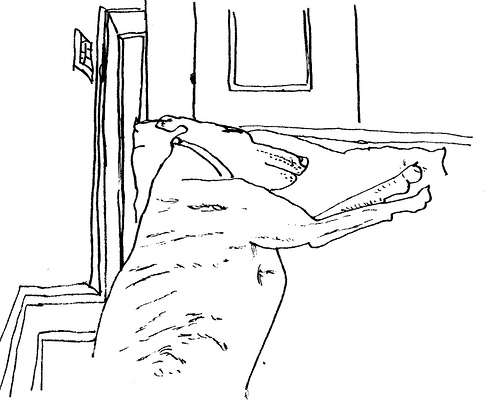
Scully, from the Retired Greyhound Trust, came to spend sunday afternoon with us.
His visit prompted lots of questions from Anna about dogs.
Saturday, January 06, 2007
Ffawd, Cywilydd a Chelwyddau
I've found a novel that I want to read in a language that I don't know.
It is called Ffawd, Cywilydd a Chelwyddau (Fate, shame and lies) by a Cardiff writer called Lloyd Owen.
The novel almost won the Daniel Owen Memorial Prize for best unpublished novel in the Welsh Language at the 2005 Eisteddfodd. The judges said it showed 'the boldest thinking and the closest to genius" of all the competition's entrants. But they didn't give it the prize because it pushed the boundaries of acceptable publishing.
It is described as cross between Catcher in the Rye and Trainspotting, a dark journey of the soul aimed at teenagers. There is a lot of swearing in it, but the swearing is in English because their isn't much swearing in the welsh language.
Lloyd Owen says that he is influenced by the Coen brothers films: (Fargo and Big Lebowski are two of my favourite films too).
Waterstones at Ludgate Circus have ordered the book for me. They say it will be in within 7 to 10 working days.
That gives me a week or so to learn the sounds of the letters in Welsh. Then I will read the first chapter at normal reading speed.
It will be a good test for the ideas on language learning I put forward yesterday. I hope that reading it, even without comprehension, will encourage rather than discourage me from learning the language. I hope that I will be able to tell you something about the chapter. Not much, but something.
I'll let you know how I get on! I am going to visit Bangor later this month for a consultancy assignment so it would be nice to have even a smidgeon of Welsh before I go.
It is called Ffawd, Cywilydd a Chelwyddau (Fate, shame and lies) by a Cardiff writer called Lloyd Owen.
The novel almost won the Daniel Owen Memorial Prize for best unpublished novel in the Welsh Language at the 2005 Eisteddfodd. The judges said it showed 'the boldest thinking and the closest to genius" of all the competition's entrants. But they didn't give it the prize because it pushed the boundaries of acceptable publishing.
It is described as cross between Catcher in the Rye and Trainspotting, a dark journey of the soul aimed at teenagers. There is a lot of swearing in it, but the swearing is in English because their isn't much swearing in the welsh language.
Lloyd Owen says that he is influenced by the Coen brothers films: (Fargo and Big Lebowski are two of my favourite films too).
Waterstones at Ludgate Circus have ordered the book for me. They say it will be in within 7 to 10 working days.
That gives me a week or so to learn the sounds of the letters in Welsh. Then I will read the first chapter at normal reading speed.
It will be a good test for the ideas on language learning I put forward yesterday. I hope that reading it, even without comprehension, will encourage rather than discourage me from learning the language. I hope that I will be able to tell you something about the chapter. Not much, but something.
I'll let you know how I get on! I am going to visit Bangor later this month for a consultancy assignment so it would be nice to have even a smidgeon of Welsh before I go.
Friday, January 05, 2007
Anna's horse
We bought Anna a horse for christmas.
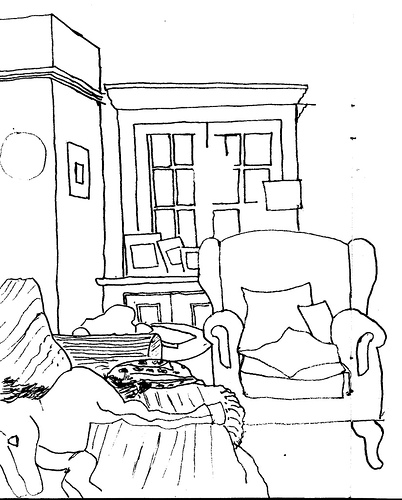
She is a bit weak, she has no strength in her legs so we have to carry her anywhere she wants to go. She still spends most of the day sleeping. We call her 'floppy'.
When I came downstairs early yesterday morning floppy was asleep on the sofa, so I sketched her for you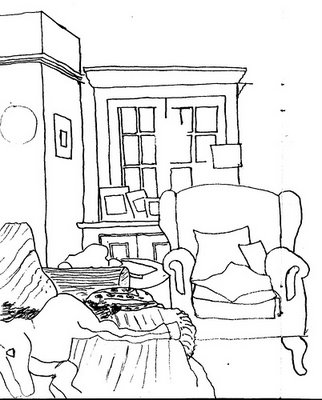
She is a bit weak, she has no strength in her legs so we have to carry her anywhere she wants to go. She still spends most of the day sleeping. We call her 'floppy'.
When I came downstairs early yesterday morning floppy was asleep on the sofa, so I sketched her for you
Reading a novel in a language you don't know yet
Lucy posted a great question in response to yesterday's post on learning languages.
I would normally advise you to firstly read that little bit of your language text book that tells you what noise each letter makes ( I get a bit discouraged if I don't know how to pronounce the words to myself in my head).
Then start to read your novel. Don't be discouraged if you don't understand a word of the first page. Carry on reading the first chapter at the same pace you read in english, without looking up anywords in a dictionary, and without re-reading anything. When you have finished the chapter note to yourself anything at all that you picked up about that first chapter. I am sure you will be suprised at what you can say about it.
Now read the next bit of your language text book. Don't bother with their exercises, don't try to memorise any of the vocabulary, just read what they are teaching you.
Then read chapter two of your novel.
Does anyone want to try it? Or nominate a language that you would like me to demonstrate this on?
Would you get discouraged if you read the first page of a novel in the language you wanted to learn, and couldn't understand a word of it?
I would normally advise you to firstly read that little bit of your language text book that tells you what noise each letter makes ( I get a bit discouraged if I don't know how to pronounce the words to myself in my head).
Then start to read your novel. Don't be discouraged if you don't understand a word of the first page. Carry on reading the first chapter at the same pace you read in english, without looking up anywords in a dictionary, and without re-reading anything. When you have finished the chapter note to yourself anything at all that you picked up about that first chapter. I am sure you will be suprised at what you can say about it.
Now read the next bit of your language text book. Don't bother with their exercises, don't try to memorise any of the vocabulary, just read what they are teaching you.
Then read chapter two of your novel.
Does anyone want to try it? Or nominate a language that you would like me to demonstrate this on?
Thursday, January 04, 2007
Learning to draw/ learning a language
Check out this brilliant blogpost by Danny Gregory on drawing.
I love Danny's book 'The creative license'.
A couple of years ago I tried to teach myself to draw from two standard texts on drawing. They covered the major aspects of drawing. The authors had drawn pictures to illustrate the points they were making about perspective, proportion and tone. But I gave up fairly soon.
I believe that for an adult, learning from a text book often doesn't work. The strength of text books is that they are comprehensive, and explain all the complexities of something. This is necessary for students, who will have to defend themselves against exam questions. But it is a weakness for adults, who tend to be more prone to giving up. If you are put off starting to draw by a concern that drawing might be a very complex skill, then a book that explains all the complexities is just going to feed that concern.
The challenges facing the author of a book for adult learners are:
Gregory isn't interested in telling us all there is to know about drawing. He isn't interested in getting us to any particular standard. He is interested in getting us to pick up a pen and paper and draw. Just draw the outlines of things, he says. Maybe after a few months you'll want to start to concern yourself with colour and the effect of light, or maybe never. But for the moment just draw the outlines.
I'd love to write a book on learning languages that persuades people first of all to find something that they want to do with that language (say, read a particular novel in the original) and then to get hold of that novel and spend a bit of time each day reading it. (Reading is easy, it just involves scanning your eye over a page of words. Comprehension comes a bit later). I'd ask readers to spend as much time with that novel as they do with their language text book.
They would be staying close to their reason for starting to learn. If they give up after three months they will still have read that novel in the original. And the novel will provide them with a means of gauging their progress, and a means of seeing what aspects of the language text book are useful to them and what aspects they don't need to bother their head about.
I love Danny's book 'The creative license'.
A couple of years ago I tried to teach myself to draw from two standard texts on drawing. They covered the major aspects of drawing. The authors had drawn pictures to illustrate the points they were making about perspective, proportion and tone. But I gave up fairly soon.
I believe that for an adult, learning from a text book often doesn't work. The strength of text books is that they are comprehensive, and explain all the complexities of something. This is necessary for students, who will have to defend themselves against exam questions. But it is a weakness for adults, who tend to be more prone to giving up. If you are put off starting to draw by a concern that drawing might be a very complex skill, then a book that explains all the complexities is just going to feed that concern.
The challenges facing the author of a book for adult learners are:
- how do you help the learner find the inspiration they need to keep learning, and to keep enjoying it?
- how do you help them to keep in mind the real reason that they wanted to learn the skill in the place?
- how do you help them to suspend judgement on themselves long enough so that the thought 'I can't learn a language/draw/cook' doesn't prompt them to give up?
Gregory isn't interested in telling us all there is to know about drawing. He isn't interested in getting us to any particular standard. He is interested in getting us to pick up a pen and paper and draw. Just draw the outlines of things, he says. Maybe after a few months you'll want to start to concern yourself with colour and the effect of light, or maybe never. But for the moment just draw the outlines.
I'd love to write a book on learning languages that persuades people first of all to find something that they want to do with that language (say, read a particular novel in the original) and then to get hold of that novel and spend a bit of time each day reading it. (Reading is easy, it just involves scanning your eye over a page of words. Comprehension comes a bit later). I'd ask readers to spend as much time with that novel as they do with their language text book.
They would be staying close to their reason for starting to learn. If they give up after three months they will still have read that novel in the original. And the novel will provide them with a means of gauging their progress, and a means of seeing what aspects of the language text book are useful to them and what aspects they don't need to bother their head about.
Tuesday, January 02, 2007
Another way of stubbornly refusing to be miserable about anything
Yesterday we went to see Fulham play Watford, the bottom team in the league. Fulham had two goals disallowed, missed a hatful of chances including an open goal, and had our goalie stretchered off. It finished 0-0.
On the way out I passed a man who declared:
There is no particular animosity (as far as I am aware) between Fulham and West Ham United.
This man may well have found a foolproof way a way of fending off any existential regrets, misgivings, worries you may be experiencing. On the day of your unhappiness simply scan any football results to find a team in some league, somewhere who has suffered an incongorously large and unlikely defeat, and laugh.
Today is a bank holiday in Scotland, with a full programme of league games. For those of you feeling the blues today I will try to find a result that will give you a confortable feeling of schadenfreude to dispel them (for 24 hours at least).
If you haven't got time to search through football results simply stretch the statement out a bit:
Update: I've just checked those Scottish results. Dundee United lost 5-1 at home to Falkirk. I can not feel down this week.
On the way out I passed a man who declared:
'I can not feel down on a day when West Ham lose 6-0 at Reading'.It sounded incredibly profound and true at the time.
There is no particular animosity (as far as I am aware) between Fulham and West Ham United.
This man may well have found a foolproof way a way of fending off any existential regrets, misgivings, worries you may be experiencing. On the day of your unhappiness simply scan any football results to find a team in some league, somewhere who has suffered an incongorously large and unlikely defeat, and laugh.
Today is a bank holiday in Scotland, with a full programme of league games. For those of you feeling the blues today I will try to find a result that will give you a confortable feeling of schadenfreude to dispel them (for 24 hours at least).
If you haven't got time to search through football results simply stretch the statement out a bit:
I cannot feel down in the month/year/solar system in which West Ham lose 6-0 at Reading
Update: I've just checked those Scottish results. Dundee United lost 5-1 at home to Falkirk. I can not feel down this week.
Tuesday, December 26, 2006
conversation between daughter and father
daughter (Anna, aged 4): Your name is James, isn't it daddy
father (James, aged 37): Yes Anna
daughter: When I'm a grown up, if I have a little boy, I will call it James too
father: (bursting with pride): thats nice Anna
daughter (thinking hard): ......or I might call it James and the Giant peach
father (James, aged 37): Yes Anna
daughter: When I'm a grown up, if I have a little boy, I will call it James too
father: (bursting with pride): thats nice Anna
daughter (thinking hard): ......or I might call it James and the Giant peach
Friday, December 22, 2006
Wordsmiths
Wordie is a terrific new site that lets you collect and share your favourite words.
It also lets you make lists of particular types of words.
Like these:
more than human by Lampbane
tales from another world by squareintheteeth
scripted apathy by uselessness
the horizontal hula by nkocharh
Joycean vocab by inkhorn
I've listed some of the words Morrissey used on Hatful of Hollow. Slackagogo has made listings of words from XTC and The Ramones
It also lets you make lists of particular types of words.
Like these:
more than human by Lampbane
tales from another world by squareintheteeth
scripted apathy by uselessness
the horizontal hula by nkocharh
Joycean vocab by inkhorn
I've listed some of the words Morrissey used on Hatful of Hollow. Slackagogo has made listings of words from XTC and The Ramones
Monday, December 18, 2006
Drawing for Cosmos

stars reflected in the reservoirs
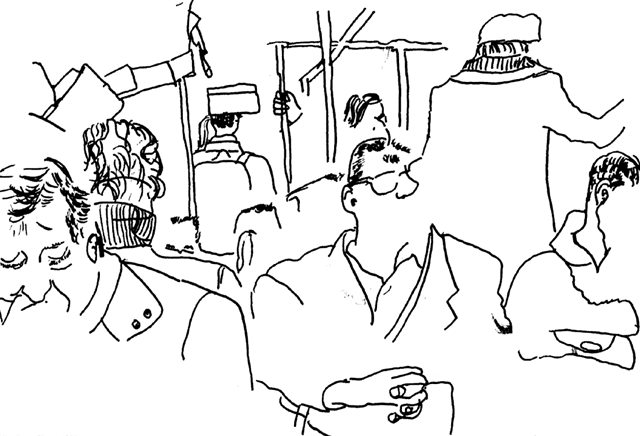
I got a nice seat on the train this morning, snuggled in the far back corner of the carriage. I was singing Morrissey's 'First of the Gang to die' to myself while I drew the picture.
I tried to keep in time to the music (but some of it may be a little of tune).
Tuesday, November 28, 2006

Sunday, November 12, 2006
El mondo no eschuara
I am kicking myself for missing 'El mondo no eschuara': the film Phil Collins made of Columbian people singing songs by The Smiths. It toured British art galleries in 2005.
He had kicked off the project by going to Bogata and inviting:
He ended up getting a version of all 17 songs on the album, each sung by a different person. I managed to find a two minute sample of different parts of it, on You Tube: here it is:
As is usual with Phil Collins work it works as conceptual art: you can think about the ideas behind it, and why he chose to execute the ideas in the way he did. A project possible because of the globalisation of pop music and the English language, but worthwhile becasue of people's individual reaction to Morrissey's songs and appropriation of them as their own . But it also works without being art too, its moving and interesting to watch.
The Pretty Pretty thieves blog have a good review of a review of el mondo no eschuara/ the world won't listen, written by a Smiths fan.
He had kicked off the project by going to Bogata and inviting:
“the shy, the dissatisfied, the narcissistic, the shower super-stars and anyone wanting to be someone else for a night”to come and record a karaoke version of a song from the album 'The world won't listen'.
He ended up getting a version of all 17 songs on the album, each sung by a different person. I managed to find a two minute sample of different parts of it, on You Tube: here it is:
As is usual with Phil Collins work it works as conceptual art: you can think about the ideas behind it, and why he chose to execute the ideas in the way he did. A project possible because of the globalisation of pop music and the English language, but worthwhile becasue of people's individual reaction to Morrissey's songs and appropriation of them as their own . But it also works without being art too, its moving and interesting to watch.
The Pretty Pretty thieves blog have a good review of a review of el mondo no eschuara/ the world won't listen, written by a Smiths fan.
Saturday, October 21, 2006
Phil Collins and the Turner Prize
Phil Collins says that he uses his camera as an excuse to meet people, that he has made his art in places like Bogata, Baghdad, Ramallah and Belgrade because he doesn't trust the images that the global media shows us of these cities, of the people in those cities.
Collins poses a question or a challenge to people in the city:
I've got tickets to see him talk about his Turner Prize entry on November 22.
The Turner Prize exhibition at Tate Britain has four artists exhibiting side by side for three months, then on December 4 one gets chosen to win the prize. I'm sure Collins will win. The opening hours of the exhibion are from 10am to 6pm each day. Collins is showing an eight hour long film (Return to the real), that starts at 10am each morning and finishes at 6pm. He hasn't left time for you to look at the work of the other artists.
The film consists of eight one hour long interviews with people talking about how appearing on a chat show ruined their life. You watch it in a room that is like a cinema, except you don't sit facing a screen. There are two screens : the one on the front wall shows the interviewee, the one on the back wall shows the interviewer. You sit on a side wall, and you have to turn your head from one screen to the other to follow the conversation, like watching a tennis match.
The interviewee has a single colour backdrop behind him or her, as though packaged for future television broadcast. The interviewer has no backdrop, you can see the studio monitors and equipment behind him, and the odd colleague wondering past to adjust a setting.
As you listen you realise that the tone of the conversation is intimate, undermining the gulf between the two roles, the two backdrops and the two screens . They may be on seperate screens now but when it was recorded they were sat facing each other, near each other. The conversations make no acknowledgement of the fact that they are destined to be viewed by people arriving half way through the interview. There is no summary of what has gone on before, no hype, no razzmattazz, no attempts to package the story or the person as being more interesting or more sensational than they come across in their own words.
Collins started with the chat show formula, with a sensational question about an intimate part of someone's life. He took the formula so far and then dropped it to leave us with a normal unsensationalised conversation. Just as the interviewees had, after appearing on the chat show, been left back with an unpackaged, unsensationalised life to lead.
If you do arrive half way through an interview and want to catch up on what you miss then you have to return to 'Return to the real' on a different day, but this time arrive a little earlier (or spend a bit less time looking at the work of the other artists).
When you leave the little cinema you pass by the second half of Colllins entry: a working office for Shady Lane Productions. You can look through the windows of the office and see Collins and his team working on his next project which is a challenge to the people of Britain, similar to that issued to the people of Turkey, to come and tell him how appearing on a chat show has adversly affected their life. You can open the window to the office if you want to chat to them, or want to volunteer your story to them.
A great idea by Collins, using the Turner Prize to repackage his last project (he did the work for Return to the Real for the Istanbul biennale in 2005) and to get free office space, heat, light and publicity for his next project. It works for me: its as though he is projecting his project forward in time and space. And projects are meant to be projected. Especially projects by film makers.
Collins poses a question or a challenge to people in the city:
Come and tell us how appearing on a TV chat show has ruined your life (Istanbul)
Come and dance for eight hours non-stop at a disco (Ramallah)
Come and do a karaoke version of a song by The Smiths (Bogata)
Come to a hotel and remove articles of your clothing (Baghdad)The trivial nature of the challenges could appear insulting given the serious predicament of some of those cities. But Collins gives people the time and space to talk/sing/dance/pose for themselves. The challenge may come from a globalised nowhere, but the work itself reflects the people who stepped forward to answer it.
I've got tickets to see him talk about his Turner Prize entry on November 22.
The Turner Prize exhibition at Tate Britain has four artists exhibiting side by side for three months, then on December 4 one gets chosen to win the prize. I'm sure Collins will win. The opening hours of the exhibion are from 10am to 6pm each day. Collins is showing an eight hour long film (Return to the real), that starts at 10am each morning and finishes at 6pm. He hasn't left time for you to look at the work of the other artists.
The film consists of eight one hour long interviews with people talking about how appearing on a chat show ruined their life. You watch it in a room that is like a cinema, except you don't sit facing a screen. There are two screens : the one on the front wall shows the interviewee, the one on the back wall shows the interviewer. You sit on a side wall, and you have to turn your head from one screen to the other to follow the conversation, like watching a tennis match.
The interviewee has a single colour backdrop behind him or her, as though packaged for future television broadcast. The interviewer has no backdrop, you can see the studio monitors and equipment behind him, and the odd colleague wondering past to adjust a setting.
As you listen you realise that the tone of the conversation is intimate, undermining the gulf between the two roles, the two backdrops and the two screens . They may be on seperate screens now but when it was recorded they were sat facing each other, near each other. The conversations make no acknowledgement of the fact that they are destined to be viewed by people arriving half way through the interview. There is no summary of what has gone on before, no hype, no razzmattazz, no attempts to package the story or the person as being more interesting or more sensational than they come across in their own words.
Collins started with the chat show formula, with a sensational question about an intimate part of someone's life. He took the formula so far and then dropped it to leave us with a normal unsensationalised conversation. Just as the interviewees had, after appearing on the chat show, been left back with an unpackaged, unsensationalised life to lead.
If you do arrive half way through an interview and want to catch up on what you miss then you have to return to 'Return to the real' on a different day, but this time arrive a little earlier (or spend a bit less time looking at the work of the other artists).
When you leave the little cinema you pass by the second half of Colllins entry: a working office for Shady Lane Productions. You can look through the windows of the office and see Collins and his team working on his next project which is a challenge to the people of Britain, similar to that issued to the people of Turkey, to come and tell him how appearing on a chat show has adversly affected their life. You can open the window to the office if you want to chat to them, or want to volunteer your story to them.
A great idea by Collins, using the Turner Prize to repackage his last project (he did the work for Return to the Real for the Istanbul biennale in 2005) and to get free office space, heat, light and publicity for his next project. It works for me: its as though he is projecting his project forward in time and space. And projects are meant to be projected. Especially projects by film makers.
Wednesday, October 18, 2006
iLiKETRAiNS
I went to see iLiKETRAiNS last night, in the brick arches of Cargo, just behind Old Street.
They came on stage wearing shirt and tie, jeans, and old British Rail drivers' jackets. Most of them had beards. They played a brooding, intense, indie guitar music.
The first lines of their songs hook you straight away:
No-one danced. You can't dance and brood at the same time.
A guitar broke just before they were going to start playing their song about chess. Whilst we were waiting the singer invited members of the audience to describe any chess matches that they had played recently. Sounded promising, but a flat headed screwdriver was found and the gig resumed.
I bought a t-shirt: a map of Britain with lots of squiggles on, each squiggle marking a railway line that Dr Beeching closed down in the 1960s: isobars linking places of equal marginalisation.
The highlight of the gig was their encore when they invited the support bands on stage to be the Greek chorus in their tragic dirge of venom 'The Beeching Report' : you can here the track on their myspace site
They came on stage wearing shirt and tie, jeans, and old British Rail drivers' jackets. Most of them had beards. They played a brooding, intense, indie guitar music.
The first lines of their songs hook you straight away:
'I discharged myself today'
'Don't go into the kitchen, that's where the knives are'
No-one danced. You can't dance and brood at the same time.
A guitar broke just before they were going to start playing their song about chess. Whilst we were waiting the singer invited members of the audience to describe any chess matches that they had played recently. Sounded promising, but a flat headed screwdriver was found and the gig resumed.
I bought a t-shirt: a map of Britain with lots of squiggles on, each squiggle marking a railway line that Dr Beeching closed down in the 1960s: isobars linking places of equal marginalisation.
The highlight of the gig was their encore when they invited the support bands on stage to be the Greek chorus in their tragic dirge of venom 'The Beeching Report' : you can here the track on their myspace site
Monday, October 16, 2006
Celt

Yesterday we went to Hersham where the Wimbledon branch of the Retired Greyhound Trust have their kennels.
We took one of their greyhounds (Celt) for a twenty minute walk. It was a really nice thing to do, I would heartily recommend it.
Tania and Anna wanted to take Celt home with us (we couldn't because we haven't got a six foot fence all the way round our garden).
Thursday, October 12, 2006
Gravitas
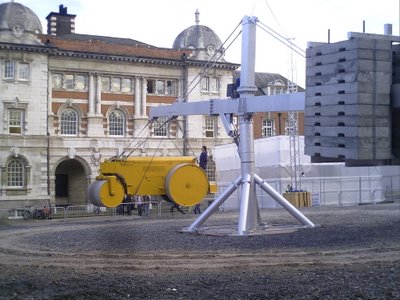
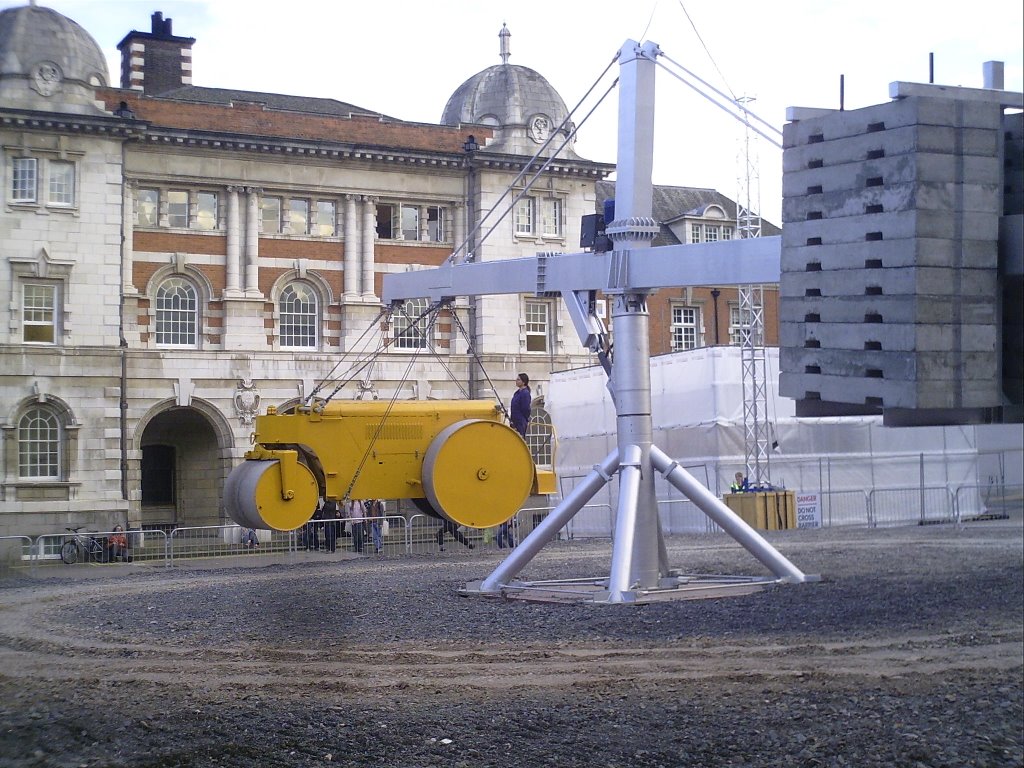
The flying steamroller: a big yellow diesel roller linked by wires and a beam to a counterweight. It was very grounded when I walked between the Tate Britain and the Chelsea Parade Ground at five to five on Monday.
I assumed it was some arty joke: that we the audience had to imagine it flying in our heads, just like Mark Titchner's Tuner prize entry asks us to use our psychic powers to lift his sculpture off the ground.
I confess to failing to lift Titchner's statue. I am aware that this failure of mine is one factor contributing to the likelehood that Titchner will not get the Turner prize (another being that Phil Collins's reality TV work has blown everyhting else away). I really did not feel confident about levitating that steamroller.
They didn't need me. At five o'clock an announcement was made, stewards went to the four corners of the parade ground and a driver in blue overalls walked over to the roller. She turned its engines on and drove it noisily round the parade ground a few times. Then all of a sudden it lifted up. She switched the engine off, and her and roller very quietly rotated round the counterweight for a few spins of the parade ground.
She closed her eyes, and driver and steamroller looked as serene and weightless as human being and machine have ever looked.
I felt as light as air, as though it was me flying above the ground, not the steamroller.
We don't have to let gravity keep us down
Technorati tags:
[Flying Steamroller]
[Chris Burden]
I assumed it was some arty joke: that we the audience had to imagine it flying in our heads, just like Mark Titchner's Tuner prize entry asks us to use our psychic powers to lift his sculpture off the ground.
I confess to failing to lift Titchner's statue. I am aware that this failure of mine is one factor contributing to the likelehood that Titchner will not get the Turner prize (another being that Phil Collins's reality TV work has blown everyhting else away). I really did not feel confident about levitating that steamroller.
They didn't need me. At five o'clock an announcement was made, stewards went to the four corners of the parade ground and a driver in blue overalls walked over to the roller. She turned its engines on and drove it noisily round the parade ground a few times. Then all of a sudden it lifted up. She switched the engine off, and her and roller very quietly rotated round the counterweight for a few spins of the parade ground.
She closed her eyes, and driver and steamroller looked as serene and weightless as human being and machine have ever looked.
I felt as light as air, as though it was me flying above the ground, not the steamroller.
We don't have to let gravity keep us down
Technorati tags:
[Flying Steamroller]
[Chris Burden]
Subscribe to:
Posts (Atom)