Thursday, March 30, 2006

Jim Latter's 'Stations of the Cross'

‘Stations of the Cross’ by Jim Latter is a series of 15 paintings. Each painting relates to a particular point in the journey of Jesus from condemnation to resurrection. The paintings are on display in St Mary le Bow church for the duration of Lent (until Easter Sunday, April 16).

The paintings are incredibly simple. Each shows the same sized rectangle on the same sized piece of paper. Each rectangle contains a cross. The dimensions and proportions of the cross do not vary. This gives the series coherence, strength, and power.

Using only colour, shape, pattern and the relationship between the foreground of the cross and background of the rectangle, the artist manages to convey or suggest something of the essence of each of the episodes in the story of the Passion of Christ, and also something of the essence of the story as a whole.

I visited the exhibition four times. On my third visit I quickly toured round the 15 paintings, making a note into my laptop of what I perceived in each painting. Yesterday lunchtime I went back to note down the titles of each painting. By a nice co-incidence Jim Latter was in the church at the time. He introduced himself, and walked around the exhibition with me.

What follows is, for each painting, firstly the original notes that I took of my perceptions of the painting, and then some of what Jim told me of how he made the painting and what he was looking to convey.


I
red at the bottom fading in to black at the top. like a sunset or a dawn with light diffusing but it feels like the darkness from the top is pushing down on the red fading light below
(condemned)

Jim’s comments: I paid a lot of attention to the proportions of the cross, and the ratios between it and the rectangle that the cross is contained in. I’ve noticed that most of the crosses you see in churches haven’t got the right proportions. The dimensions of the cross in this rectangle create two squares as background above the arms of the cross, and two rectangles below the arms.

I started by placing masking around the rectangle and over the cross. I painted the background with layers of acrylic paint. Then I uncovered the cross, masked the rest of the rectangle and painted the cross.


II
the darkness is lightened somewhat. The cross is brought to the fore by evenly spaced vertical lines, like scars that cut across the grain and run down the cross - both its arms and its support. In the background you have green light at the bottom fading into grey at the top.
(taking up the cross)


III
the cross stands out blue, garish and the lines on the cross are at an oblique angle, all leaning the same way. The background is brown - a light mud brown – but it is scarred by lines, lines that have been made before the imposition of the cross, lines that are interrupted by the cross.
(first fall)

Jim: I masked over the cross and used a ruler and a knife to scour lines into the paper in the rectangle. I did it with a ruler, more or less at random. Then I scoured the diagonal lines onto the cross.

I used a blue oil pastel to colour the cross: it was like brass rubbing, it’s a solid lump of pastel and, the pastel doesn’t get into the channels created by the knife. The scourings into the paper are there to show the pain, I was thinking of someone scraping their fingernails down a blackboard.


IV
the only one where the pain spills outside of the rectangle and reaches into the white space beyond the rectangle. The one where the cross almost merges into the background, the cross is a deeper blue, the background the same blue more lightly applied, it is watercolour and you get the fluidity of the cross and the background joining, spreading, merging, like the baby and the mother in the womb.
(mary)

Jim: I wanted to show the pure pain and grief of a mother for a child. I thought of tears.
I used a different technique for this one. I didn’t use the masking tape. First I wet the whole rectangle and dripped drops of blue watercolour (like putting in eyedrops). Most of the blue stayed within the rectangle but sometimes the blue splashed outside the rectangle, like tears.

I waited till it dried then I wetted the cross, leaving the background of the rectangle dry. I dropped blue paint onto the cross to make the cross stand out from the background in a deeper blue, knowing that some of the blue of the cross would spill out into the background.

V
wow. Colours, bright colours. The cross marked out by vertical stripes going from left to right (arm) green black yellow red green black yellow (support) red green black yellow red (arm) green black yellow red green black yellow. The four corners of the background are reading from left to right and top to bottom: black green yellow red. The background corners have diagonal lines each diagonal taking the line from the edges in towards the centre of the cross, the cross of the cross.
(Simon)

Jim: I spoke to Rev Bush (the minister at St Mary le Bow) about Simon. He helped Jesus. Some sources suggest he was black. I wanted to use colours that paid homage to that: I wanted to use Rasta colours.


VI
watercolour again. The cross brown, the background a dull blue. Some horizontal drips of blue flow downwards and change their course as they flow over the brown cross. Several patches of the cross are a darker brown, where the head would be, where the feet would be, where the arms would hang
(Veronica)

Jim: Veronica wiped Jesus’ brow with her cloth, when she looked at the cloth afterwards the sweat had formed the image of Jesus’ face on the cloth.

I made the cross wet and applied the brown, then I made the background wet and applied the blue watercolour.

When you wet the paper it buckles, when it buckles the paint runs into hollows and groups in different places: you can’t control how it turns out. The dark patches of brown you see on the cross could have occurred in any pattern, it was beyond my control, I was amazed to see that way the dark patches have grouped suggests the presence of the body of Jesus, like an x-ray.

VII
cross is a blue, a deeper blue than before. Background is brown, a deeper brown than before. The lines on the cross are diagonals moving downwards from right to left. In the background there are lines, interrupted by the cross, entangled lines, lines that form an entangling meshy trap like lots of ropes that keep tripping you up
(second fall)

Jim: If the scar lines on the cross had been horizontal and vertical everything would have seemed stable: I made the scar lines diagonals to show the instability, the falling


VIII
watercolour. Cross is brown but invaded by the colours of the background which is a tie died, psychedelic, rainbow of beautiful, peaceful spectrum-like colours.
(women of Jerusalem)


IX
the cross is a duller blue, almost all the blue has faded now. The demarcation between the blue of the cross and the brown of the background is being lost: they are fading into one. The lines of the cross are diagonals going downwards from left as I view to the right. The same entangling, tripping lines.
(third fall)

X
the mood feels different over here, more serious, less human, less alive, hope has been stripped out. The cross, white, the background black with paler patches.
(stripped)

Jim: The cross is bare, just white, to show the nakedness of flesh. For the background I wanted to create the effect of metal. To show the vulnerability of the flesh against the harshness of the metal.

XI
the cross red the background red. The cross demarcated from the background only by the different orientation of the lines scarring its surface. The lines scarring the surface of the background run horizontally, the lines scarring the surface of the cross are orientated vertically. The lines don’t run as neat parallels: they are entangled lines, like the lines in the paintings of the falls
(crucifixion)

Jim: I’ve given this painting to the church, so it will stay here at St Mary le Bow when the exhibition has finished.

XII
black. Only black. If you look for a long time, the black of the cross appears to show out from the black of the background.
(death)

Jim: I painted the whole rectangle black. Then I masked over the background and gave another coat of the same paint to the cross. So the only difference between the background and the cross is that the cross is painted twice.

XIII
some colour is coming back. Pale colour, but pale hopeful colours. The foot of the cross is pink like flesh, the foot of the background is green like grass, pink and green fading upward but the colour of the background at the top is blue, not black.
(taken down)

Jim: for the blue at the top I was thinking of all those renaissance paintings which seem to have a clear morning sky, when it hasn’t got hot yet, when there is still a bit of freshness in the air.

When I painted the cross I had in my mind a picture from an American comic that was passed round my school when I was a kid. It was a pretty nasty comic and one picture showed a picture of a man who had been shot. The man was slumped back on a chair, his arms hanging over the sides of the chair. He had obviously been dead for some hours and the blood had sunk down to the bottom of the arms, so the artist showed the top of the arms as pale, getting pinker as you moved down towards the man’s hands. This was my image of what death was for a long time.

XIV
the cross is black with thin, horizontal, evenly spaced, parallel red scars. The background is black with thin vertical parallel scars.
(entombment)

Jim: There is nowhere that the horizontal lines of the cross can go, they are trapped by the vertical lines of the background. I wanted to give that feeling of being closed in, of being unable to move. This is also a nod to the work of Frank Stella, an abstract artist whom I admire.

XV
white. If you look for a while you will see the white cross emerging from the white background and appearing to light up the white of the paper outside the square.
(resurrection)

Jim: I didn’t know what to do for resurrection. I spent two weeks wondering around my studio without a clue on how to depict it. Then I thought ‘white’.

I painted the whole rectangle white, then masked out the background and painted the cross again with another coat of white. But the second coat was very light, there is very little difference in weight between the white of the cross and that of background.

When you look at this you are seeing four different whites: the white of the cross, the white of the background, the white of the paper, and the white of the mount.

Some comments from Jim about the work as a whole
When I researched the stations of the cross all the previous work I came across, with one exception, were figurative, depicting in some way the people involved in the story. The one exception was a Stations of the cross by the abstract artist Barnett Newman.

Newman's work simply used geometric shapes, it did not even use the cross. But somehow it worked. I saw it in London when it came over as an exhibition about 5 years ago. I felt that the work gave me 'permission' to do the work without figures. At one point I was thinking of using circles as the basis of the work, but after a time I realised that I needed to have the cross in there.

Some comments from me for Jim about the work as a whole
It seems that most stations of the cross by other artists have 14 stations: is your work unique in adding the 15th station, for the resurrection?
The first time I saw this work it was the contrast between the black of your depiction of death, and the white of your depiction of the resurrection that really sucked me into this whole work. The contrast gives a pure energy to the work, like a star near a black hole.

Does the series continue after resurrection? Does the slight difference between the white and the white mean a new cycle, a different cycle starts anew? Or does the white gradually dissolve into the white?

Wednesday, March 29, 2006

Monday, March 27, 2006

Inspired writing

Here are the notes I took at Nick William’s ‘inspired writing’ course on Saturday

Nick’s recipe for writing is to:
• work out what inspires you
• overcome the resistance you feel to writing
• turn up at the page and write
• learn some craft techniques for making the most of your ideas

Work out what inspires you
Inspiration is natural to human beings. The latin origin of the word ‘inspiration’ is to breathe, and it is as simple as that. Inspiration is available to us as human beings living in the world.

Inspiration is an evolutionary force, a force for change in our lives. You may have an idea and think to yourself ‘that is a great idea but I’m not big enough to do/write that’’. Inspiration is the motive force for us to grow to become big enough to express and develop that idea.

To stay inspired we need to stay in touch with the things in the world that inspire us. Our sources of inspiration are like our wells which stop us from running dry. Work out what inspires you. Make time in your daily life for the things that inspire you: if nature inspires you, spend time with it. If you get inspired by art, spend time with art. If you get inspired by dancing, dance.

Nick advised us to look for unexpected source of inspiration, and to trawl our nets wider in search of new sources of inspiration. Nick was surprised to be inspired by Las Vegas, by all the entertainment available there.

I realised on the course that I am inspired by:
  • people who are willing to express and live by their values in life
  • acts of friendship, kindness and solidarity
  • small second-hand bookshops, art galleries and bakers that manage to keep going
  • art
  • conversations or books that cause me to make connections between people, places, ideas ,times and possibilities
  • strong and humorous communities of people
  • rivers and the sea
  • my friends.


Overcome your resistance
Resistance is our attempts to dissuade ourselves from acting on our inspiration. Could be anything from ‘I’ m too tired’ ‘I’m not ready’ ‘I’m not capable’ ‘I’ve got more important things to do’.

The more important something is to you, the stronger will be your own resistance to doing it. Realise that you will resist your own creativity, and be prepared to defend your own creativity against your own resistance.


Turn up at the page and write
Nothing will get written if you don’t turn up at the page and write.

Don’t wait until you have something great to say before you write: start off by writing some crap! Adults have a tendency to think they ought to know how to do stuff. The best way of learning is to try things. When children learn to walk they fall over lots of times and they don’t care, they try again. When adults try something that doesn’t work they have a tendency to say to themselves ‘I can’t do this’.

Don’t wait until you feel inspired with lots of ideas before you write: start writing to unlock your ideas.

Use some craft techniques
Start small. Lower your bars for success. You don’t have to write a book all at once. Start with an article, or a presentation or a workshop.

Craft your writing so that it works for the reader. You don’t have to tell the reader everything you know.

One craft technique that Nick showed us was coming up with some ‘top tips’ and then elaborate on each one: I’ve used it for this blog post.

Be clear about why you are writing: are you writing to entertain, to inform, as catharsis for yourself, to make money? Any one piece of writing may be for one or more of those reasons. We will write for different purposes at different times.

If your writing was just about using craft techniques then you would just end up as a hack and you would not enjoy it. But if you keep in touch with your inspiration then writing will not only be a source of joy but also of personal growth and fulfilment.

Sunday, March 26, 2006

Meeting other succesful authors

Yesterday I went to an Alternatives workshop on Creative writing.

The course leader was Nick Williams who has written books such as The work we were born to do and How to be inspired.

The first thing Nick asked to us to do was to introduce ourselves to other people in the room as though we had already published a really succesful book that we were proud of.

I told a tall, quiet chap about my history of Hungarian literature, and how I had written it without ever having read a Hungarian novel. I told him about my research for the book, which involved riding on buses and trams in Budapest and asking people to tell me which stories and characters from their country’s literature had made an impression on them.


He told me about his economics book. He wrote it from the standpoint that resources in the world are abundant, thus overturning the traditional view of of economists that resources are scarce. His book has inspired the creation of many different self-sufficient communities. He is proudest of the one near his hometown in the West Country, which now has over 50 members.

Later on I introduced myself to Maureen who has written a self help book from the different perspectives of the many cultural groups in London.

And I met Stephanie who has written a book about how to connect with people. I told her about the book that I had written on how to enjoy life, with its chapters on how to enjoy watching a cricket match, how to enjoy your lunch break, how to enjoy an art exhibition and so on.

Stephanie and I have agreed to co-operate on a book which will tell you you how to enjoy connecting with people at art galleries, cricket matches……….

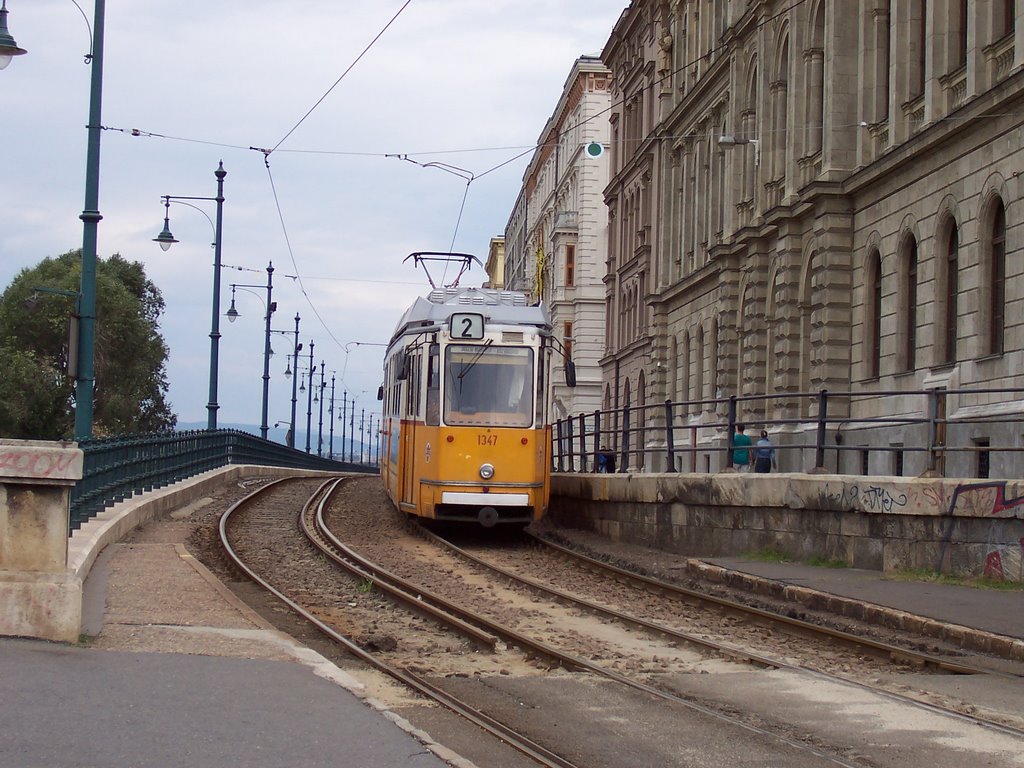
(the photo of the tram comes from http://commons.wikimedia.org/wiki/Image:Tram_in_Budapest)

Friday, March 24, 2006

Monuments

I went to see the Dan Flavin retrospective at the Hayward Gallery on Tuesday.

Every piece consists of his arrangement of flourescent lights. The tubes are from a narrow range of colours, a narrow range of lengths. Flavin was influenced by the Constructivists, an artistic movement that grew up in the years just after the Russian Revolution, which mad repeated use of a relatively small set of simple elements, which they combined in different ways.

The flourescent lights provide all the light in the gallery: there is no other sources of light in the exhibition apart from the art (well I did spot a couple of lights on the stairs that must have been there for safety reasons). In fact the Hayward haven't just switched off their own lighting, they have totally removed all their lighting: their are no other lights to be seen. You walk around the gallery bathing in the light of Flavin's art.

The experience started to twig with me when I realised that the walls were different colours depending on where you were looking at them from:. Flavin was painting the walls with his lights. I didn't just have to look at the arrangement, shape, and colour of the tubes themselves: I could look all around me at the colours and the luminescence that I was walking in.

A lot of the pieces are entitled 'monument to' . I found that moving. Flavin is quoted as saying that in calling them monuments he was being ironic because his light tubes don't last anywhere near as long as your traditional stone monument.

Flavin was creating light sculptures which he is dedicating to people: some people he knows, some dead, some alive, some he doesn't know like the Soviet Constructivist V.Tatlin. And he does multiple different monuments: so we think of one main monument someone, but here is Flavin doing 50 monumebts for Tatlin, each composed of a small number of white flourescent tubes, each monument different from the other, different shape, different disposition.

It reminded me of that religious instinct to light candles in a flickering memory to people (as in my wife's Greek church). And I have since learned that Flavin had trained to be a Catholic priest before starting his career as an artist, and had studied Byzantine icons.

Flavin's monument Tatlin is interesting because Tatlin is most famous for designing a monument that was never built, a monument to the Third Socialist International. Well it was never built in Moscow where Tatlin intended. I remember the Transport and General Workers Union had a small one built on the PierHead in Liverpool which my grandad used to take Lucy and I too: I wonder what happened to that: does anyone else remember it?

Saturday, March 18, 2006

Forget about the station, forget about the game

A few weeks ago I got the wrong branch of the Northern Line coming southbound.
It didn't really matter, I got off at Bank and went on the Central Line to Tottenham Court Road and got to Waterloo that way (it was too late for the Waterloo and City Line).

But getting the wrong branch of the Northern Line northbound is more serious. Look at this story that I read on wikipedia yesterday, in the page for 'The game':

"Three young men, following a heavy night out in the west end, accidentally took the wrong branch on the northern line, and found themselves stranded at East Finchley. As they had no money, they decided to wait on the platform until the first morning service to take them back into town. To help the time pass, they decided to play a game, and one suggested that they should try to forget about where they were, and that they were playing a game, and the first one to think about the game, or about East Finchley, was the loser."

This has now been formulised into a game that apparently anyone can play . The object is simply to forget you are playing the game. You lose every time you remember that you are playing, and you should announce the fact that you have lost.

There are some good tactics for winning the game mentioned on the wikipedia site, liking putting post it notes up where your opponents can see them that say 'the game'. But this does cause philosophical problems as you were probably thinking about the game when you wrote the post it.

There is a wikipedia deletion page for the article where there is a debate going on about whether or not to delete the page

Thursday, March 02, 2006

Will you ever play test cricket again?

Andrew asked me that question while I was washing up last night.

Of course I stopped washing up and looked at him, eager to hear more. Does my son think I was once a swashbuckling, globetrotting, batsman, striding out to the wicket carrying the hopes and dreams of my nation, before the call of fatherhood led me to shun travel and stardom in favour of records management consultancy?

Andew's next question dispelled my illusions: will you play test cricket for Battersea Ironsides again daddy?

Saturday, February 25, 2006

why is your face on your head?

That is another one of Anna’s questions, that she shouted it out from her bed at 8:30pm: I guess like a facilitator at a meeting she is asking a thought provoking question to stimulate discussion. I didn’t respond at the time, but having had time to think about it I would say that having the face on your head (rather than say, your lower back) shortens the communication lines between your brain and the rest of the universe.

Later on I popped upstairs and she was still awake. She said ‘daddy I can’t get to sleep because my dreams are too noisy’.

I’ve been reading Uncle Lubin with Andrew. I used to love that book when I was about 10. What a cool guy Uncle Lubin is. He always finds a way out of things. A huge long serpent is about to eat him, but he remembers that serpents can't resist music, so he plays his concertina for hours and hours and the serpent just gets caught up in knots and dies. Lubin's only real mistake is at the start of the book when he falls asleep looking after his nephew Peter and the wicked bag bird snatches Peter away in his beak. At the time of writing Uncle L still hasn’t managed to get Peter back, but he is working on it.

Here is a link to a guy has scanned onto his website lots of Heath Robinson’s illustrations for Uncle Lubin http://bugpowder.com/andy/e.robinson.heath_lubin.html

Andrew is really looking forward to going to the test match (England v Sri Lanka) with me and my mate Phil on May 11. He asked me if I could get a bit of card and draw a 6 on it He said ‘I will hold it up if it is a six, but if I catch it then I’ll give it to you and you can hold it up’ Visions of Freddie Flintoff hitting a massive six into the grandstand and Andrew calmly passing me his little cardboard number 6 before pouching the ball in both hands.

Sunday, February 19, 2006

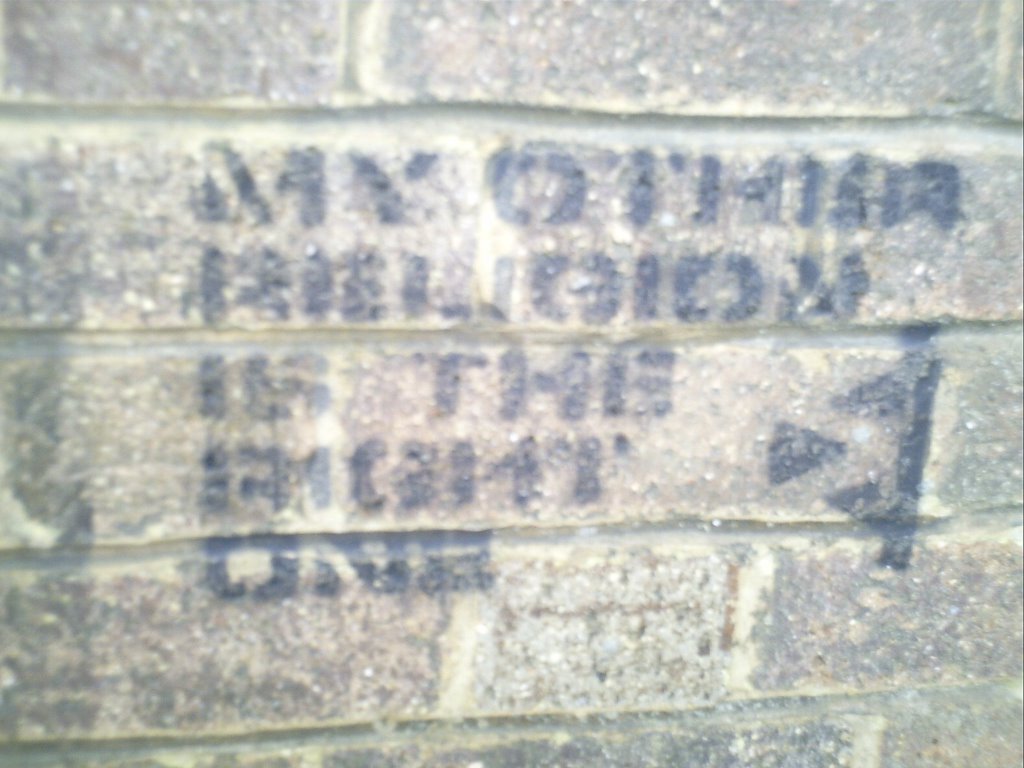
My other religion is the right one


I saw this graffiti on the river facing wall of the Tate Modern last week.

The sentiment really resonates with me. I remember attending a superb parenting course (http://www.familycaring.co.uk/course_parents.htm), run by local health visitors. The course had a session on spirituality and parenting. At the end I asked the course leader whether she thought it was a good idea for us as parents to introduce our children to religion and she said 'yes, and to as many religions as you can'.

Religions shouldn't have to prove themselves to be true. To me it is enough if their teachings help those who come into contact with them to express and explore their feelings at being alive at a particular point within the vastness of space and time on a planet and in a universe that are both so uniquely hospitable to us.

Wednesday, February 08, 2006

No wonder I couldn’t find it


Have you ever lost a boiled egg?

For the first time in my life that happened to me on Monday morning. I got up early, put the egg on to boil, and plugged in the laptop to write a blog post. I started to type about how the people that came to my training course last Friday walked over the Thames with me at lunchtime to visit the Tate Modern.

Once the egg had boiled I drained the water out, took the laptop to the table and ate a bowl of muesli. When I’d finished the muesli I went to get my boiled egg, but couldn’t find it. It wasn’t in the pan, or in the sink. I hadn’t put it back in the fridge, nor had I chucked it in the bin.

I made Tania a cup of tea, warned her about the free-ranging boiled egg and went to work. The absence of egg didn’t affect me too much, our very hospitable clients at the bank gave me a nice croissant to have with a cup of tea.

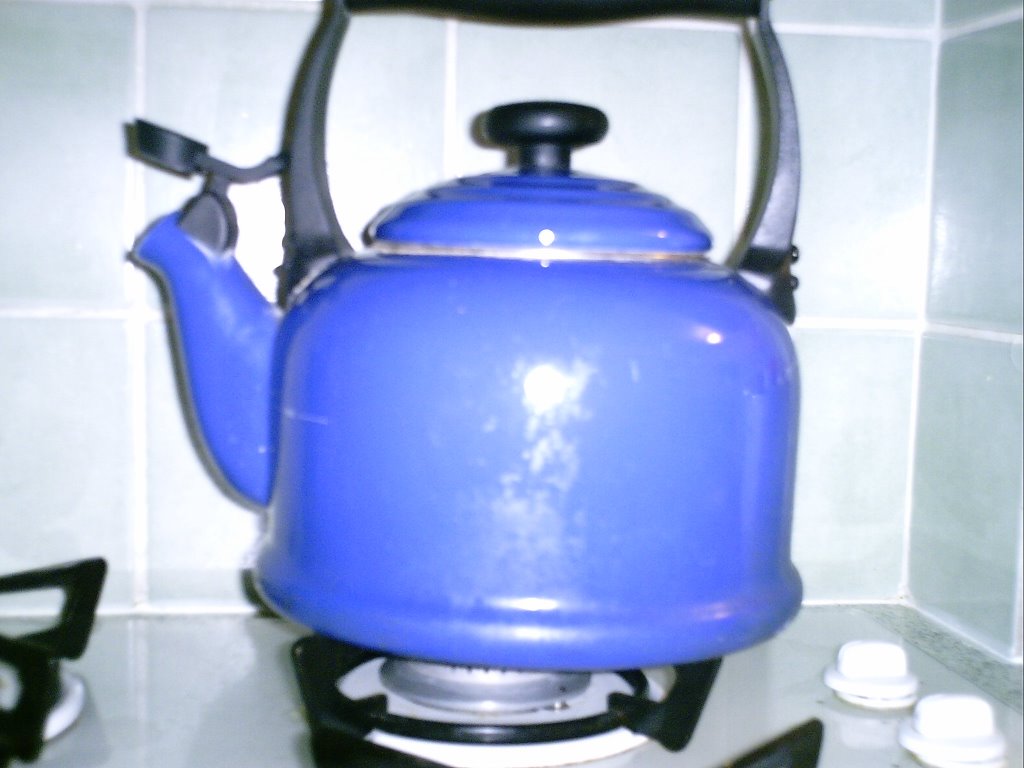
I got a text from Tania saying ‘it was in the kettle!’

Courtney Pine

Saw Courtney Pine at the Jazz Café with my dad on Saturday (I mean I went with my dad, it didn’t look like Courtney needed the help of a fellow saxophonist)

Piney was great. After an hour and a half he said to us ‘’well, our time is up now, and I guess your busy, you’ve got things to do and all that….. shame cos me and the band are just getting warmed up’’

Then when the audience made some noise he said ‘’I want you to sing along with this next one: we will do a three part harmony, yesterday they managed something special but you’re gonna do better cos you’ve got the Saturday night Camden Town Jazz café vibe, yeah?’’

So he pointed his sax at different parts of the audience, played a riff and got them to sing it back to him. And he liked our part of the audience the best cos we made the most noise at the beginning, so when another part of the audience didn’t come up to scratch he said to them ‘watch how my people can do this’ and turned back to us to do the riff. When we’d got it right he just left us to repeat it over and over again while he was off playing something else entirely.

I found it inspiring that someone at the top of his fame put so much effort, warmth and fun into his performance, into involving the audience in it, and into creating a memorable evening.

I remember seeing Tommy Smith play the sax at the Glasgow Jazz festival. He was quieter than Courtney. He played old standards, hackneyed tunes you’d heard millions of times before, with a real care and depth of heart that made them sound suddenly really touching and profound. I thought what dedication he must have to his instrument and int his art to play it that well.

My dream would be to let the passion, freedom and enjoyment shown by Pine, and the care and dedication shown by Smith , show up in my work too.

On the train back home Dad told me that the gig he played a couple of weeks ago was at The Greyhorse in Kingston: I was really impressed: they have some semi-decent bands on there.

Daddy, why do we have to protect our eyeballs when we are asleep?

Anna has just called down from her bedroom to ask me that. Funny how she comes up with these great questions when she is lying in bed trying to get to sleep.

At this time on Friday she shouted ‘mummy, why can’t you see your head?’.

Later that night she asked ‘why can you only dream when you are asleep?

Friday, February 03, 2006

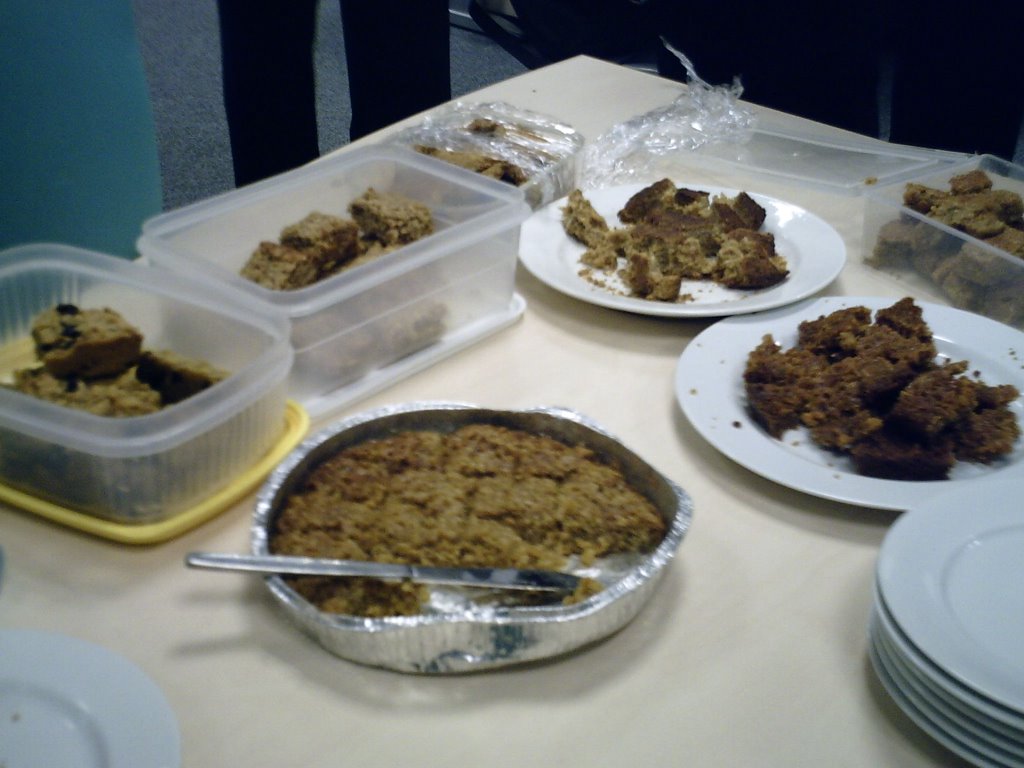
February 2: National flapjack day


TFPL celebrated National Flapjack Day on Thursday, and the competion for the 'flapjack of the year' award was the closest fought many of us could remember.

The competion had everything:
- skulduggery (Carmel tipped a tub of marks and spencers flap's into a tupperware pot and expected us to believe she'd cooked it)
- heroism (Nicky and her mum drove to Beddington Asda at 1am to buy another pot of syrup after their first batch of flapjacks had charred in the oven)
- international rivalry (Belinda had told us that Anzac biscuits were better than flapjacks, and was bitterly disappointed at only getting 2 votes).
- despair (Nicky's late night vigil had looked like paying off until a late flurry of votes tore victory from her grasp)
-triumph (Clare's bold decision to make an exotic ginger and chocolate flapjack was rewarded when the last vote, from Sheetal, handed her victory by one vote)

Well done Clare!


-

Friday, January 27, 2006

Bert update

Anna pointed out to me last night that Bert knew how to say soup too.

I told Anna how I taught Bert to say cheese, how long it took me and how many pieces of cheese I ate whilst saying the word.

I told her how I smiled when he pointed at the wardrobe and said 'cheese' and how puzzled he was when on subsequent performances of the same manoeuvre I shook my head and said 'no Bert thats not cheese, I can't keep my school uniform and my P.E kit and my jeans and t-shirts in cheese, they would smell awful'.

Every day for months he would swivel his head, look at the wardrobe, point and say cheese. Every day he would look crestfallen in his teddy way when I shook my head. I tried everything. I got my parents to bring back a really pungent cheese from France so he could compare the smell to the veneer of my walnut wardrobe. Nothing worked.

Next time they crossed the channel I got them to bring back a poster of the 360 cheeses of France. I stuck it on the wardrobe. Bert pointed, said cheese, I smiled, he smiled.

Then I started to teach him about Yoghurt.

Thursday, January 26, 2006

Bert

I told Anna about Bert last night, the teddy I had when I was small that only knew seven words. Each of the seven words was the name of a fruit or other type of foodstuff.

I told her how he would slowly swivel his head, then lift his arm and point to an object in my room.

Once he pointed to my wardrobe and said 'cheese'. Anna asked whether he could say 'Baby Bell' and I had to admit that he couldn't distinguish between types of cheese.

Another time he pointed at the window when my next door neighbour was walking past and said 'bannana'.

He didn't seem to have much facility for learning, but he was very entertaining: I wonder which child has him now.

Wednesday, January 25, 2006

Will there ever be a world flapjack day?

I've hit an obstacle: Belinda tells me that in Australia the word flapjack has nothing to do with oats: it is merely a synonym for 'pancake'.

I didn't realise how strong my cultural prejudices are. I thought the concept of oats baked with butter and syrup was so simple as to be universal (as I write this I realise that without Columbus we in England would not been missing a rather crucial ingredient).

What is the nearest French/Russian/Hungarian/Ghanaian equivelant to a flapjack? I find it hard enough to find a freshly baked flapjack in London, what chance would I have in Adelaide or Lagos?

A further blow to my preconceptions has been dealt by Martin on my left here: apparently the original application of the word flapjack is from the New England states of America, and does indeed refer to a pancakefried on a griddle. Jack was then a common workd for 'thing' and flapjack meant a thing that was flipped. Our present biscuity use of the term originated in England in the 1930s.

Saturday, December 31, 2005

On discovering Korean Poetry at my hairdressers

I took my son to Boko's, our very friendly local Korean hairdressers. You'll find it on Coombe Road, opposite New Malden Station, above an Italian (or Italianish) café. I was offered a pile of books and papers to peruse while Andrew was being shorn. I never expect to read any thing decent in a hairdressers, doctors or dentist. But in amongst the pile was a book called ‘Korea’s Golden poems’: 50 poems in Korean, with English translations alongside. They were really interesting: crystal clear, painting pictures using elements of the natural world (trees, waves, raindrops) to illuminate the inner feelings of us human beings.

The poem that really grabbed me was called ‘My Mind’. In it the poet compares his mind to a lake. The lake is occasionally furrowed by a gentle wind, there are people fishing on it, or lying down and chatting beside it. The poet reminds himself to keep the lake properly in anticipation of the coming of a great swan.

The poem got me thinking: about how to wait for things constructively, actively; and about how important it is to distinguish the people and things in your life that are really important to you. The poet seemed to have no control over when the swan would come, but he does have control of the environment that the swan would visit.

I took the swan to signify anybody or anything who brings joy into your life. But of course no-one or no-thing can bring joy into your life unless you are ready to receive them and to sustain the friendship/ relationship/interest. The poet was describing a situation where there were no swans around his lake, just diverting distractions. But the poet was careful not to be consumed by the distractions, he wasn’t going to let his lake be cluttered to such an extent that there was no place for the swan when it came.

I thought about who/what the swans are in my life now ( and what the swans might be in the future). I thought about my wife and kids; the great swans in my life. And about my friend Michael who died just before Christmas and who had been a friend who really made me laugh, who got me out of my shell, and who simply made me feel happier and more alive. Friends like Michael don’t come into your life any more frequently than Halley’s Comet. He is going to be missed on my lake/life (and in many other people’s lives too).

It was my turn to get my haircut. In between my haircut and hairwash I went back to look at the book to see who wrote ‘My Mind’. But I couldn’t find it instantly and I didn’t want to linger on the book because the people in Boko's are very generous and I was worried they might offer it to me to take home. So I left not knowing who wrote it.

I searched the internet for two hours but couldn’t any mention of ‘My Mind’. But I did find a superb site at which Brother Anthony of Taize (An Sonjae) provides lots of English translations of Korean poems, as well as some information about the poets http://hompi.sogang.ac.kr/anthony/KoreanPoems.htm

And I found out about an amazing poet called Ko Un, who many Koreans hoped would win the Nobel prize for literature in 2005 (our own Harold Pinter got it instead). One of the things Ko Un is attempting to do is to write a poem about everyone he has ever known. So far he’s written about 10,000 of these poems in 20 volumes and he’s still going strong.
Here is a link to ten of them, translated by Brother Anthony http://www.sogang.ac.kr/~anthony/ManinboTen.htm.
And here is some backround about Ko Un: http://levity.com/interbeing/ko.html

The book I found at Bokos hairdressers is described at http://www.hollym.co.kr/english/literature/golden_poem_ko.htm